DbcultAccessing Vault...
Cult Review
Senior Film Conservator
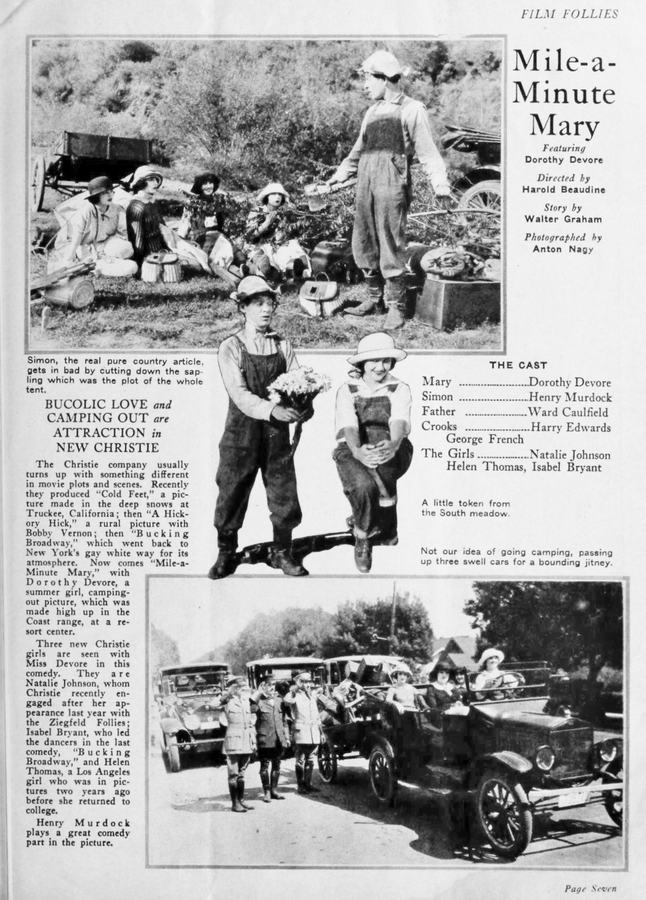
The year 1920 stood at a precipice of social and mechanical transformation, and few films capture that frantic energy quite like Mile-a-Minute Mary. Directed with a penchant for rhythmic pacing by Walter Graham, this feature serves as a vibrant showcase for the irrepressible Dorothy Devore. While modern audiences might view the 'flivver' as a relic of a bygone era, in the context of this film, it is a symbol of unfettered agency. The narrative doesn't just utilize the car as a prop; it treats the automobile as a character, a fickle partner in Mary’s journey from a clumsy novice to a master of the open road.
Dorothy Devore’s performance is a masterclass in physical comedy that avoids the over-the-top mugging often associated with lesser silent stars. Her interactions with the 'Henry'—the affectionate colloquialism for the Ford Model T—are imbued with a sense of genuine struggle. We see her wrestling with the crank-start, navigating the eccentricities of the planetary transmission, and treating the steering wheel like the reins of a wild stallion. This isn't just slapstick; it’s a commentary on the democratization of technology. Much like the characters in The Silver Car, the vehicle represents a shift in class dynamics, though here it is flavored with the zest of youth rather than the gravity of a thriller.
The first act’s focus on the 'driving lessons' provides a structural foundation that pays off handsomely in the climax. Graham’s direction ensures that every stall and backfire serves to build Mary’s character. She is resilient, undeterred by the grease on her face or the mockery of onlookers. By the time she invites her three chums on the camping trip, we are fully invested in her competence—or lack thereof. The chemistry between the girls is light and airy, providing a stark contrast to the more somber tones found in contemporary dramas like The Siren's Song.
As the film transitions into the camping episode, the cinematography shifts to capture the sprawling beauty of the countryside. Here, the film introduces the 'country boy,' a trope that allows Graham to explore the dichotomy between the burgeoning urban 'New Woman' and the traditional agrarian lifestyle. The boy’s admiration for the girls is handled with a droll sweetness. He represents a slower pace of life that the high-speed Mary is rapidly outgrowing. This segment of the film functions as a necessary breather, a pastoral idyll that heightens the tension of the industrial drama lurking in the wings.
The contrast between the girls' modern attire and the rustic setting highlights the film’s underlying theme of progress. Unlike the more traditionalist perspectives seen in His Country Cousin, Mile-a-Minute Mary champions the encroaching modernity. The country boy’s attempts to present Mary with a bouquet are consistently thwarted by her momentum. She is literally and figuratively moving too fast for the old world to catch her.
Every great silent comedy requires a pivot into high-stakes drama to justify its third-act spectacle. In this instance, it is the 'oil gusher' subplot. While oil was a common MacGuffin in the era—seen in various iterations in films like The Bait—Graham uses it here to test Mary’s responsibility. Her initial 'carelessness'—a trait often attributed to the flighty flapper archetype—nearly ruins her father. This serves as the emotional low point of the film, grounding the comedy in a relatable familial anxiety.
The legal ticking clock—the need to reach the lawyer’s office to exercise an option—is a classic narrative device, but it is executed here with a visceral sense of urgency. We see the shift in Devore’s performance from the whimsical girl-about-town to a focused, determined driver. The stakes are no longer about personal fun; they are about economic survival. This transition reminds one of the grit found in The Moth and the Flame, where the fragility of social standing is always a moment away from shattering.
The climax of Mile-a-Minute Mary is a tour de force of early action cinema. Mary must race her humble flivver against a 'high powered motor'—a behemoth of steel and horsepower that dwarfs her little Ford. The editing here is remarkably modern, utilizing quick cuts and alternating close-ups of the speedometer, the churning wheels, and Mary’s gritted teeth. It is a David vs. Goliath story played out on the dusty roads of the early American landscape.
What makes this sequence particularly compelling is the 'clever manipulation' Graham mentions in the plot. Mary doesn't just win through speed; she wins through intelligence. She understands the limitations of her vehicle and the terrain better than her opponent. This nuance elevates the film above mere slapstick. It’s a thematic resonance shared with Shirley Kaye, where female wit proves superior to male-dominated power structures. The dust clouds, the vibrating chassis, and the narrow escapes from ditches create a genuine sense of peril that many modern CGI-heavy chases fail to replicate.
The film’s conclusion, wherein Mary is rewarded with a 'regular car,' is a fascinating coda. It signifies her graduation from the experimental, DIY world of the flivver to the established, polished world of the elite. The flivver was her training ground, her rite of passage. By proving she could handle the most difficult of machines under the most dire of circumstances, she earned her place in the upper echelon of the motorized age. This trajectory of earning one's status through trial is a recurring theme in the era, echoed in the struggles of characters in The Slave Mart, though Mary’s journey is significantly more buoyant.
The final image of the country boy attempting to deliver his bouquet as Mary speeds off in her new, superior car is a poignant, if humorous, dismissal of the past. The agrarian world is left in the dust of the internal combustion engine. It’s a bittersweet moment that encapsulates the 1920s' relentless drive toward the future. The supporting cast, including George B. French and Henry Murdock, provide solid anchors, but this is undeniably Devore’s film. Her energy is the fuel that keeps the engine of the plot humming at a high RPM.
In the wider canon of silent cinema, Mile-a-Minute Mary deserves a seat alongside more celebrated comedies. It lacks the surrealist bent of Keaton or the pathos of Chaplin, but it possesses a uniquely American verve. It is a film about the joy of movement, the thrill of the chase, and the breaking of barriers. When compared to the more static dramas of the time, such as The Death Dance, Graham’s work feels revolutionary in its mobility.
For those interested in the evolution of the 'action heroine,' Mary is a foundational figure. She isn't a damsel waiting to be rescued; she is the one behind the wheel, the one saving the family fortune, and the one dictating the speed of her own life. Whether she’s navigating the complexities of a camping trip or the life-altering stakes of an oil gusher, she does so with a 'mile-a-minute' spirit that remains infectious over a century later. It’s a cinematic joyride that reminds us that before there were superheroes, there were girls in flivvers, conquering the world one gear-grind at a time.
Final verdict: A high-speed delight that balances slapstick with genuine tension. Dorothy Devore is a revelation, and the film’s technical execution of the final race is a testament to the ingenuity of early independent filmmaking. If you enjoyed the frantic energy of Edgar and the Teacher's Pet, this is a mandatory addition to your silent film watchlist.
IMDb —
1927
Community
Log in to comment.