DbcultAccessing Vault...
Cult Review
Senior Film Conservator
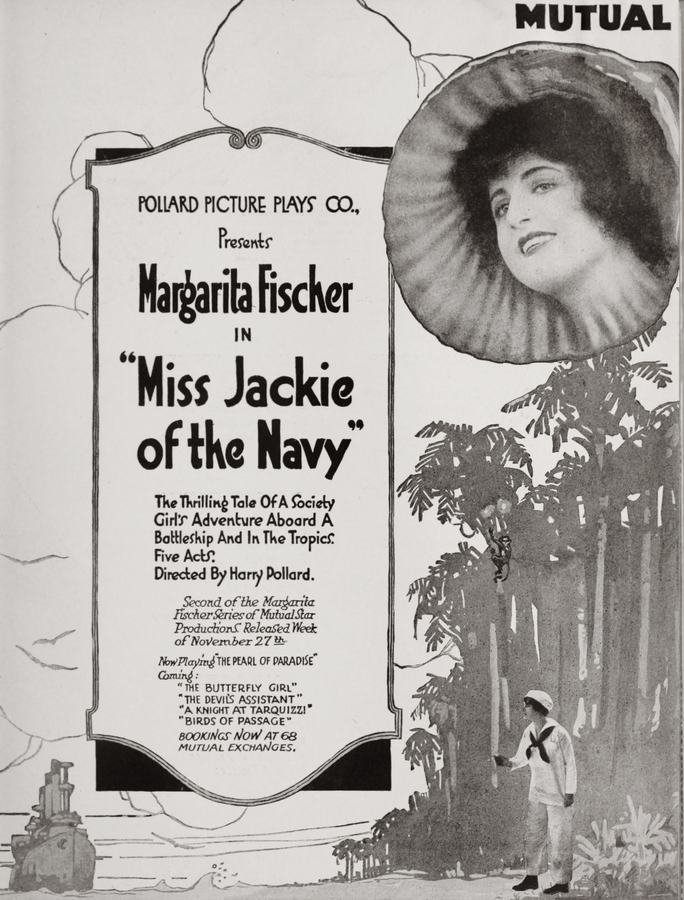
In the annals of early cinema, where narrative conventions were still nascent and the power of visual storytelling reigned supreme, certain films emerge as fascinating time capsules, offering glimpses into societal mores, evolving gender roles, and the sheer audacity of nascent filmmaking. One such intriguing artifact is Miss Jackie of the Navy, a delightful confection from 1918 that, despite its seemingly lighthearted premise, delves into themes of identity, agency, and the transformative power of experience. It’s a film that, even a century later, manages to provoke thought on the performativity of gender and the often-unconventional paths to romantic fulfillment.
The narrative unfurls around Miss Jackie Holbrook, a character who, from the outset, defies the demure expectations of her aristocratic Californian lineage. She is not merely wealthy; she is vibrant, spirited, and possessed of a frolicsome nature that sets her apart from her more conventional peers. Jackie, by all accounts, is accustomed to being the cynosure of all eyes, adored and indulged. Yet, her world intersects with Captain Robert Crowne, U.S.A., whose ship, anchored off the picturesque coast of Coronado, embodies a stoic masculinity that remains impervious to her charms. This perceived slight, this singular lack of adoration from a man of such formidable bearing, becomes not an insult but a challenge, a captivating puzzle for Jackie to solve. Her resolution is swift and utterly audacious: she will make Captain Crowne fall in love with her.
The opportunity for this grand romantic conquest arrives cloaked in the guise of international diplomacy and military action. News of a new sailor destined for Crowne's vessel, bound for the distant and tumultuous Isle of Vergania to quell a native uprising, sparks a daring idea in Jackie's fertile imagination. What better way to infiltrate the captain's world, to truly understand the man beneath the uniform, than to don one herself? This act of cross-dressing, a recurring motif in cinematic history, is here employed not for political subversion or economic necessity, but for the most personal of quests: love. It’s a testament to the era’s fascination with disguise and mistaken identity, a trope that resonated deeply with audiences seeking escapism and a playful subversion of norms, much like the intricate plot twists found in serials such as Beatrice Fairfax Episode 15: Wristwatches, where identity often plays a pivotal role in unfolding drama.
Once aboard, Jackie’s transformation is, superficially, complete. The delicate heiress is now a fledgling sailor, navigating not just the rolling deck but also the rough-and-tumble world of naval camaraderie. Her innate 'effeminacy' – a term loaded with societal judgments of the time – becomes a source of endless amusement for her shipmates. Big Bill Blount, a character seemingly designed to embody the blunt, unrefined masculinity of the naval world, takes particular delight in teasing and jesting at Jackie’s expense. This segment of the film, while played for comedic effect, subtly highlights the rigid gender expectations of the era. A woman, even disguised, struggles to conform to the performative aspects of maleness, and her 'failures' are met with laughter rather than suspicion. This comedic tension, derived from the juxtaposition of a refined woman in a rough male environment, is a classic device, and its execution here provides a window into the prevailing attitudes towards gender roles in early 20th-century America.
The ship itself becomes a microcosm of society, a contained environment where social hierarchies and personal identities are tested. Jackie’s initial struggles underscore the physical and social challenges inherent in her disguise. Yet, it is precisely this immersion into a world so antithetical to her upbringing that begins to shape her, preparing her for the greater challenges ahead. The laughter she endures, the jeers from Blount, while perhaps initially hurtful, serve to toughen her spirit, stripping away the layers of privilege and forcing her to adapt. This period of adaptation and mild tribulation sets the stage for her eventual heroism, demonstrating that true strength lies not in inherited status but in resilience and courage under pressure.
The narrative’s dramatic pivot occurs with the arrival at the Isle of Vergania. The shift from the contained, comedic environment of the ship to the dangerous, untamed interior of the island raises the stakes considerably. Jackie, still maintaining her male persona, is selected as part of the contingent to venture inland, a decision that places her directly in harm’s way. It is here, far from the polished ballrooms and safe harbors of her former life, that her true character shines brightest. When Captain Crowne’s life hangs in the balance, it is the seemingly effeminate recruit, the target of so much jest, who rises to the occasion. Jackie, through an act of profound bravery, saves Crowne’s life, transforming herself from a playful socialite and a comical sailor into an undeniable hero.
This pivotal act of heroism serves multiple narrative functions. Firstly, it validates Jackie’s audacious journey, proving that her pursuit of Crowne was not merely a whim but a testament to a deep-seated courage. Secondly, it shatters Crowne’s preconceived notions, not only about the 'sailor' who saved him but also, implicitly, about what constitutes strength and valor. The traditional masculine ideals that Crowne likely embodied are challenged by the fact that his savior was, in fact, a woman. This dramatic irony is the very heart of the film's appeal, echoing themes of hidden potential and unexpected heroism that resonate across cinematic genres. The revelation of Jackie’s identity, following this act of heroism, is orchestrated for maximum impact. The delight of the sailors, their laughter now transformed into admiration and respect, underscores the film’s message: appearance can be deceiving, and true worth often lies beneath the surface.
Crowne’s immediate proposal of marriage is the film’s romantic climax, a swift and decisive acknowledgment of Jackie’s extraordinary spirit. It is a union forged not in the polite society of Californian high life, but in the crucible of shared danger and profound gratitude. His love is won not by her beauty or wealth, but by her courage, wit, and the sheer force of her personality, which dared to defy convention. This resolution, while perhaps seeming abrupt to modern sensibilities, was a common trope in early cinema, where romantic conclusions often served as a neat wrap-up to adventurous narratives. It symbolizes a triumph of genuine connection over societal expectations, a recognition of an individual’s true essence beyond the superficialities of gender and class.
The film, through Jackie's journey, subtly critiques the rigidity of gender roles prevalent at the time. Her ability to navigate a male-dominated world, albeit with initial difficulty, and ultimately to prove herself a hero, suggests a nascent acknowledgment of female capability beyond the domestic sphere. While the ultimate goal is marriage, a traditionally feminine aspiration, the path to it is anything but traditional. This makes Miss Jackie of the Navy a surprisingly progressive film for its era, offering a protagonist who actively shapes her destiny rather than passively awaiting it. It stands in contrast to films like The Last Dance or Midinettes, where societal pressures and gendered expectations often lead to more constrained or tragic outcomes for female characters. Here, Jackie seizes agency, transforming her desire into a daring adventure.
Much of the film’s charm undoubtedly rests on the shoulders of Margarita Fischer, who embodies Miss Jackie Holbrook. Fischer, a prominent star of the silent era, possessed a vivacity and expressive quality that translated beautifully to the screen. Her ability to convey both the pampered heiress and the awkward, yet ultimately brave, sailor would have been crucial to the film’s success. Without dialogue, the nuances of her performance – her facial expressions, her body language, her comedic timing – would have been paramount in communicating Jackie’s journey from playful mischief to genuine heroism. Her portrayal likely infused Jackie with an irresistible blend of vulnerability and determination, making her cross-dressing escapade believable and her eventual triumph all the more satisfying. Her performance would have been key in making the audience root for her, even during her initial struggles with the masculine persona. This kind of physical acting, where every gesture tells a story, is a hallmark of the silent film era, and Fischer was clearly adept at it, ensuring that Jackie's transition from an object of ridicule to a figure of admiration felt earned and authentic.
Fischer's presence would have been a significant draw for audiences of the time. Her star power, combined with a plot that offered both humor and adventure, made Miss Jackie of the Navy a compelling cinematic offering. The film's relatively straightforward narrative, focused on a strong central character and a clear objective, would have been highly accessible to audiences, further cementing its appeal. It’s the kind of performance that distinguishes a film, making it memorable long after the reels have stopped turning. The transformation she undergoes, both physically and emotionally, is central to the film's message, showcasing a range that few actors could master without the aid of spoken words. Her ability to convey Jackie's initial naiveté, her growing resilience, and finally, her triumphant self-discovery, is what elevates the film beyond a simple romantic comedy into something more profound.
Miss Jackie of the Navy, while a product of its time, resonates with themes that remain perennially relevant. The exploration of identity, the challenge of societal expectations, and the pursuit of love against odds are narrative pillars that continue to captivate audiences. The film's use of disguise, a popular trope, allowed for a playful subversion of gender roles, providing a space for a female protagonist to demonstrate agency and courage in a traditionally male domain. This particular narrative device, where a character's true identity is hidden, then dramatically revealed, is a timeless storytelling mechanism, seen in everything from Shakespearean comedies to modern thrillers. Here, it’s used not just for humor, but to underscore a deeper message about capability and self-worth, irrespective of external presentation. The narrative's simplicity belies a clever manipulation of audience expectations, leading to a satisfying conclusion where genuine character triumphs over superficial judgments.
In an era when film was still discovering its voice, such stories, with their clear arcs and morally satisfying conclusions, played a crucial role in establishing cinema as a powerful medium for entertainment and social commentary. The film's portrayal of a wealthy woman choosing adventure over a life of leisure, and proving her mettle in a dangerous environment, would have been particularly inspiring, perhaps even subversive, for female audiences of the time. It offered a vision of womanhood that extended beyond the domestic sphere, hinting at the burgeoning social changes that would redefine women's roles in the coming decades. Compared to films like Stolen Goods, where identity is often a burden or a means to an end, Jackie's disguise is a tool for self-discovery and empowerment. It's a proactive choice, demonstrating a pioneering spirit that would define many of the era's most memorable heroines.
The direction, likely emphasizing clear visual storytelling given the silent nature of the film, would have focused on strong character blocking, expressive close-ups (if available given the era's cinematography), and dramatic action sequences during the Vergania segment. Alfred Solman's writing would have provided the structural backbone, ensuring that Jackie's motivations were clear and her journey compelling, even without spoken dialogue. The pacing would have been crucial, building from the comedic interludes on the ship to the tension and heroism on the island, culminating in the romantic resolution. This careful construction of narrative, using visual cues and character actions, is a hallmark of effective silent filmmaking, and Miss Jackie of the Navy appears to have leveraged these techniques to tell a captivating story.
Ultimately, Miss Jackie of the Navy stands as more than just a historical curiosity. It’s a testament to the enduring appeal of a compelling character, a daring adventure, and a love story that defies convention. It reminds us that even in the earliest days of cinema, filmmakers were exploring complex ideas about identity, gender, and the audacious spirit of individuals who dared to chart their own course. For those interested in the evolution of cinematic storytelling, the portrayal of women in early film, or simply a charming tale of love and heroism, this film offers a rich and rewarding experience. It's a delightful reminder of how much courage and creativity went into crafting the foundational narratives of the silver screen, proving that even a century ago, audiences were hungry for stories that challenged norms and celebrated the extraordinary within the ordinary. The film's legacy, though perhaps not as widely known as some of its contemporaries, lies in its spirited protagonist and its optimistic embrace of self-determination, a message that continues to resonate today. It’s a film that, in its own charming way, sails beyond mere entertainment, offering a glimpse into the evolving social landscape and the enduring power of a good story well told.

IMDb —
1929
Community
Log in to comment.