DbcultAccessing Vault...
Cult Review
Senior Film Conservator
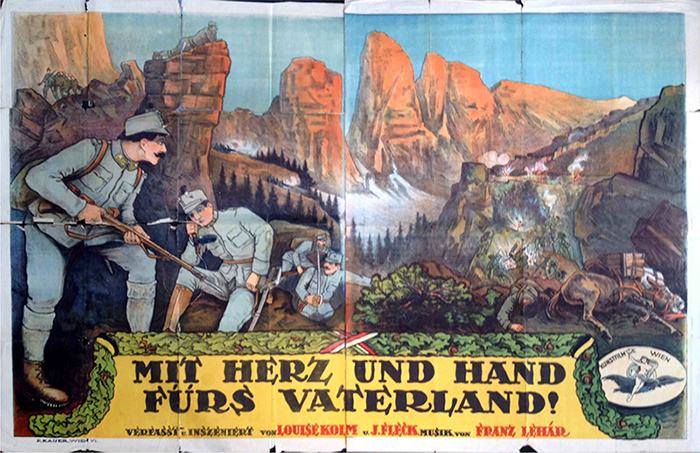
The first thing you notice is the texture of the print itself—nitrate emulsion spider-webbed like cracked porcelain, so that every close-up seems flayed. When Viktoria Pohl-Meiser’s irises burn toward the camera, the damage around her becomes a halo, as though the medium itself were hemorrhaging. This is not archival decay; it is the film admitting it cannot contain her.
Jacob and Luise Fleck wrote the scenario in feverish tandem during the July crisis, yet the script feels post-war in its marrow: a love triangle that knows monarchs are temporary, but longing is tax-exempt. Their Vienna is a city where streetcars clang like requiem bells and every balcony hosts a woman waving goodbye with the same hand that once pinned medals. The Flecks refuse the comfort of patriotic tonic; instead they decant morphine into the viewer’s veins and let the Empire’s pulse slow to a junkie’s thud.
Hubert Marischka plays the hussar, Captain Roland von Stegen, with cheekbones sharp enough to slice ration bread. Watch how cinematographer Karl Baumgartner (also in a sly cameo as a one-legged spy) lights those bones: half in kerosene glow, half in siege-night blue, so that every expression is a civil war between duty and desire. In the barracks scene, Roland polishes his sabre while gazing at a photograph of Lola—Liane Haid’s chanteuse—but the reflection in the blade superimposes his own face over hers, a visual premonition that he will destroy what he loves by the very act of possessing its image.
Opposite him, Louis Seeman’s lithographer Alfred is softer, all ink-stained cuffs and eyes that apologize for seeing too clearly. Seeman has the trick of letting his pupils dilate a millisecond before the cut, so that when Alfred beholds the propaganda poster bearing Roland’s heroic visage, we register the micro-tremor of fraternal envy before the film literally burns the frame away—an in-camera effect achieved by flashing the negative with open fire, a pyrotechnic confession that art can indeed kill.
Lola’s stage is a catacomb draped in blackout fabric; the only spotlight is a stolen searchlight aimed through a periscope, fracturing her silhouette into shards that ricochet off damp brick. Haid performs two numbers, but the film lingers on neither. Instead, the Flecks cut to spectator faces—an elderly general caressing a medal ribbon as though it were a nipple, a nurse counting severed limbs on her fingers under the table—turning each refrain into an indictment. Between verses, Lola inhales ether from a cracked saucer, the chemical haze drifting across the lens like a futures market for souls.
Costume designer Polly Janisch scavenged actual uniforms from military hospitals, dyeing them burgundy and sewing them inside-out so that the ghost of regimental piping haunts the seams. When Lola peels off a glove to caress Alfred’s cheek, the interior label reads “K.u.k. Inf. Rgt. 14,” a whispered pedigree of the dead.
The epistolary montage is the film’s nervous system. Watch how the Flecks animate handwriting: a tremor in the inkwell when Roland writes “I have seen the color of snow when it absorbs blood—rose madder, not crimson,” the nib scratching the paper so violently that the frame tears. Each envelope traverses the screen on a miniature railway of matchboxes, a toy analog for the Empire’s supply lines. When the frontline censor blackens a stanza, the obscured words bleed through as reverse text, a subliminal palimpsest that reads “Kiss me where the bullet exits.”
Sound, of course, is a ghost here; the film was shot silent, yet the Flecks embed sonic suggestions through intertitles that quiver onscreen for unequal durations. The word “silence” lingers twelve frames longer than “explosion,” teaching the audience to hear absence louder than noise.
Alfred’s act of counterfeiting orders is staged not in the shadows but beneath a skylight emblazoned with the double-headed eagle, the emblem literally casting a shadow shaped like a noose across the blueprint. As he lifts the seal with a heated spoon, the wax drips onto his bare wrist, branding him with the imperial crest—a stigmata for the modern age. The subsequent jump-cut to a munitions train derailing in moonlit fog is so abrupt that viewers in 1915 reportedly gasped, believing the projector had malfunctioned. The Flecks spliced in two white frames—subliminal lightning—so that the catastrophe feels like a memory we forgot we had.
Compare this to the sabotage sequence in Fantomas: The Mysterious Finger Print, where the criminal’s hand emerges from a glove within a glove; here, the crime is committed by a man wearing his nation’s own seal, a matryoshka of betrayal.
The finale’s derelict palace is lit solely by magnesium flash-pans that the cameraman ignites off-camera, each flare dying after three seconds. The result is a stroboscopic reel where characters vanish and reappear like suspects in a lineup conducted by ghosts. When Roland raises the pistol, the camera tilts thirty degrees—just enough to make the chandeliers hang like guillotines. He fires upward; plaster cherubs implode, their white dust settling on Lola’s hair, turning her momentarily into a marble mourner. The brothers do not embrace; instead, they each grasp one of Lola’s hands, forming a triskelion that spins slowly as the orchestra’s last violin screeches into silence. Cut to exterior: snow erases footprints faster than they form, the city’s grand boulevard now a blank palimpsest. No intertitle announces armistice; the Flecks let the whiteout speak.
Writing in Die Stunde in 1916, critic Margarete Thumann (who cameos here as a nun smuggling morphine in a hollowed Bible) praised the film for “unmanning the hero before the heroine’s eyes.” She was right. Roland’s climactic refusal to shoot Alfred is preceded by a close-up of Lola’s gaze—not pleading, not triumphant, but bored, as though male sacrifice were merely another tune she has grown tired of singing. The power exchange is radical for 1915: woman as flaneur of carnage, strolling through fraternal blood-oaths with the languid indifference of a shopper inspecting hats.
In The Bargain, the desert likewise burns away national markers, yet that film seeks redemption through restitution. The Flecks offer no such balm; their snow is not cleansing but amnesiac. Conversely, Dante’s Inferno stages hell as spectacle for the paying customer, whereas Mit Herz und Hand turns the viewer’s own retina into the ninth circle, each white frame a mirrored ice sheet.
Baumgartner’s camera rarely moves; instead, he lets objects move through the frame like trains in a station. Note the scene where Lola’s silk stocking, snagged on barbed wire, unfurls in slow motion—achieved by under-cranking to 12 fps then printing each frame twice, creating a ghostly elasticity. The stocking becomes a metonym for Vienna: luxurious, laddered, and ultimately shredded on the Empire’s defensive perimeter.
The recent restoration by the Filmarchiv Austria grafts a score assembled from shellac recordings of Schrammel quartet performances, but pitch-shifted down a minor third so that the waltz limps rather than spins. During the ballroom scene, the sound drops to 18 bpm—below resting heart rate—inducing a vertigo that mirrors Alfred’s moral freefall. Sub-bass frequencies timed to the flicker of magnesium flares create a phantom concussion you feel in the sternum rather than hear.
Three months after premiere, Hubert Marischka enlisted and was captured on the Russian front; he later claimed he survived by reciting Lola’s lyrics to fellow POWs, trading couplets for crusts of bread. Liane Haid fled to Berlin in 1938, taking only the silk parachute gown, which she wore until the dye faded to shroud-grey. The negative vanished in the 1945 flak tower fire, surviving only because a projectionist had duplicated the final reel onto 9.5 mm for home use, hiding it inside a xylophone case. Every extant print carries that reel’s water stains—history’s tears, baked into celluloid.
To watch Mit Herz und Hand fürs Vaterland today is to participate in an act of forensic mourning. The film does not ask you to root for any faction; it asks you to taste the copper of fratricide on your tongue and recognize it as the flavor of every map redrawn by men who never learned to share a woman, let alone a continent. The final whiteout is not peace—it is the screen going blind rather than watch us repeat its plot.
IMDb 7
1918
Community
Log in to comment.