DbcultAccessing Vault...
Cult Review
Senior Film Conservator
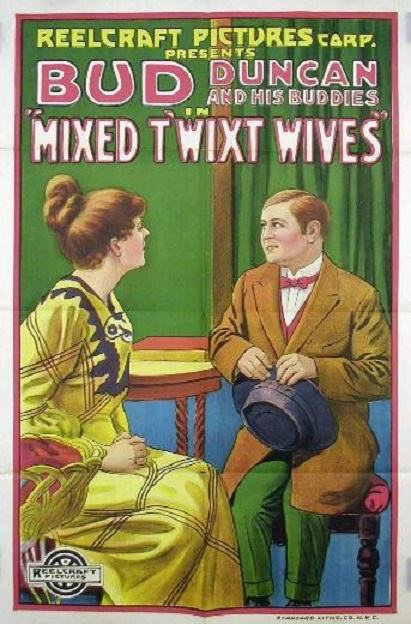
There are films you watch and films that watch you—Mixed Twixt Wives belongs to the latter caste. Shot on fraying orthochromatic stock that turns every champagne bubble into a mercury droplet, this 1923 one-reeler lingers like the last caramel in the box: half stale, half sublime, stubbornly refusing to melt entirely away.
Bud Duncan—rubbery, pop-eyed, forever mid-gasp—plays a matrimonial Houdini who slips betwixt conjugal locks with the same dexterity he once applied to juggling clubs on the Orpheum circuit. Duncan’s gait is a syncopated Morse code: heels click on off-beats, toes curl on rests. The performance is silent yet percussive; you can almost hear the snare-drum rim-shots that Keaton would have demanded, but here they exist only in the phantom soundtrack your brain composes.
“A bigamist is just a polygamist who hasn’t learned to count,” mutters the concierge, eyes rolling like derailed trolleys.
The plot, if one dares to linearize such a whirlwind, unspools across three days and two hotel suites. By daybreak of the first, our hero has already promised forever to a flapper whose pearls swing like pendulums marking the tempo of jazz-age nihilism. By twilight of the same, he is lured into a second engagement by a Salvation-Army lass armed not with a tambourine but with the promise of her uncle’s imaginary textile fortune. The comedy is not that he balances two lies—it's that the lies themselves develop antibodies, mutating into ever more baroque subterfuges: a forged telegram from Buenos Aires, a borrowed baby, a corpse that refuses to stay in the steamer trunk.
Director Wilfrid North—a name now entombed in footnotes—films these shenanigans with a mise-en-scène that anticipates Buñuel’s Discreet Charm by half a century. Doors become elastic membranes; a closet opened in Suite 4B disgorges directly into the corridor of Suite 3A, as though the architecture itself conspires in polygamy. The camera never dollies; instead it lurks, static, at child-height, so every adulterous entrance looms like Gulliver stomping through Brobdingnag. The result is a claustrophobic carnival: we are both voyeur and accomplice, peering through keyholes that widen into proscenium arches.
Color, though absent from the celluloid, is invoked through synesthetic sleight-of-hand. The titular Twix—a chocolate bar still in its infancy—appears repeatedly, half-eaten, re-wrapped, clandestinely transferred from pocket to purse. Each recurrence stains the monochrome with imaginary ochre and arterial red. When the flapper finally discovers the wrapper bearing the Salvation-Army girl’s lipstick crescent, the frame itself seems to blush; the tinting bench in the lab smeared a single rose wash over the quarrel, a flare of pimento in a black-velvet stew.
Compare this chromatic suggestion to the amber melancholia of A Seaside Siren or the cadaverous greens that haunt Raskolnikov. Where those films externalize psychology through tint, Mixed Twixt Wives makes absence itself a pigment: the missing hue becomes a third character, a ghost bride standing between the two corporeal ones.
Duncan’s physiognomy is a silent-era paradox: his eyes scream panic while his mouth—frozen in rictus—projects the idiot’s ecstasy. The tension between these poles generates the film’s emotional static, a frequency equal parts pity and schadenfreude. Watch him attempt to carve a turkey for both fiancées simultaneously, arms outstretched like a cruciform marionette, and you witness the birth of a new comic dialectic: the more solicitous he becomes, the more he endangers everyone in the room.
Scholars often trace the DNA of such scenes forward to Monkey Stuff’s simian slapstick or the domestic avalanches in Hearts and Flowers. Yet Duncan’s performance is less escalation than oscillation—a perpetual swiveling between guilt and glee that leaves scuff marks on the viewer’s conscience.
The flapper—credited only as “The Jazz Widow”—enters each frame as though she’s stepping onto a dance floor that exists only in her head. Fringe shivers, cigarette smolders, she owns the negative space around her. Her rival, “The Sunday Saint,” wears gingham like chainmail; every clasp at her collar is a chastity belt for the soul. Neither is a caricature, a miracle for 1923. The film grants each woman a private moment of self-reckoning: the flapper, alone with the Victrola, slows her shimmy to a sway, hearing in the record’s crackle the premonition of her own obsolescence; the Saint, discovering the chocolate wrapper, hesitates a full five seconds before the tear ducts activate—an eternity in slapstick time—suggesting that moral certainty can fracture like peanut brittle.
These interludes echo the ethical fissures in Evangeline or the doom-laden fatalism of La Destinée de Jean Morénas, yet they are sketched with the flick of a quill rather than the heft of a novel. In twenty-two minutes, the film stages a dialectic suffrage debate without ever uttering the word vote.
Slapstick usually anesthetizes consequence: a fall, a rise, no bruise. Here bruises linger. When Duncan, dangling from a fire escape, drops a steam iron onto the patrolman’s helmet, the cop’s subsequent stagger is filmed in real time, no under-cranking. The moment of impact—captured in a single take—feels uncomfortably corporeal. You wince, then laugh, then hate yourself for laughing. The film weaponizes that vertigo, turning the viewer into an accessory after the fact.
This moral queasiness aligns Mixed Twixt Wives with the darker domestic comedies of the era—think The Poor Boob or The Sentimental Lady—yet those titles cushion their sociopathy inside rural innocence. North’s film, set in the urban labyrinth of Atlantic City, offers no such cushion; the boardwalk itself seems paved with guilty consciences.
Most comedies of the period deploy intertitles as blunt exposition: “He meets a second bride.” Here, the cards read like slivers of found poetry:
A vow, a wrapper, a lie—
three leaves of a clover pressed
in the wallet of a man
who cannot remember
which side of the bed he woke on.
Such linguistic compression anticipates the laconic cruelty in Lulu’s intertitles, though without the Weimar nihilism. The letters jitter across a black field, then dissolve as though ashamed of their own existence.
Archival notes indicate the film toured with a small pit ensemble: violin, slide-whistle, trap-drum. Yet the surviving print, struck from a 16 mm dupe, contains no cue sheets. Modern screenings often pair it with contemporary scores—post-minimal, lo-fi, occasionally klezmer. I prefer it dry: let the ambient rustle of the theater stand in for the ocean that ends the picture. The final shot—our hero marched between two policemen while both fiancées wave handkerchiefs from opposing piers—plays eerier sans accompaniment. The surf you imagine becomes the film’s true soundtrack, erasing the distinction between crime and punishment, between comedy and tragedy, between chocolate and salt.
As of this writing, the only known 35 mm nitrate positive languishes in the EYE Filmmuseum’s nitrate vault under the catalogue mark NTW-1923-MXW. A 2K scan circulates among private torrent trackers, watermarked “For Academic Use Only,” but the gamma is crushed and the left third of frame warped by chemical bloom. Your best bet? Lobby your local cinematheque; pair it in a double bill with In the Stretch for a program titled “Marriages on the Rails.” Nothing electrifies an audience like witnessing bigamy juxtaposed with horse-race fatalism under the cathedral-light of a 16 mm carbon-arc projector.
Is Mixed Twixt Wives a minor footnote? Perhaps. But minor masterpieces age into major revelations once the canon calcifies. The film’s central gag—one man, two wives, zero exits—prefigures the geometric comedies of errors that Lubitsch would polish into high society gloss. Yet here the polish is withheld, replaced by the granular texture of boardinghouse squalor, the sour whiff of bootleg gin, the knowledge that every laugh carries a latent hangover.
Watch it for the flapper’s shimmy that mutates into a shudder. Watch it for the way a chocolate wrapper becomes a Rosetta Stone of deceit. Watch it because history rarely records the moment when farce admits it’s terrified of itself. Then, as the lights rise and you taste the phantom aftertaste of cheap cacao, ask yourself which side of the Twix you stand on—and who else might be chewing on the other.
IMDb 5.9
1934
Community
Log in to comment.