DbcultAccessing Vault...
Cult Review
Senior Film Conservator

In the annals of early cinema, where narratives often grappled with the burgeoning complexities of modern life, 1917’s Money Madness emerges as a compelling, if often overlooked, artifact. This silent drama, a product of writers Frank H. Spearman and William Parker, delves into the precarious world of finance, betrayal, and the steadfast pursuit of justice, themes that remain startlingly resonant even a century later. Far from a mere historical curiosity, it offers a trenchant critique of corporate ethics and the insidious nature of greed, framed within a thrilling detective narrative that captivates with its moral clarity and dramatic urgency.
At the heart of Money Madness lies the poignant struggle of George Fuller, portrayed with gravitas by Charles Hill Mailes. Fuller is not merely a bank president; he is the embodiment of a rapidly fading ideal of integrity, a man so deeply intertwined with the institution he helms that its impending collapse feels like a personal failing of the soul. When his bank teeters on the brink, threatened by unforeseen losses, Fuller makes a drastic, almost Quixotic, decision: to liquidate his own considerable fortune to plug the gaping holes in the bank's balance sheet. This act of profound self-sacrifice elevates him beyond a simple protagonist, transforming him into a tragic hero whose unwavering commitment to his depositors and the very concept of financial trust stands in stark contrast to the burgeoning avarice that would define much of the 20th century. Mailes’ performance, relying on the nuanced pantomime characteristic of the silent era, conveys Fuller's internal torment and resolute determination with remarkable clarity, painting a portrait of a man under immense pressure, yet unyielding in his principles. It’s a performance that speaks volumes without uttering a single word, etching the character of Fuller into the viewer's consciousness as a beacon of moral fortitude in a darkening landscape.
The tragedy of Fuller's sacrifice is deepened by the revelation that the bank’s woes are not merely a result of market forces or unfortunate circumstances. Instead, they are the deliberate machinations of Monroe Simmons, the bank’s seemingly trusted vice-president, brought to life with chilling effectiveness by Gayne Whitman. Simmons represents the antithesis of Fuller: a calculating, opportunistic figure who exploits his position of power for personal gain, systematically undermining the very foundation of the institution he is sworn to protect. His conspiracy, an insidious plot unfolding from within, adds a layer of psychological tension that elevates Money Madness beyond a simple financial drama into a gripping tale of betrayal. Whitman’s portrayal of Simmons is subtle yet menacing, conveying a quiet malevolence that is arguably more terrifying than any overt villainy. He is the smiling face of corruption, a stark reminder that the greatest threats often come from those closest to us, those who have earned our trust. This theme of internal sabotage, of the enemy within, resonates powerfully, echoing similar anxieties about corporate malfeasance found in later films, and even finding parallels in earlier works that explored the exploitation of the working class, such as Upton Sinclair's The Jungle, albeit here focused on the financial elite.
Amidst the high-stakes world of banking and corporate intrigue, a tender romance blossoms between Fuller's daughter, Ethel, sensitively played by Mary MacLaren, and Tom Williams, brought to the screen by Eddie Polo. Their burgeoning affection is not merely a saccharine subplot designed to lighten the dramatic tension; it serves as the crucial catalyst for the unraveling of Simmons's nefarious scheme. It is through Tom's concern for Ethel and her father's plight that the legendary detective "Whispering Smith" is brought into the fold. MacLaren imbues Ethel with a quiet strength and deep filial loyalty, making her a sympathetic figure caught in the maelstrom of her father's troubles. Eddie Polo's Tom is earnest and resourceful, his love for Ethel providing the moral imperative for seeking external help. Their relationship underscores the human cost of financial corruption, demonstrating how the ripples of one man's greed can threaten not just institutions, but also personal happiness and familial bonds. The inclusion of this romantic element provides a grounding emotional core, preventing the narrative from becoming too abstract or purely procedural.
The true turning point, and indeed the film's most thrilling element, arrives with the introduction of "Whispering Smith." Though his specific portrayal isn't explicitly detailed in the surviving records, the character itself is a formidable presence, a famed detective known for his quiet vigilance and sharp intellect. He is the moral compass and the instrument of divine retribution in a world mired in deceit. Smith’s investigation is presented as a meticulous, almost surgical, dissection of Simmons's conspiracy. He doesn't rely on brute force or dramatic confrontations, but rather on observation, deduction, and an uncanny ability to connect disparate pieces of evidence. This methodical approach places Money Madness firmly within the nascent genre of detective thrillers, sharing DNA with literary figures like Sherlock Holmes, and indeed, cinematic adaptations such as Der Hund von Baskerville. The film skillfully builds suspense as Smith closes in, each revelation tightening the narrative coil. The ultimate apprehension of Simmons and his co-conspirators is not just a triumph of justice, but a restoration of equilibrium, a powerful affirmation that even the most elaborate schemes of greed can be thwarted by unwavering moral resolve and keen investigative prowess. The presence of actors like M. Everett, Don Bailey, and Rex De Rosselli in supporting roles undoubtedly contributed to the ensemble that formed the conspiratorial network and the forces of order.
For a film from 1917, Money Madness exhibits a remarkable grasp of narrative pacing and visual storytelling. The direction, while uncredited in the prompt, effectively uses the visual language of silent cinema to convey complex emotional states and plot developments. The film likely employed a combination of expressive acting, carefully composed shots, and informative intertitles to guide the audience through its intricate plot. The tension surrounding the bank's impending collapse is palpable, conveyed through frantic expressions, hurried movements, and perhaps even symbolic imagery of teetering scales or crumbling structures. The transition from the desperate atmosphere of financial ruin to the methodical investigation by Whispering Smith is handled with a smooth progression that maintains audience engagement. The filmmakers understood how to build suspense without relying on spoken dialogue, a testament to the era's mastery of visual communication. The visual contrast between the opulent, yet threatened, bank setting and the shadowy corners where conspiracies are hatched would have been key to establishing the film's mood.
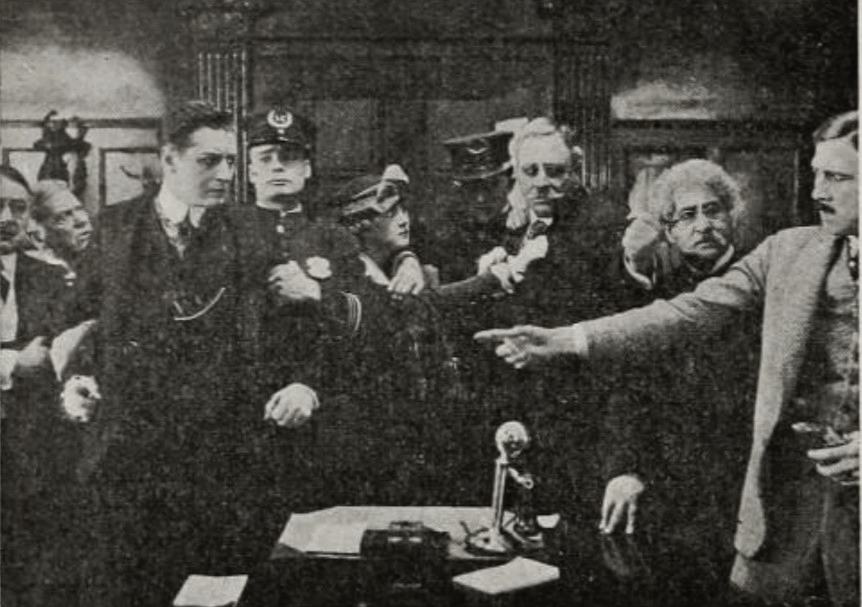
What truly elevates Money Madness beyond a mere historical curiosity is its enduring thematic relevance. The anxieties surrounding financial institutions, the moral compromises made in the pursuit of wealth, and the eternal struggle between good and evil are as pertinent today as they were over a hundred years ago. The film critiques the inherent vulnerabilities of a system built on trust, showing how easily it can be exploited by those devoid of scruples. This exploration of financial corruption and its societal impact places it in a lineage of films like Ready Money and The Plunderer, both of which tackled similar themes of wealth, power, and ethical decay in their respective narratives.
Moreover, the film's depiction of a detective tirelessly working to uncover the truth speaks to a universal human desire for order and justice. "Whispering Smith" embodies the hope that even in the face of overwhelming odds and sophisticated deceit, truth will ultimately prevail. His character harks back to classic literary detectives, whose intellectual prowess was their primary weapon, offering a reassuring counterpoint to the forces of chaos. The film subtly suggests that while laws and regulations are important, it is the integrity of individuals, and the vigilance of those dedicated to justice, that truly safeguard society. The tension between the letter of the law and its spirit, a theme explored in films like A Boy and the Law, is present here, though manifested through the lens of corporate crime.
The performances, particularly those of Charles Hill Mailes and Gayne Whitman, are commendable for their ability to convey complex characters without the aid of dialogue. Mailes’ Fuller is a sympathetic figure whose moral struggle anchors the film, while Whitman’s Simmons is a memorable villain, his quiet villainy a testament to the power of understated performance. Mary MacLaren and Eddie Polo provide the necessary emotional depth, their romance serving as both a personal stake and a narrative engine. The collective efforts of the cast, including M. Everett, Don Bailey, and Rex De Rosselli, contribute to a richly textured world where every character plays a part in the grand scheme of financial peril and ultimate redemption.
The foundation of any great film lies in its script, and Money Madness benefits immensely from the narrative craftsmanship of Frank H. Spearman and William Parker. Their ability to weave together a tale of corporate malfeasance, personal sacrifice, and detective work into a coherent and engaging whole is a testament to their storytelling prowess. The plot is intricate enough to maintain suspense, yet clear enough for audiences to follow without difficulty, a crucial balance in the silent era where exposition relied heavily on visual cues and intertitles. They understood the dramatic potential of an 'inside job' and the appeal of a brilliant detective character, elements that would continue to define the thriller genre for decades to come. The narrative arc, moving from crisis to investigation to resolution, is expertly structured, ensuring a satisfying emotional and intellectual payoff.
In an era when cinema was still finding its voice, films like Money Madness were crucial in demonstrating the medium's capacity for complex storytelling. It wasn't just about spectacle; it was about engaging with contemporary issues, exploring human nature, and delivering narratives that resonated deeply with audiences. The film serves as an important reminder of the sophistication present in early cinema, often underestimated in retrospect. It proves that compelling drama, intricate plotting, and profound thematic exploration were already hallmarks of the art form well before the advent of sound. Its insights into the human condition, particularly concerning the corrupting influence of wealth and the redemptive power of integrity, remain surprisingly sharp and relevant.
Ultimately, Money Madness stands as a compelling testament to the enduring power of classic storytelling. It’s a film that, despite its age and silent format, speaks volumes about the timeless struggles between virtue and vice, loyalty and betrayal, and the relentless pursuit of justice. Its detailed portrayal of financial intrigue, anchored by strong performances and a skillfully constructed plot, ensures its place as a significant entry in the history of the crime and drama genres. For cinephiles and historians alike, it offers a fascinating glimpse into the social anxieties and narrative conventions of its time, while simultaneously delivering a thrilling and thought-provoking cinematic experience that transcends its historical context. It reminds us that the fundamental human dramas, particularly those involving the corrupting influence of money and the quest for truth, are indeed universal and eternal. The film's legacy is not just in its pioneering efforts but in its powerful and continuing ability to reflect the very real complexities of the human relationship with wealth and power.
IMDb —
1916
Community
Log in to comment.