DbcultAccessing Vault...
Cult Review
Senior Film Conservator
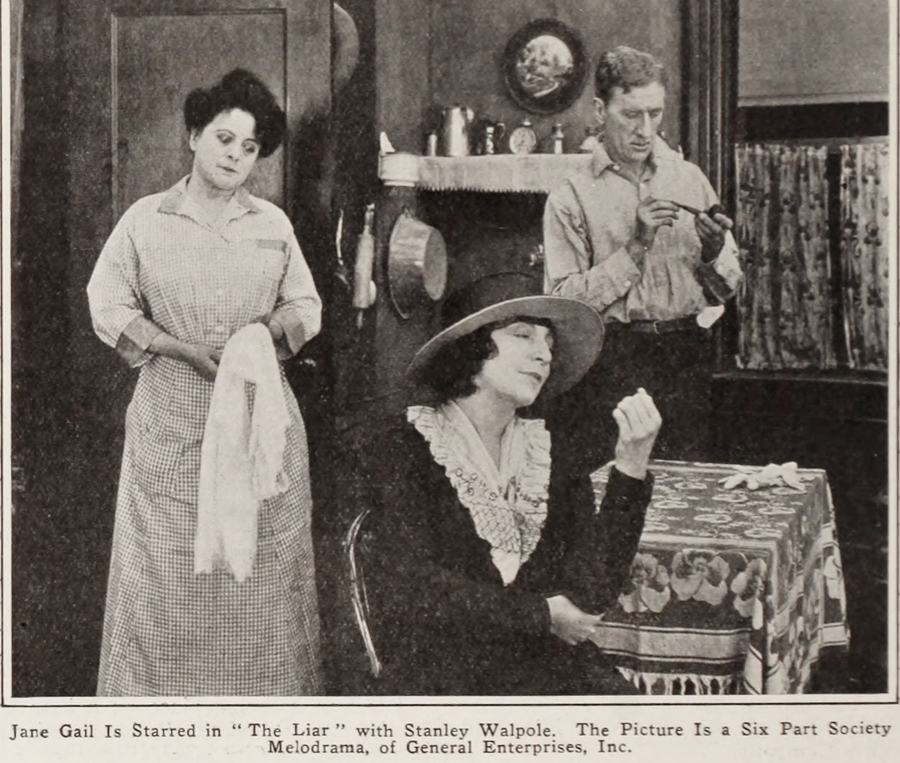
The year 1918 represents a fascinating threshold in the history of American cinema. It was a period of transition, where the simplistic moralities of the Victorian era began to collide with the burgeoning cynicism of the Jazz Age. The Liar, directed with a keen eye for social stratification, stands as a testament to this era's obsession with the 'Great White Way' and the inherent dangers of the urban sprawl. In this film, we find a narrative that transcends mere melodrama, offering instead a sharp critique of class mobility and the gendered expectations of the early 20th century.
At the heart of the film is Lucille, portrayed with a haunting vulnerability by Jane Gail. Her performance is a masterclass in silent expressionism, capturing the fleeting moments of hope and the crushing weight of betrayal without the need for excessive intertitles. Lucille’s ambition is not presented as a flaw, but as a survival mechanism. She is a woman suffocating under the weight of her 'sordid life,' a term the film uses to denote the lack of aesthetic and social fulfillment in her domestic sphere. When she encounters James Lambert (Stanley Walpole), he is not just a man; he is a gateway to the Broadway nightlife, a world where the lights never dim and the consequences of the 'morrow' seem like a distant myth.
This thematic exploration of the city as a siren call is a recurring motif in films of this period. For instance, in The Straight Road, we see a similar struggle with moral direction, yet The Liar handles the descent with a more nuanced psychological edge. Lambert is the quintessential cad, a character archetype that Walpole inhabits with a chilling, polished indifference. He represents the predatory nature of the leisure class, those who consume the vitality of others to fuel their own fleeting amusements.
The film’s visual language distinguishes between the 'gaiety' of New York and the 'repentant' atmosphere of the countryside. The cinematography utilizes the stark contrasts of the era to highlight Lucille’s isolation. While Silks and Satins focused on the aesthetic beauty of the upper crust, The Liar strips away the glamour to reveal the rot underneath. The 'gaiety' Lucille finds is a hollow construct, a series of staged moments that Lambert orchestrates to maintain his control.
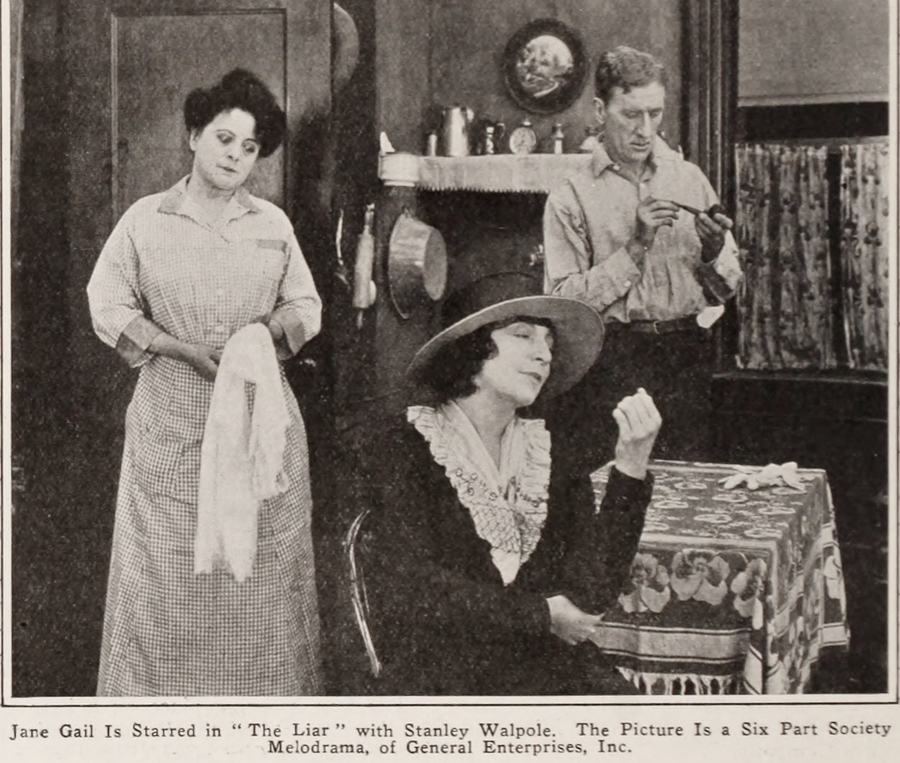
When Lambert announces his engagement to Irene Wallace, the film pivots from a romance to a revenge tragedy. It is here that Lucille’s character exhibits a radical agency. Unlike the passive victims seen in Modern Love, Lucille refuses to sink. Her decision to denounce Lambert before his family is a moment of profound social transgression. She breaks the silence that usually protects men of Lambert’s stature, forcing the private shame into the public eye. This sequence is directed with a frantic energy, the intertitles punctuating the air like physical blows.
The final act of the film deals with the concept of atonement, a theme that was nearly mandatory for the censorship standards of 1918. Lambert’s pursuit of Lucille back to her family home is framed not as a romantic gesture, but as a necessary moral correction. The film suggests that the 'wrong' done to Lucille can only be mended by a return to traditional values—a common trope that we also see explored in The New South and The Yankee Way.
However, the brilliance of Gail’s performance lies in her skepticism. Even as Lambert atones, the shadows of Broadway linger in her eyes. The film posits a difficult question: can one ever truly return to innocence after the 'gaiety' has been revealed as a sham? The resolution is tidy, but the emotional residue is messy. It lacks the pastoral simplicity of The Pendleton, Oregon, Round-Up, opting instead for a domesticity that feels earned through suffering.
Technically, The Liar benefits from the maturing grammar of the silent screen. The editing by the uncredited cutters of the era shows a sophisticated understanding of pacing. The transition from the claustrophobic interiors of Lucille’s early life to the expansive, albeit deceptive, vistas of New York highlights the internal expansion of her desires. This is a far cry from the more static presentations found in Tsar Nikolay II or the documentary-style approach of 0-18 or A Message from the Sky.
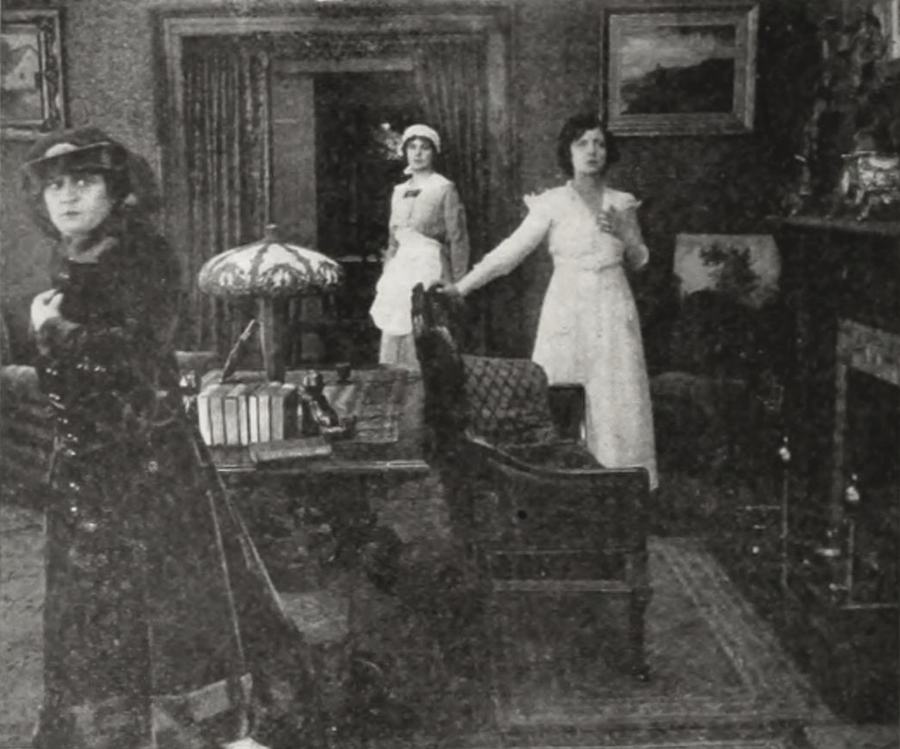
The writers have crafted a script that avoids the pitfalls of pure didacticism. While the moral lesson is clear, the characters are given enough interiority to feel like flesh-and-blood individuals. Lambert is not just a villain; he is a product of a systemic privilege that allows him to view women as disposable commodities. Lucille is not just a victim; she is an intellectual combatant who learns to use the truth as a weapon. This dynamic elevates the film above contemporary works like Man and Beast, which relied more on primal conflict than social commentary.
In the broader scope of 1918 cinema, The Liar serves as a bridge to the more complex melodramas of the 1920s. It shares an DNA with the European sensibilities found in Midnatssjælen or the intense emotionality of Il fuoco (la favilla - la vampa - la cenere). It is a film that demands to be viewed not just as a historical artifact, but as a living piece of art that still speaks to the dangers of ambition and the necessity of personal integrity.
The inclusion of Jane Gail was a stroke of casting genius. Having previously appeared in The Dancing Girl, she brought a certain level of prestige and theatricality to the role. Her ability to convey Lucille’s internal collapse during the engagement announcement is a highlight of silent cinema. It is a moment of pure, unadulterated cinema, where the image conveys more than a thousand words could ever hope to. This is the essence of why we still watch these films: they capture the raw, unvarnished human experience in a way that modern CGI-laden spectacles often fail to do.
Ultimately, The Liar is a profound meditation on the cost of the American Dream. It suggests that while the 'Great White Way' may offer a temporary escape from a 'sordid life,' the true path to fulfillment lies in the confrontation of one's reality. It is a film about the power of the word—specifically, the power of the truth to dismantle the lies that the powerful tell to protect themselves. In an era where we are constantly bombarded by curated versions of reality, the message of The Liar feels more relevant than ever.
Whether compared to the patriotic fervor of My Own United States or the cautionary tales of Drugged Waters and The Unforseen, this film carves out its own unique space. It is a work of significant moral weight and artistic merit. For any serious student of film history, it is an essential viewing experience that provides deep insight into the evolution of narrative storytelling. The restoration of such films is vital, for in the silence of Jane Gail, we hear the echoes of a thousand stories that still need to be told.
Reviewer's Note: The preservation of 1918's cinematic output is crucial for understanding the sociological shifts of the early 20th century. "The Liar" remains a cornerstone of this exploration.
IMDb 7.7
1936
Community
Log in to comment.