DbcultAccessing Vault...
Cult Review
Senior Film Conservator
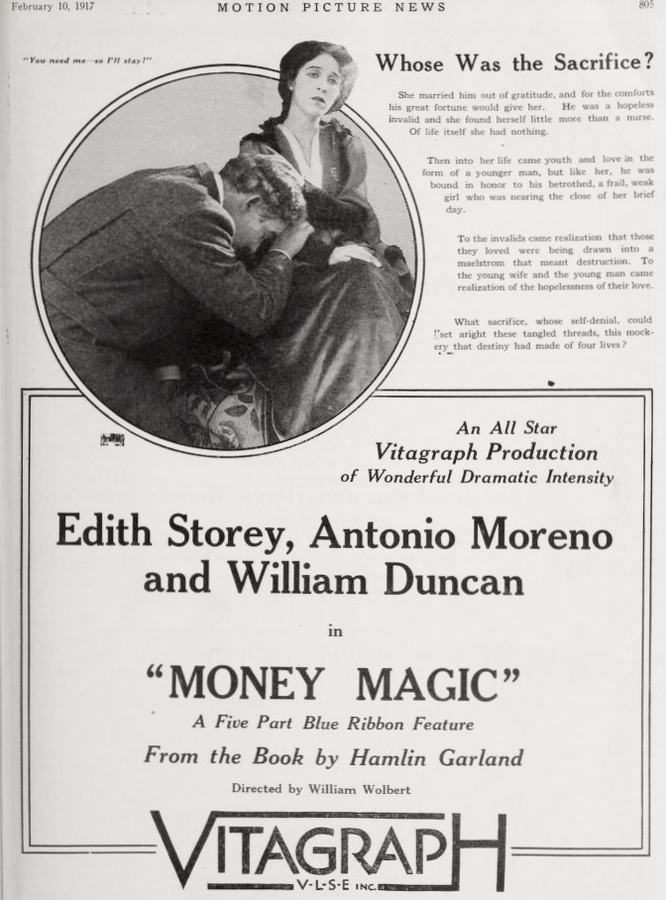
The Alchemy of Sacrifice and Mineral Wealth
William Duncan’s Money Magic represents a pivotal moment in the transition of American silent cinema from simple moralistic fables to complex psychological dramas. Adapted from the prose of Hamlin Garland, the film navigates the precarious interstices between the rugged frontier ethos and the burgeoning sophistication of the early 20th-century American bourgeoisie. It is a work that refuses to settle for the binary of hero and villain, opting instead for a haunting exploration of the pecuniary weight of obligation and the often-lethal price of social mobility.
The Domestic Crucible: Bertha Gilman’s Ascent
The film opens with a stark depiction of domestic labor. Edith Storey’s Bertha is not introduced as a damsel in distress, but as a woman of agency, navigating the demands of her mother’s hotel with a weary competence. When Marshall Haney enters her orbit, the attraction is not presented as a lightning strike of passion, but as a transactional possibility. Haney, played with a rugged, eventually tragic dignity by William Duncan himself, is a man of the earth and the gaming table. His wealth, derived from the literal veins of the mountains, represents a double-edged sword: it offers Bertha an escape from the drudgery of the hotel, yet it binds her to a man whose past is written in the losses of others.
The shooting of Haney serves as the narrative’s first great pivot. It is an act of karmic retribution that echoes the themes found in The Price of Crime, where the ghosts of one’s previous transgressions inevitably demand payment. Haney’s transition from a vigorous man of action to a crippled, dependent invalid transforms Bertha’s role from a partner to a secular saint. Storey conveys this shift through a subtle hardening of her features, a performance that eschews the over-the-top gesticulation common in 1917 for a more internalized, modern sensibility.
The Colorado Springs Paradox
As the setting shifts to the architectural splendors of Colorado Springs, the film’s visual palette expands. The magnificent home purchased by the Haneys is not merely a signifier of wealth; it is a gilded cage. Here, the film introduces Ben Fordyce, portrayed by Antonio Moreno with a luminous, almost agonizing integrity. The juxtaposition of Haney’s physical decay against Fordyce’s youthful vitality creates a tension that is palpable even through the silent medium. The film masterfully handles the introduction of Alice Heath, the consumptive fiancée, whose presence mirrors Haney’s own mortality. Both Bertha and Ben are tethered to dying or broken partners, creating a symmetry of suffering that elevates the film into the realm of high tragedy.
While some films of the era, such as One Million Dollars, focus on the corruptive influence of sudden riches, Money Magic focuses on the emotional paralysis that wealth can induce. The money does not solve Bertha’s problems; it merely provides a larger, more beautiful stage for her unhappiness. The train journey eastward is a masterclass in claustrophobic tension. The four protagonists, trapped in the rhythmic motion of the locomotive, are forced into an intimacy that is both desired and dreaded. Duncan’s direction during these sequences utilizes the confined space to emphasize the psychological entrapment of his characters.
The Metaphysics of the Final Ascent
The climax of Money Magic is one of the most intellectually provocative sequences in early cinema. Marshall Haney’s realization of Bertha’s longing for Ben is not met with jealousy, but with a profound, almost liturgical sense of duty. The death of Alice Heath serves as the catalyst for Haney’s final decision. He understands that in the economy of these four lives, his continued existence is a debt that Bertha cannot pay. His decision to climb the mountain—a physical feat his weakened heart cannot sustain—is a deliberate act of self-erasure.
This mountain climb is filmed with a stark, documentary-like realism that stands in contrast to the earlier, more theatrical scenes. The physical struggle of Haney as he ascends mimics the spiritual struggle of a man seeking to redeem his soul through the ultimate sacrifice. When he reaches the summit and expires, it is not a moment of defeat, but of transcendental victory. He has used the very landscape that gave him his wealth to give his wife her freedom. The final shot of Bertha and Ben gazing upon his body is a haunting tableau of realization. They are united, but they are forever haunted by the magnitude of the gift they have received.
Comparative Analysis: A Genre Unto Itself
When we look at other contemporary works, the uniqueness of Money Magic becomes even more apparent. Unlike the social upheaval depicted in Les Misérables, Part 1: Jean Valjean, where the struggle is against an unjust system, the struggle here is internal and ontological. Haney is not fighting a police inspector; he is fighting the limitations of his own heart. Similarly, while Nuori luotsi explores the dangers of the natural world, Duncan uses the mountain not as a monster, but as a witness to a moral apotheosis.
The film’s refusal to indulge in the sensationalism found in The Story of the Kelly Gang allows it to maintain a somber, meditative tone. Even the inciting incident—the shooting of Haney—is handled with a restraint that emphasizes the consequence over the spectacle. This is a film interested in the "magic" of the title not as a supernatural force, but as the transformative power of wealth and the even greater power of relinquishing it.
Performative Nuance and Technical Prowess
Edith Storey’s performance remains the film’s emotional anchor. In an era where female protagonists were often relegated to roles of passive suffering, Storey’s Bertha is a woman of formidable internal strength. Her loyalty to Haney is never portrayed as a lack of options, but as a conscious moral choice. Antonio Moreno provides the necessary contrast, his Ben Fordyce representing a modern, urban sensitivity that was beginning to replace the old-world archetypes of the frontier. The chemistry between the two is characterized by a restrained yearning, a "longing for the unbearable" that Hamlin Garland’s source material captured so vividly.
Technically, the film benefits from the high production standards of Vitagraph. The use of natural light in the Colorado sequences provides a sense of place that is visceral and immersive. The cinematography captures the vastness of the American West, using it as a mirror for the vastness of the characters' internal landscapes. The editing, particularly during the train journey, creates a rhythmic pulse that mirrors the mounting anxiety of the protagonists.
The Legacy of a Forgotten Masterwork
Why does Money Magic deserve a place in the pantheon of essential silent cinema? It is because the film dares to ask difficult questions about the nature of love and the ethics of happiness. It suggests that sometimes, the most honorable act one can perform is to recognize one's own obsolescence. It is a film that values the silence between its characters as much as the plot itself. In its depiction of Haney’s final ascent, it creates an image of secular redemption that is as powerful today as it was in 1917.
As a piece of art, it stands as a testament to the sophistication of early filmmakers who were already pushing the boundaries of the medium. It is not merely a historical curiosity; it is a deeply moving human drama that explores the vicissitudes of the human heart with a precision that many modern films fail to achieve. To watch Money Magic is to witness the birth of the psychological thriller, the social drama, and the tragic romance, all distilled into a single, haunting experience.
© 1917 Vitagraph Studios | Analysis by The Cinephile Collective

IMDb —
1928
Community
Log in to comment.