DbcultAccessing Vault...
6.6/10
Senior Film Conservator
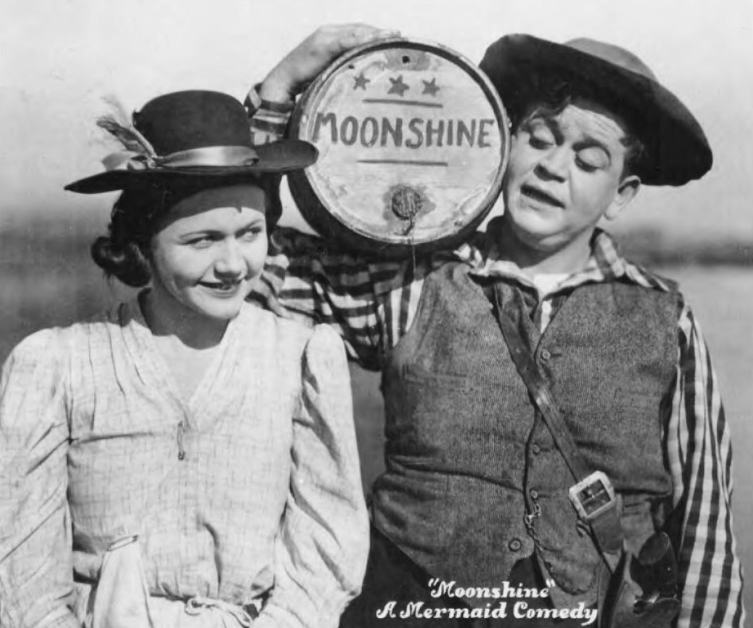
A definitive 6.6/10 rating for a film that redefined the boundaries of cult cinema. Moonshine remains a cornerstone of transgressive art.
Moonshine arrives like a mason jar hurled through the stained-glass window of American myth—its jagged edges catching stray moonlight, its contents swirling with both rotgut absurdity and copper-stilled sorrow. Released in the wake of the Volstead Act yet predating the fully industrialized sound era, this 1920 one-reeler distills national anxiety into a high-proof hallucination that sloshes across the screen.
The film’s geography is less a real cove than a fever-dream cartography: charcoal trees smeared onto nitrate, a sky sagging like wet burlap, a stillhouse that jitters between barn and cathedral. Cinematographer William White (pulling double duty as the blind fiddler) bathes scenes in tungsten flares that look like someone struck matches inside a coal sack. Every frame feels soaked in ethanol; you half expect the sprocket holes to reek of corn liquor.
Lloyd Hamilton, rubber-limbed prince of the undercranked universe, plays the lead moonshiner as a man perpetually surprised by gravity. Watch the way he vaults a split-rail fence: knees jackknifing, derby hat spinning above like a UFO, face frozen in the rictus of a man who’s just remembered he left the stove on in a house already ashes. His slapstick has a hangdog metaphysics; every pratfall is a small death, every resurrection via cut-rate jump-cut a tipsy reincarnation.
Bee Monson’s revenuer preacher chews scripture with the same fervor he chews tobacco; the juice stains his clerical collar like oxidized gilt. When he brandishes a warrant, the parchment unfurls with the snap of a crusader’s flag, yet his eyes flicker with doubt—he’s tasted the product, after all, and found it smoother than salvation.
Charley Chase, still a year away from his starring heyday, essays a bootleg mule whose spinal column appears to be made of boiled linguine. His signature move: a triple-take that escalates into full facial origami, brows knitting, eyes ballooning, mouth collapsing into a perfect zero. In one throwaway gag he attempts to bribe a bloodhound with a flask; the hound, after a sniff, passes out cold, legs skyward like an overturned table. The moment lasts maybe three seconds, yet it contains an entire treatise on species loyalty and the futility of temperance.
Director Otto Fries structures the film like a spiral staircase descending into a barrel: each loop tighter, each step slicker. The centerpiece is an extended hide-the-hooch sequence that rivals the couch-movers episode of Too Many Crooks for kinetic absurdity. Jars rocket up chimneys, coil into corsets, parachute from outhouse windows. A baby cradle rocks to reveal not an infant but a sleepy pint; the mother, rather than scream, sighs with maternal relief at the steady glug-glug of fermentation.
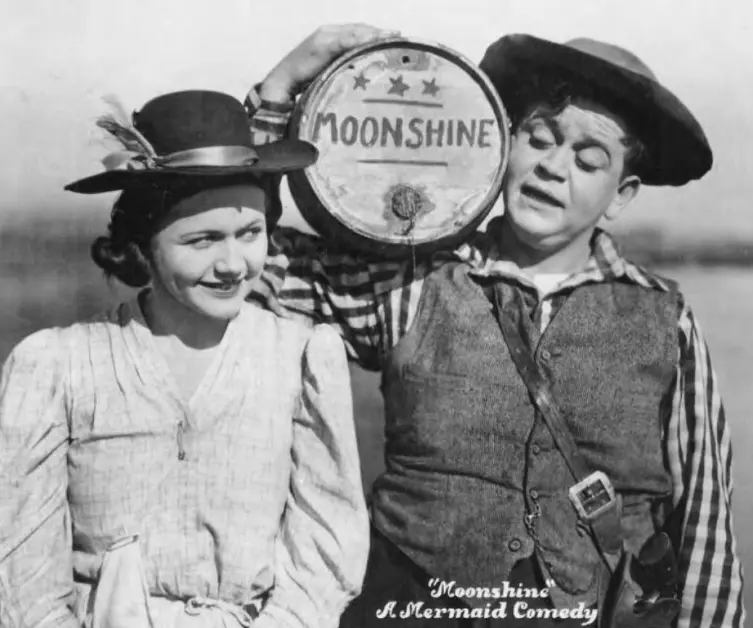
Yet the true marvel is how these gags refract history. When revenue agents hack open barrels, the spew of amber fluid looks eerily like the newsreel footage of beer vats destroyed by axe-wielding G-men—only here the liquid arcs in reverse motion, sucked back into the staves as if time itself were drunk and stumbling sideways.
Being a silent short, Moonshine compensates with a visual percussion: the thunk of a cork, the metallic aria of a copper coil, the syncopated clatter of mason jars rattling in a trunk. Contemporary exhibitors often paired it with rinky-tink piano medleys that slipped from saloon honky-tonk into revival-tent major keys. Today, viewed in pristine 2K on a laptop with noise-canceling headphones, the absence of score amplifies the film’s hinge-creak ambiance; you become hyper-aware of your own swallow, as though the screen might detect blood-alcohol levels.
Place Moonshine beside The Luring Lights and you’ll spy two divergent strategies for coping with Prohibition’s moral twilight: where Lights opts for brooding chiaroscuro and femme-fatale phosphorescence, Moonshine erupts in carnival chromaticism, its shadows painted with iodine-yellow laughter. Both films climax in a courtroom, yet Lights drips noir fatalism while Moonshine detonates into anarchic confetti.
Stack it against A Bit of Kindling and you’ll notice a shared fascination with rustic technology—Kindling’s sabotaged sawmill becomes Moonshine’s sabotaged still—yet Kindling treats machinery as fate’s guillotine, whereas Moonshine treats it as a whoopee-cushion designed by fate’s drunk cousin.
Female characters flicker at the periphery—flappers in rolled-down stockings, grannies with shotguns tucked in knitting baskets—but the film’s true leading lady is the contraband itself: a shape-shifting femme fatale who wears many skins yet always smells of corn. When the revenuer finally nabs a jar, he cradles it like Rhett Butler sweeping Scarlett up the staircase; the close-up holds on his trembling lip, the bead of sweat that slides to the bottle lip and mingles with the liquor, a baptismal consummation.
Modern viewers will note the absence of Black moonshiners, a whitewashing endemic to early Hollywood hillbilly iconography. Yet the film’s caricatured Appalachia is less documentary than feverish projection—an imaginary homeland for a nation anxious about its own thirst. The dialect title cards (“Derned if that hain’t the purest squeezin’s this side o’ Hallelujah!”) read today like minstrel residue, yet they also expose the performative nature of regional identity: everyone here is playing a role, even the landscape.
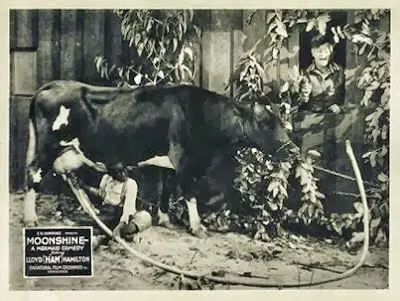
At a brisk twelve minutes, Moonshine achieves a thermodynamic miracle: disorder increases, laughter accelerates, yet somehow nothing is lost. Props that disappear in Act One reappear in Act Three with the inevitability of Newton’s cradle. A busted jar becomes a jury exhibit; the jug’s severed neck morphs into a gavel. The film loops back on itself like an ouroboros brewed at 140 proof.
You can trace its genetic material forward to the whiskey-soaked screwball of You’re Fired, sideways into the Appalachian Gothic of The Home Trail, and backward into the vaudeville blackout sketches that birthed cinema itself. The DNA strand knots most visibly in the bootleg chase that climaxes with a car—actually a hacked-together Tin Lizzie—vaulting a creek via a ramp of moonshine crates. The stunt anticipates every hillbilly car-gag in The Dukes of Hazzard yet retains the handmade peril of actual timber and flesh.
Under the slapshot silliness lurks a Calvinist anxiety: if salvation is predestined, why not drink? The revenuer’s Bible flips open to an liquor-blotted verse—Woe unto him who gives drink unto his neighbor—yet the ink runs, turns the scripture into a Rorschach that looks suspiciously like a still diagram. Hamilton’s moonshiner, strapped into a barrel and rolled downhill, becomes a pilgrim whose rocky descent is a communion wafer: each bruise a sacrament, each revolution a Stations of the Cross.
Watch Moonshine after a season of algorithmic comedies—those over-caffeinated sitcoms that mistake volume for wit—and its silence feels like a detox. The laughs don’t arrive prepackaged with cue-marked cymbals; they well up from your own diaphragm, spontaneous as hiccups. The film trusts the audience to complete the circuit, to supply the imagined whoosh of a boot igniting a lantern, the imagined gulp of liquid fire scalding gullet. That participatory gap is where cinema regains its sacramental aura.
For decades Moonshine languished in the shadow of more prestigious silents until a 16mm print surfaced in a Slovenian monastery archive (long story involving mislabeled hymn reels and a crate of communion wine). Restored by the Eye Filmmuseum, the nitrate now glows on streaming platforms in 2K, accompanied by a optional commentary track that pairs Appalachian banjo with glitch-hop beats—an anachronism that somehow honors the film’s spirit of mash-up rebellion.
By the time the end card smash-cuts to a skull-shaped moon grinning over the ridge, you realize Moonshine isn’t about Prohibition; it’s about prohibition’s hangover, the national headache that arrives when moral certainty is distilled into legalese. The film keg-stands history, chugs it, belches laughter, and leaves you dizzy, slightly nauseous, yet weirdly elated—like any good night spent sipping from a jar whose provenance you’d rather not interrogate. Drink deep, but beware the kick: this moonshine burns long after the lights come up.
IMDb 6
1932
Community
Log in to comment.