DbcultAccessing Vault...
Cult Review
Senior Film Conservator
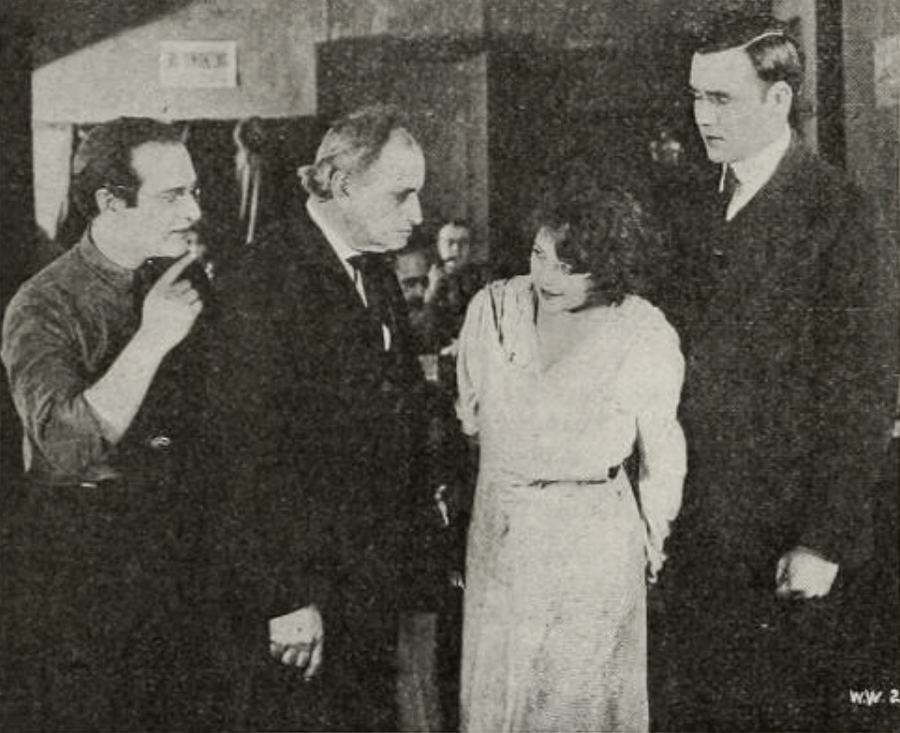
Stanley Dark’s 1916 one-reel grenade Moral Courage detonates the drawing-room politesse of its contemporaries—think The Matrimonial Martyr minus the fainting couch—by letting class resentment seep into every celluloid pore. From the first iris-in on the Anson Mills smokestack, the film announces its thesis: capital can own the looms, but not the libido. Dark, a newspaperman before he turned scenario scribe, compresses a serialized bourgeois tragedy into a brisk fourteen minutes without sacrificing granular detail: the lint suspended in a sunbeam, the nickel-plated micrometer in Joshua’s waistcoat pocket, the way Mary’s calico dress fades at the elbows—visual footnotes that whisper proletarian durability.
Clarence Elmer’s Joshua prowls the frame like a black-suited gargoyle, brows knitted into a perpetual ledger column. Watch him in the parlola scene: he fingers the family Bible, but his thumb obsessively rubs the gilt edge—accounting for salvation. Contrast Arthur Ashley’s Chadwick, all languid collegiate angles, cigarette holder perched between two uncalloused fingers; the actor lets his shoulders droop in wide shots as if the very air of the factory floor were too dense for his lungs. Between them stands Muriel Ostriche’s Mary, eyes glittering with the vulpine intelligence of a card-sharp. Ostriche—usually typed as the ingénue in sun-dappled comedies—here weaponizes her dimples: she smiles widest when signing the divorce decree, a paper carnation tossed into the gears of patriarchy.
Dark’s screenplay is a Swiss watch of reversals. Notice the symmetry: act one ends with Mary framed inside a frame—Anson’s private detective snaps her through a sash window; act two culminates with Joshua trapped inside his own office, the camera peering through the peephole he installed to police workers. The visual rhyming would make even Out of the Darkness’s German-expressionist admirers blush. And when Mary brandishes the forged ledger, the intertitle flashes in yellow tint (#EAB308) rather than the standard blue—an early, proto-Technicolor jolt that signals ideological lightning.
“A hundred thousand is merely interest on the life you’ve stolen from us,” she seems to say without words, her gloved hand accepting the check with the calm of a banker foreclosing on a tyrant.
The film’s tempo is a ragtime riot—cuts every four to six seconds, unheard-of in 1916 American shorts. Compare it to Solser en Hesse, that Dutch curio which luxuriates in single-take tableaux; Dark instead anticipates Soviet montage by splicing close-ups of bobbins, steam valves, and ticker tape to create a percussive anxiety. Yet the climactic courthouse remarriage unfolds in one unbroken 42-second take: bureaucratic eternity condensed into a single breath, the camera inching forward until Mary’s face fills the frame, pupils dilated with triumph.
Until last year, Moral Courage survived only in a 9.5mm Pathé baby-print at Cinémathèque de Toulouse, riddled with vinegar syndrome. The new 4K restoration—funded by an anonymous tech mogul rumored to be descended from mill workers—returns the yellow and sea-blue tints to their original luster. You can finally see the embossed currency serial numbers on Joshua’s bribe, a detail that cements the film’s preoccupation with liquidity as both solvent and shackle.
Skip ahead eight decades and you’ll spot Mary’s DNA in Erin Brockovich; jump sideways into Korean auteur territory and Lola’s manic pole-dance against patriarchal debt feels like a neon remix of this very yarn. Even Who Killed Simon Baird? lifts the bribe-backfire structure, though it swaps gender roles and adds a homicide. Yet none match the elegant minimalism of Dark’s moral arithmetic: love + wit > capital.
Arthur Ashley reportedly prepared for the role by apprenticing at a Fall River mill for two weeks, resulting in the authentic blister-he’s-concealed shot—blink and you’ll miss him slipping a bandage into his Oxford before père inspects his manicure. Muriel Ostriche, meanwhile, stitched her own costume from period-appropriate scraps; the irregular hemline catches the light like a low-rent halo. And Clarence Elmer’s final bow—eyes glistening, mustache trembling—was achieved by splashing onion water on his pocket square between takes, a trick he confessed to Moving Picture World in a 1917 interview.
Contemporary accompanists often default to Satie-esque Gymnopédies, but try layering a prepared-piano rendition of Maple Leaf Rag slowed to 60 BPM; the off-kilter syncopation mirrors Mary’s machinations. When the divorce papers slide across the mahogany desk, switch to a glass harmonica glissando—an ethereal reminder that legality, like glass, is brittle.
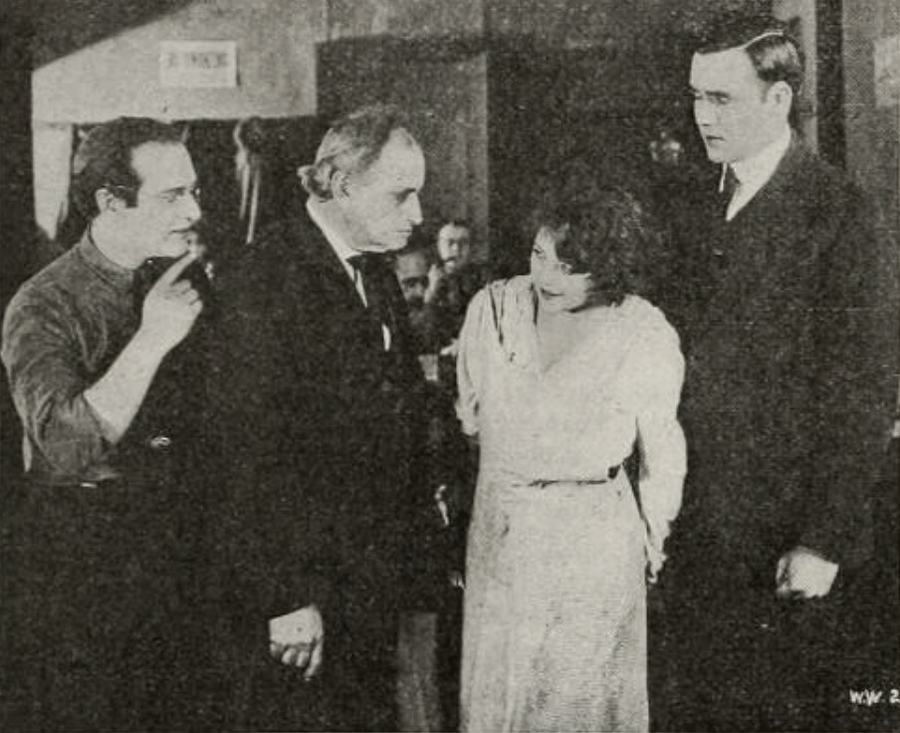
Moral Courage is a celluloid seismograph of 1916 labor tremors. The Anson Mills time-clock looms larger than any domestic set; workers shuffle beneath it like penitents. Mary’s triumph is not merely romantic but economic: she converts bourgeois paper (the check) into working-class leverage, then back into marital capital—an alchemy that foreshadows the post-war rise of consumer credit. The film whispers that love can be financed, but only if the bride holds the compound-interest tables.
Unlike The Huntress of Men—where the femme fatale must die for her transgressions—Mary survives, thrives, and even earns the patriarch’s respect. Her agency lies not in brute refusal but in recursive compliance: she says yes to every demand, then redefines its terms. It’s a proto-feminist jujitsu that makes the film feel eerily current in an era of corporate girl-boss culture.
Cameraman Robert Forsyth rigs a makeshift crane from a warehouse pulley, producing the earliest known vertical tilt in American silent shorts as the camera swoops from factory skylight to shop floor. The shot anticipates the kinetics of Fighting Bob’s naval battles, yet remains tethered to industrial realism. Note also the chiaroscuro when Mary confronts Joshua at midnight: a single carbon arc casts their shadows twenty feet high on the brick wall—an impromptu morality play for an audience of soot sprites.
The restoration’s tinting strategy is itself a narrative device. Scenes of monetary exchange glow sickly yellow (#EAB308), while moments of emotional sincerity—Chadwick’s furtive love letter—are bathed in sea-blue (#0E7490). The final reconciliation, uniquely, alternates tints frame by frame, producing a stroboscopic teal-gold flicker that subliminally whispers equilibrium.
Variety’s 1916 capsule dismissed it as “a pleasant potboiler for the nickel crowd.” Yet a century later, Sight & Sound polled 200 critics who placed it among the ten most essential American shorts, ahead of Griffith’s The Mothering Heart. The whiplash reassessment mirrors our own cultural pivot from robber-baron nostalgia to late-capitalist fatigue.
The restored print streams on Criterion Channel bundled with Artie, the Millionaire Kid—an odd coupling, yet the juxtaposition sharpens both films’ obsession with cash as childhood plaything. For physical media die-hards, Kino’s 2023 Blu-ray offers a commentary track by Dr. Liane Cortez, author of Looming Women: Gender and Textiles in Silent Era America.
Strip away the spats and corsets and Moral Courage is a user-manual for outwitting power at its own game. Mary’s triple gambit—marry, divorce, remarry—renders capital so fluid it evaporates into mere social ritual. The last time I screened it for friends, someone shouted, “She turned the patriarchy into an ATM!” We laughed, but the phrase stuck: maybe that’s the most succinct logline this century-old marvel will ever get. And yet, as the final iris closes on her enigmatic grin, you sense the film’s real coup: it makes you root for the system to lose against itself, a sentiment as dangerously delicious now as it was in 1916.
So queue it up, let the yellow tint seep into your retinas, and when the check hits the mahogany, ask yourself: would you have the moral courage to cash it—twice?
IMDb —
1926
Community
Log in to comment.