DbcultAccessing Vault...
5.9/10
Senior Film Conservator
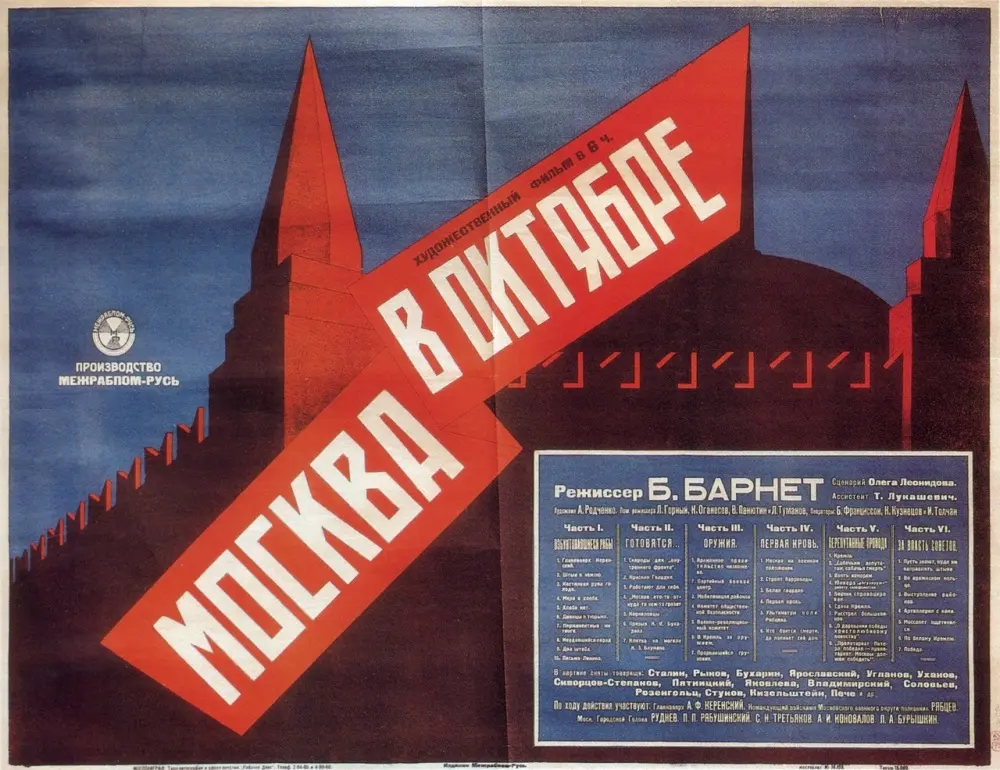
A definitive 5.9/10 rating for a film that redefined the boundaries of cult cinema. Moskva v oktyabre remains a cornerstone of transgressive art.
Is this film worth watching today? Short answer: Yes, but only if you view it as a historical artifact rather than a night of entertainment. This film is for the archival-obsessed and those fascinated by the birth of Soviet montage; it is definitely not for anyone seeking a character-driven narrative or emotional resonance.
1) This film works because it captures the raw, unpolished energy of urban combat without the gloss of modern artifice. 2) This film fails because it prioritizes ideological messaging over individual human stakes, leaving the viewer cold. 3) You should watch it if you want to see the literal blueprints of revolutionary cinema before it became a set of tired tropes.
Moskva v oktyabre is a blunt instrument. Unlike the more celebrated works of the era that sought to find beauty in the revolution, Boris Barnet’s approach here feels almost forensic. The film is a reconstruction of the events following the Bolshevik seizure of government in Petrograd, and it treats the city of Moscow not as a backdrop, but as a combatant. The street fighting sequences are choreographed with a frantic, messy energy that feels surprisingly modern. There is a specific scene where the revolutionary forces approach the Kremlin that lacks the polished rhythm of a Hollywood epic, and that is its greatest strength. It feels dangerous.
The film’s pacing is a strange beast. It oscillates between long, static shots of bureaucratic tension and sudden, violent bursts of movement. This isn't a flaw; it is a reflection of the 1917 experience itself—months of waiting followed by days of world-shattering change. When compared to the domestic sentimentality of something like The Old Nest, the contrast is jarring. While American cinema was perfecting the art of the close-up to evoke sympathy, Barnet was using the wide shot to show the scale of the collective. The individual is erased. The mass is the only hero.
Boris Barnet is often remembered for his later, more lyrical works, but here we see him grappling with the requirements of the state. He was tasked with creating a film for the 10th anniversary of the revolution, and the pressure is visible on the screen. The direction is aggressive. He uses the high-contrast geometry of the Moscow streets to create a sense of entrapment. Every corner feels like a potential ambush. It works. But it’s flawed. The lack of a central protagonist makes it difficult to anchor the viewer's attention for the full duration.
One of the most surprising observations is how Barnet handles the 'White' elements of the army. They aren't just faceless villains; they are depicted with a specific, rigid formality that contrasts with the fluid, chaotic motion of the revolutionaries. This visual storytelling does more to explain the class divide than any of the title cards. It is a mechanical reconstruction of urban warfare that feels more like a military exercise than a movie. It is loud without making a sound.
The cast, including Aleksandr Gromov and Vasili Nikandrov, perform with a stylized intensity that was typical of the period. Nikandrov’s portrayal of Lenin is particularly fascinating. He wasn't a professional actor; he was a worker who happened to look like the leader. His performance is less about acting and more about iconography. He moves like a statue come to life, which adds an eerie, hagiographic quality to the film. It is unsettling to watch today, as it feels less like a performance and more like a ghost inhabiting a role.
In contrast, Boris Barnet’s own appearance in the film brings a spark of vitality. He understands the camera better than his peers, and his presence often provides the only moments of genuine human movement in an otherwise stiff production. If you compare the acting here to the exaggerated melodrama found in The Dawn of Love, you can see the Soviet 'factory' style of acting taking shape—utilitarian, sharp, and devoid of ego.
Moskva v oktyabre is worth watching for anyone interested in the evolution of visual propaganda. It provides a rare look at how the early Soviet state wanted its own birth to be remembered. While it lacks the artistic heights of Eisenstein’s 'October,' it offers a more grounded, perhaps more realistic, depiction of the Moscow uprising. It is a vital piece of the puzzle for understanding 1920s cinema.
The cinematography is the true star of the show. The use of natural light during the street battles creates a documentary-like feel that was ahead of its time. The camera isn't afraid to get low to the ground, putting the viewer in the middle of the barricades. There is a specific shot of the Kremlin walls at night, illuminated by flares, that is hauntingly beautiful despite the film's overall lack of poetic intent. The high-contrast black and white film stock is used to maximize the grit of the urban environment.
This film doesn't care about your feelings. It doesn't want you to cry; it wants you to understand the logistics of a coup. This is a cold, hard look at power. When compared to the atmospheric horror of something like The Wolf Man, the 'horror' here is grounded in reality—the horror of neighbor fighting neighbor in the streets of a crumbling empire. The visual language is one of sharp angles and rapid cuts, a precursor to the action cinema we see today.
Pros:
The film uses authentic locations, giving it a sense of place that studio-bound films like Headin' Home lack. The editing is fast-paced for 1927, keeping the energy high during the battle scenes. It serves as an incredible time capsule of Moscow before decades of reconstruction changed the city's face.
Cons:
The political bias is heavy-handed, which can be exhausting for a modern audience. The geography of the battles is often confusing; it’s hard to tell who is where and why it matters. The lack of individual character arcs makes it difficult to stay emotionally invested in the outcome.
Moskva v oktyabre is a fascinating failure. It succeeds as a technical exercise and a piece of historical myth-making, but it fails as a piece of dramatic cinema. Boris Barnet’s eye for movement is evident, but he is constrained by the rigid requirements of the state. It is a film that demands to be studied rather than enjoyed. If you go in expecting the emotional depth of Another Scandal, you will be disappointed. But if you want to see history written with a sledgehammer, this is the film for you. It is a relic that still has the power to provoke, not through its story, but through its sheer, unrelenting kineticism. It is a blunt, grey, and vital ghost of a movie.

IMDb —
1934
Community
Log in to comment.