DbcultAccessing Vault...
Cult Review
Senior Film Conservator
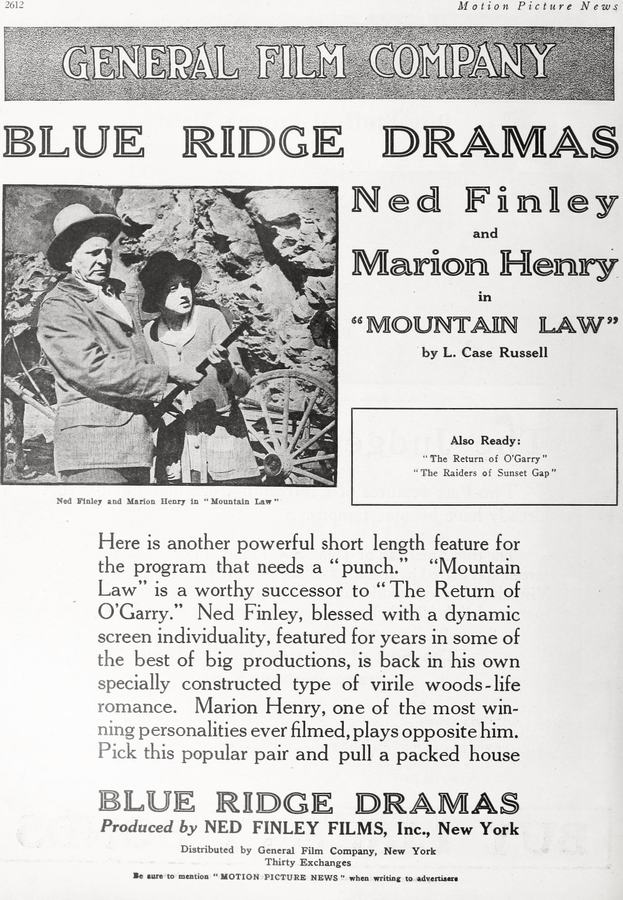
The Blue Ridge Mountains unfurl like crumpled velvet in Mountain Law's opening frames, their beauty belying the rot festering in the valley below. Director Charles M. Seay immediately establishes geography as destiny—the steep, isolating slopes serving as both protector and prison for families locked in a twenty-year feud. We enter this hermetic world through Fannie Bruce (Marion Henry), whose calico dress and stack of primers seem laughably fragile against the towering pines and hardened men. Her arrival in the one-room schoolhouse—its chalk dust an affront to gunpowder—signals the first tremor in the valley’s entrenched ecosystem of violence. Henry plays Fannie not as a naive idealist, but as a woman wielding quiet observation like a scalpel. Watch how her eyes linger on the children’s knuckles, whitened from clutching fathers’ rifles, or how she notes the way Rob Clayton (Ned Finley) positions himself at the schoolhouse window, scanning treelines for threats even during arithmetic lessons.
"The mountains don't forget a killing, Miss Bruce. They breathe it into the soil and grow it back as poison ivy."
- Elias Dancey (Richard Neill)
The film’s pivotal sequence—Rob discovering his father’s corpse—is rendered with harrowing minimalism. No orchestral swells, just the sickening thud of Rob’s knees hitting cabin floorboards, the camera fixed on his trembling hands as they hover over blood-soaked overalls. Cinematographer Harry Hammill makes brilliant use of negative space in the ensuing rampage: Rob’s silhouette filling the Dancey doorway, backlit by lightning as he raises his rifle—a tableau echoing the stark fatalism of Fatal orgullo. What distinguishes this vengeance is its chilling efficiency. Rob doesn’t roar; he dispatches the Danceys with methodical quiet, each gunshot punctuated by the sputter of a dying lantern. This isn’t heat-of-passion murder but the cold execution of inherited obligation, a son becoming the avatar of generational rage.
Fannie’s reformation of Rob begins not with sermons but shared silences. In a daring narrative choice, writer Lillian Case Russell allows their bond to germinate through glances across the schoolroom: Rob cleaning mud from a child’s slate, Fannie noticing how his calloused fingers handle chalk with unexpected delicacy. Their pivotal moment occurs not in embrace but over a botany lesson—Fannie pressing bloodroot petals into a ledger as Rob recognizes the plant that killed his mother (a Dancey poison, we infer). "Some things grow to heal," she murmurs, and Finley’s face undergoes a tectonic shift—grief giving way to dawning horror at the futility of reciprocal destruction.
Marion Henry’s genius lies in what she doesn’t perform. Witness the schoolhouse scene where a Dancey widow spits at her feet—Fannie’s only reaction is a slight tightening of her jaw as she continues writing multiplication tables. Her stillness becomes armor against the valley’s hysteria. Contrast this with Ned Finley’s Rob, whose body seems permanently tensed for violence; even while courting Fannie, his shoulders hunch as if expecting a bullet. The film’s most revolutionary choice? Making Rob’s redemption physically painful. When he finally lays flowers on a Dancey grave, Finley clutches his ribs as though breaking a biological law. This echoes the somatic cost of change explored in Doch Anny Kareninoy, where love demands corporeal sacrifice.
Lillian Case Russell’s script smuggles incendiary ideas beneath period trappings. Consider the scene where Fannie teaches Newton’s Third Law—"For every action, an equal reaction"—and a Clayton boy mutters, "Like when Pa shot Elias Dancey ’cause he kilt Uncle Jed." Fannie doesn’t correct his physics, but asks: "What if the chain snaps?" This moment crystallizes the film’s thesis: that feud logic relies on scientific illiteracy, reducing cause/effect to primitive stimulus-response. Russell implies that mathematical literacy breeds moral complexity—a daring argument in 1915. Her blueprint for peace involves practical collectivism: when both families’ stills are destroyed by revenue agents, Fannie brokers a shared whisky operation, making cooperation lucrative. This materialist approach to conflict resolution anticipates sociological dramas by decades.
Cinematographer Hammill transforms the Blue Ridge into a psychic mirror. Early scenes frame characters through tangled rhododendron branches—nature’s prison bars. After the killings, we get disorienting low-angle shots of cliffs, making the mountains loom like disapproving gods. Most ingeniously, the schoolhouse itself becomes a visual manifesto: its east-facing windows flood morning light onto the children’s faces while the feud-haunted adults remain in shadowed back rows. The film’s chromatic arc moves deliberately: sepia-toned violence giving way to silver-hued frost sequences (the shared blizzard survival), culminating in spring’s tender greens during the reconciliation. This progression from monochrome brutality to polychrome hope shares DNA with Pesn torzhestvuyushchey lyubvi's color symbolism.
The film avoids facile resolutions by demanding visceral losses. When Rob surrenders to federal marshals (for the Dancey killings), it’s not a martyr’s triumph but a hollow-eyed necessity. Fannie’s victory requires sacrificing her lover to the law—a bitter acknowledgement that some wounds can’t be fully healed. The community’s reconciliation manifests through shared labor: Danceys and Claytons rebuilding a bridge swept away by the same storm that nearly starved them all. Russell suggests that peace isn’t an emotion but a verb—hammering nails, sewing quilts for orphaned children, digging communal root cellars. This emphasis on pragmatic reconstruction over sentimental forgiveness gives the finale its grit, avoiding the treacly conclusions of contemporaries like The Waiting Soul.
"You think love papers over bullet holes? It don't. Love just builds new houses over the graves."
- Granny Clayton (Uncredited Matriarch)
Mountain Law occupies fascinating terrain within early rural dramas. Unlike the pastoral romanticism of The Life of a Jackeroo, it presents the wilderness as psychologically claustrophobic—a notion later explored in Niobe. Its treatment of education as radical intervention predates Trilby’s mentorship themes by months. Most remarkably, it rejects the "outsider savior" trope—Fannie fails repeatedly, nearly flees after a burning cross appears, and ultimately succeeds only by weaponizing local traditions (moonshine economics, quilting bees). This distinguishes it from films like Her Great Price, where redemption flows one-way from urban sophisticate to provincial innocent.
Modern viewers might critique the film’s glossing of Indigenous displacement (the "empty" valley was Cherokee land decades prior) or its sidelining of Black Appalachians. Yet within its historical context, the film remains startlingly progressive—particularly Fannie’s quiet dismantling of patriarchal feud logic. When she convinces Clayton and Dancey women to hide the men’s rifles during peace talks, it’s a masterstroke of feminist pragmatism. The closing image—children from both families drawing together in the dirt—avoids saccharine assurance. The camera lingers on a boy tracing a rifle shape beside a girl’s flower sketch; coexistence, not erasure. This ambivalent hope resonates more profoundly than the tidy finales of The Song and the Sergeant, acknowledging that some shadows lengthen even in dawn’s light.
What endures is Russell’s audacious metaphor: that chalkboards might become treaty tables, and spelling bees the training ground for diplomacy. In an era where celluloid often favored spectacle over substance, Mountain Law dared to suggest that the most revolutionary act isn’t drawing a gun—but drawing a map that includes your enemy’s homestead.
IMDb 5.7
1917
Community
Log in to comment.