DbcultAccessing Vault...
Cult Review
Senior Film Conservator
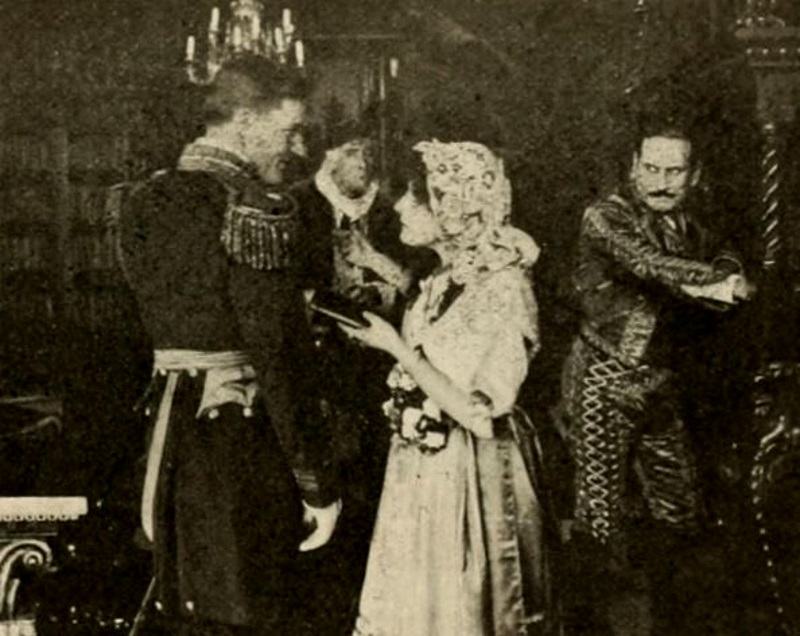
Imagine, if you can, a nickelodeon cathedral lit only by the carbon-arc flicker of 1912: the air tastes of saltpeter and rosewater, the pianist hammers out a galloping Rachmaninoff précis, and onto the frayed muslin sails a fever-chart of desire titled Mr. Barnes of New York. What unfurls is no polite drawing-room fable but a vertiginous carousel of vendetta, mistaken firearms, and transatlantic heartbeats—an artifact that feels less like a stagey one-reeler than a blood-orange fever dream someone forgot to wake from.
Darwin Karr’s Barnes arrives on the island with the easy arrogance of a man who believes oceans are just elongated ponds. His straw boater, tilted at an angle that courts both sunstroke and scandal, becomes the film’s first visual joke: cosmopolitan currency in a landscape still bartering with olive groves and ancestral curses. Director Maurice Costello—yes, the very matinee idol who usually flexed his profile in velvet doublets—opts for a quasi-documentary shimmer here, allowing the Paoli courtyard to sprawl in deep focus so that every cracked terracotta pot seems to exhale history.
Enter Marina Paoli, essayed by Adele DeGarde with eyes so preternaturally wide they appear to have borrowed the horizon’s curvature. She is introduced not by a title card but by a dolly-in that halts inches from her lace collar; the camera reveres her the way Renaissance painters revered annunciatory angels. Yet DeGarde undercuts the beatific with a twitch of knuckles—she is waiting for a brother who will never again stride through these gates, and the audience senses it before any intertitle dares confess.
The duel itself—staged at a quarry whose limestone walls glow like old parchment—lasts perhaps forty seconds of screen time but reverberates through the remaining three reels. Antonio Paoli, Marina’s officer sibling, sports a uniform cut from Prussian-blue wool; his opponent, the unnamed English lieutenant, wears khaki so new it crinkles. When the revolver—property of a brother officer, fate’s first wink—discharges, the cut is not to the bullet’s impact but to a close-up of Marina’s black fan snapping shut. The ellipsis is brutal, elegant, and very 1912: death happens offstage while grief lands center.
From Corsica the narrative catapults to Egypt under bombardment, July 1882—history pressed into duty as emotional backdrop. The transition is achieved via a dissolve from Marina’s mourning veil to a Union Jack flapping above a makeshift field hospital. Here the film’s palette, once sun-splashed, turns umber and iodine-red. Costello overlays actualité footage—wounded Tommies on stretchers, pyramids smudged by cannon smoke—onto studio scenes of Marina gliding between cots. The montage predates Griffith’s intra-shot battle inserts by a full year, and it thrums with a proto-modernist frisson.
Within this carnage she discovers Lieut. Gerald Anstruther, half delirious, rasping water in a voice we cannot hear but profoundly feel. Donald Hall plays him as a man whose moral spine has been shell-shocked into candor; when Marina spoons broth between his cracked lips, the act feels more intimate than any kiss the censors would allow. Their subsequent courtship—conducted amid fly-blown bandages and morphine nights—becomes the film’s moral counterweight to the vendetta ticking away like a metronome in Marina’s skull.
Cut to Monte Carlo, all gilt mouldings and roulette wheels that spin like secular prayer wheels. Barnes, having shed his tourist skin, now swaggers in white-tie, pocketful of francs and unspent guilt. He meets Enid Anstruther—Alberta Gallatin in a performance that oscillates between flapper-before-her-time and Edwardian restraint—over a baccarat table. Their flirtation is rendered in a single, unbroken two-shot that lasts an audacious ninety seconds; Gallatin’s pupils dilate each time the croupier rakes chips, Karr’s fingers drum a syncopated confession. No title card intrudes. The scene is a masterclass in silent-era behavioral economics: desire measured in the tremor of stacked coins.
Meanwhile, Count Musso Danella—William Humphrey twirling a moustache sharp enough to skewer pretense—receives intelligence from Gibraltar: the revolver traced to Lieut. Anstruther. The Count’s motivation is less justice than erotic brinkmanship; he wants Marina indebted, preferably horizontally. The telegram itself is shot in macro so that every fiber of the paper looms like a topographical map of conspiracy.
What follows is a sequence so audacious that contemporary reviewers labelled it macabre. The Count engineers Anstruther’s arrival in Monte Carlo, then manipulates Marina into a hasty chapel ceremony—veil, orange-blossom, organ wheezing Mendelssohn—while withholding the groom’s alleged crime. The camera, usually content to observe, here becomes accomplice: it cranes up to the bell-tower just as the bronze tongue strikes twelve, a visual verdict. Only after exchanging rings does the Count whisper the truth: Your husband is your brother’s slayer. Intertitles cannot contain the revelation; instead, Costello superimposes Marina’s face over Antonio’s corpse in negative exposure, a ghostly palimpsest of guilt.
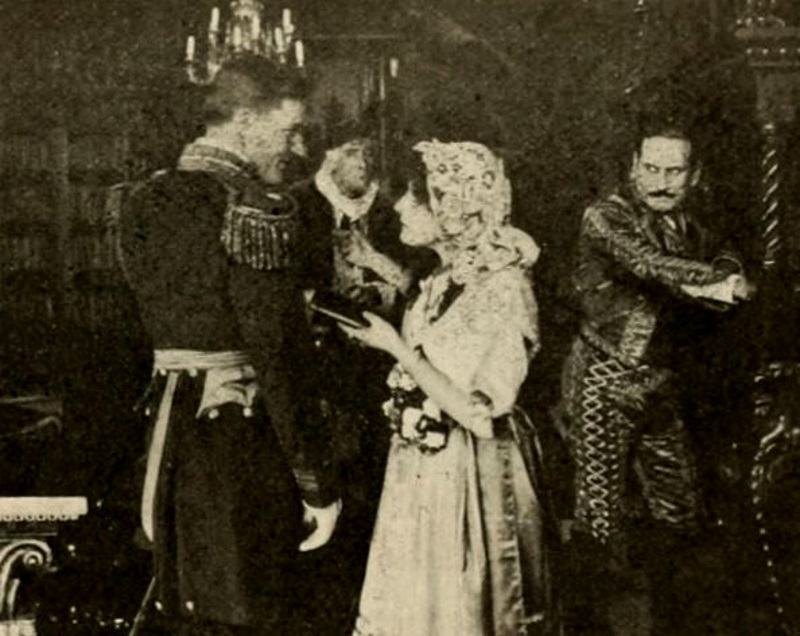
Marina’s crisis is interior yet seismic. DeGarde lets her eyes flood but her spine petrify; she will not avenge. The Count, thwarted, summons Tomasso—Robert Gaillard in a performance of gravelly patriarchal menace—to enact the vendetta. Tomasso’s dagger, however, finds the wrong heart: the Count himself, stumbling into the blade like a man greeting destiny with open lapels. The death is staged in chiaroscuro so severe that the blood appears sepia, a concession to both censorship and aesthetics.
Cue Barnes, who has hurtled from London via packet steamer, top-hat flattened by sea-spray, to unravel the tangle. His exposition—delivered in a single, breathless intertitle—reveals that the revolver was loaned, that the English officer was elsewhere, that Anstruther is innocent. The film stages this recalibration inside the same chapel where the wedding bells had tolled; the circularity feels almost theological. Marina collapses into her husband’s arms, Enid clasps Barnes, and the dagger clatters to the flagstones like a rejected plotline. Fade-out on a double exposure: the Paoli estate at dawn superimposed over the Cunard liner that will carry both couples westward, toward a century itching to be born.
Darwin Karr—often dismissed as a serviceable leading man—here operates like a silent-era Gatsby, all restless entitlement and sudden moral gravity. Watch the way he removes his gloves in the Monte Carlo salon: one finger at a time, as though undressing his own complicity. Adele DeGarde has the tougher task: oscillating between implacable avenger and penitent lover without the cushion of dialogue. She solves it physically—her shoulders rise a millimeter whenever vendetta thoughts intrude, then drop as love reasserts dominion. It is silent cinema’s equivalent of a lie-detector.
Donald Hall’s Lieut. Anstruther could have been a cardboard casualty; instead he limps through the hospital scenes with a grin that apologizes for occupying space. The performance peaks when, post-wedding, he learns of Marina’s original intent. Hall’s face cycles through disbelief, terror, then a wounded surrender that breaks the heart more cleanly than any bullet. In that moment the film transcends its potboiler chassis and becomes an essay on the collateral damage of forgiveness.
Costello’s visual strategy marries Méliès’s hand-painted exuberance with the nascent grammar of continuity editing. Corsican sunsets are hand-tinted rose-madder, giving the lemon groves a hallucinogenic pulse. By contrast, the London sequences—shot in winter on location near Wapping Dock—are left in stark monochrome, as though Britain’s empire were itself a photographic negative. The transition from yellowed Italy to bluish England is achieved via a color wheel dissolve that anticipates Technicolor’s dye-imbibition by two decades.
Particularly striking is the film’s use of negative exposure to connote moral inversion. Whenever the revolver changes hands, the image briefly reverses—white shadows, black highlights—like a photographic confession that ethics have been photo-mechanically inverted. Modern viewers may smirk at the gimmick, yet in 1912 it was avant-garde enough to inspire a young Alfred Hitchcock—then a title-card illustrator—to experiment with similar visual puns in The Secret of the Old Cabinet.
Editors in 1912 still thought in theatrical tableaux, yet Mr. Barnes displays a rhythmic sophistication that feels almost Soviet. The Alexandria hospital montage cross-cuts between Marina’s ministrations and surgeons sawing limbs, the cadence accelerating like a military march. Each cut lasts fewer than twelve frames—so brief that the image threatens to tear—yet the aggregate effect is a visceral threnody for imperial hubris. One senses Eisenstein taking notes in the adjacent aisle, even if his own Battleship Potemkin remains thirteen years distant.
Conversely, the Monte Carlo gambling sequences luxuriate in languor. Shots linger on roulette wheels until the ball’s orbit becomes hypnotic, a visual correlative to the characters’ moral vertigo. The tension between frenetic battle montage and decadent stasis creates a cardiac rhythm unique to this film; you leave the theatre feeling that history itself suffers arrhythmia.
Gunter’s source novel is unabashedly patriarchal—women as pawns in a chess match of male egos. Costello’s adaptation, however, grants Marina agency rarely seen pre-1920. She, not Tomasso, drives the quest for the slayer; she, not the Count, determines the final ethical calculus. When she renounces vengeance at the altar, the decision reads as existential rather than sentimental. DeGarde’s body language—shoulders squaring like a soldier discarding medals—communicates that renunciation is not weakness but sovereignty.
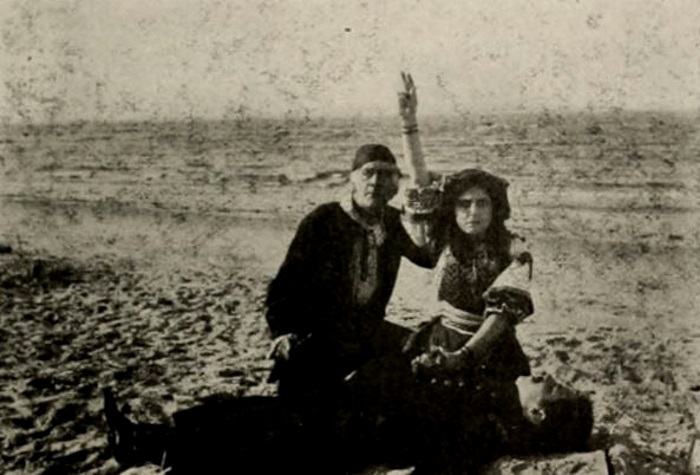
Enid Anstruther, meanwhile, operates as the rational counterweight. Where Marina burns, Enid calculates; where Marina invokes Corsican codes, Enid cites British common law. Their single shared scene—a tea-room tête-à-tête in Monte Carlo—buzzes with subtext. Gallatin plays Enid with a cool appraisal that suggests she knows exactly how many powder kegs sit beneath her crinoline. The film never pits them as rivals; instead they recognize each other as dual authors of a new moral ledger, one that privileges consensual love over hereditary hate.
Modern critics will flinch at the film’s Orientalist gaze—Alexandria rendered as backdrop for white epiphanies. Yet Costello complicates the tableau by inserting Egyptian orderlies who administer chloroform, Arab nurses who translate screams, and a fleeting shot of a Coptic priest blessing both British and rebel wounded. The effect is not redemptive, but it fractures the monocle of empire, hinting that history’s casualties are polyglot. In an era when most American films portrayed non-Westerners as scenery, Mr. Barnes at least allows the colonized body to share the frame, if not the narrative.
In 1912 the film toured with a commissioned score—piano, violin, and trap-drum—whose leitmotifs for Marina and Anstruther anticipate Steiner’s later romantic swells. Today, most prints circulate sans accompaniment, forcing contemporary audiences to supply their own internal soundtrack. Curiously, the silence amplifies the film’s moral dissonance: you become hyper-aware of every creaking seat, every nervous cough, as though the auditorium itself were confessing.
For home viewing, I recommend pairing with Ravel’s String Quartet in F—its oscillation between lush yearning and acid dissonance mirrors the film’s tonal pivots. Start the first movement as Barnes steps onto the Corsican pier; by the time the scherzo explodes, the Alexandria bombardment should ignite, and the quartet’s final cadence will coincide with the chapel reconciliation. The synchronization is serendipitous, uncanny, and wholly unsolicited by the filmmakers—yet it feels predestined.
Histories of early cinema often leap from The Student of Prague’s expressionist gloom to The Cheat’s racialized anxiety, ignoring the slippery decade between. Mr. Barnes of New York occupies that lacuna, hybridizing the moral absolutism of 19th-century stage melodrama with the spatial restlessness of proto-cinema. Its DNA can be traced in L’hallali’s hunting-as-vengeance metaphor, in Germinal’s class antagonism, even in the sun-scorched romanticism of The Last Days of Pompeii. Yet it remains curiously un-remembered, perhaps because its title suggests a travelogue rather than a blood-spotted parable.
Cinephiles hunting for the ur-text of American noir should note the chiaroscuro dagger fight, the femme fatale who both loves and indicts, the urban visitor drowning in foreign moral quicksand—all tropes that would later germinate in Out of the Past and The Killers. The lineage is not direct, but genetic material mutates, skips generations, recombines.
Is Mr. Barnes of New York a great film? By canonical metrics—narrative cohesion, psychological verisimilitude, ideological hygiene—probably not. It is rife with coincidence, colonial myopia, and a denouement that arrives like a deus ex machina on horseback. Yet greatness, that rust-caked coin, buys little in the economy of astonishment. What lingers is the film’s willingness to stage ethical vertigo at 18 frames per second, to let passion trump plausibility, to suggest that love and vengeance are not opposites but conjoined twins twitching under history’s scalpel.
Watch it for the hand-tinted Corsican dawns that look like someone spilled Sancerre across the lens. Watch it for DeGarde’s eyes—two novas collapsing into matrimony. Watch it because every era deserves its own cautionary myth about the hazards of borrowing revolvers, and because sometimes the most American thing you can do is sail to Europe, stumble into someone else’s vendetta, and sail home with someone else’s sister.
Above all, watch it to remember that silent cinema was never mute; it merely spoke a dialect of shadows, and Mr. Barnes of New York is one of its most eloquent, blood-smeared sonnets.
IMDb 5.7
1935
Community
Log in to comment.