DbcultAccessing Vault...
Cult Review
Senior Film Conservator
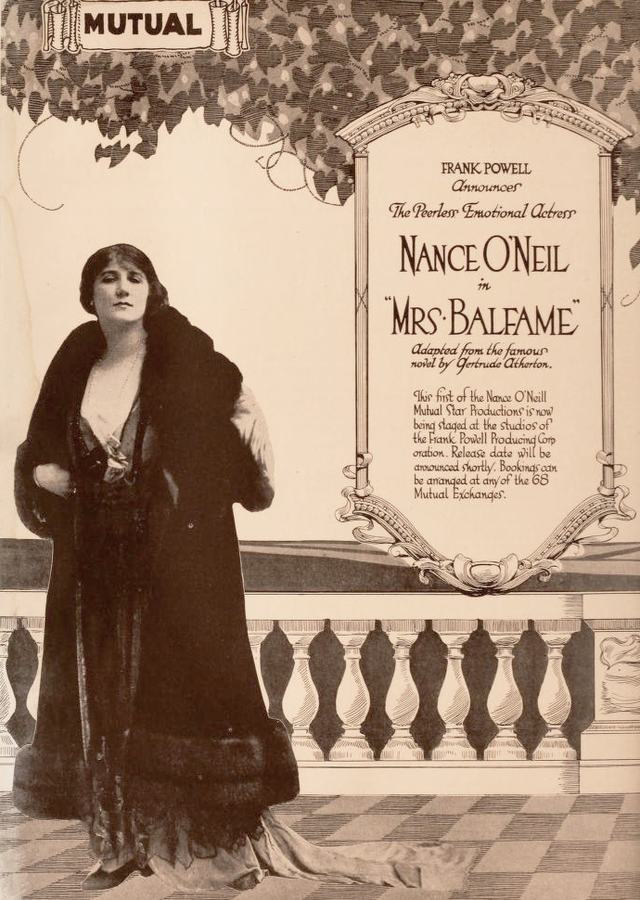
Picture the year 1917: Europe is a charnel house, Woodrow Wilson has just sworn a second oath, and American cinema—still toddling on wobbly aesthetic legs—discovers it can bite as well as coo. Out of that ferment strides Mrs. Balfame, a film whose very title sounds like a polite cough masking a gunshot. What surfaces appears to be a tidy morality tale about a genteel wife and her swinish spouse, yet beneath the perfunctory plot pulses a proto-feminist manifesto soaked in arsenic and lamplight.
The movie opens on Elsinore, a Hudson River hamlet that reeks of lilacs and rot. Gertrude Atherton—novelist, social insurgent, California volcanically transplanted to stuffy Manhattan—knew such towns the way an entomologist knows ant colonies. Together with director Frank Powell (the same Powell who once steered The Clown toward pathos without slapstick), Atherton crafts a matriarch who is equal parts Wharton and Medea. Mrs. Balfame, swaddled in mink stoles and reputational Teflon, floats through charity bazaars while her husband David—equal parts political boss and human distillery—trawls barrooms for fresh enemies.
We first sense the marital abyss during a women’s-club luncheon where Dr. Anna Steuer, a Viennese émigré with cropped hair and eyes like surgical steel, delivers a lecture on wartime widows. “Many of them,” she intones, “sleep more peacefully once the brute is underground.” The line lands like a dropped icepick; every gloved hand claps, yet every mind pictures its own private brute. Atherton’s screenplay, lean as a stiletto, lets that idea fester for exactly twelve minutes of screen time before presenting the antidote: a diminutive vial no longer than a sewing needle, filled with powder that could be mistaken for crushed moonlight.
Enter poison—enter possibility. The film’s visual grammar pivots on close-ups of gloved fingers unscrewing caps, of lemonade’s meniscus trembling beneath poison dust, of Frieda the maid’s saucer eyes reflected in the glass. Powell borrows the syntax of German Expressionism that wouldn’t officially arrive on American shores for another three years: tilted staircases, streetlamps smeared into hieroglyphs, a revolver that gleams like a cold star. The result feels closer to Mysteriet paa Duncan Slot than to any domestic melodrama of its day.
But the murder, when it arrives, is anything but clinical. David, fresh from insulting Dutchmen and dancing girls, staggers homeward through a night as thick as molasses. A shot cracks; a body folds like bad origami; and the poison—our Chekhovian vial—never meets the husband’s lips. Instead Mrs. Balfame finds herself booked for a crime she plotted yet did not commit, a paradox that the film savors with almost sadistic delight.
“To scheme is human; to be foiled, divine; to be punished for the scheme rather than the act—American.”
The trial sequence, devouring the film’s final two reels, is a carnival of hypocrisy. Prosecutors wave the unrinsed tumbler like the Holy Grail; Frieda’s testimony drips with class resentment; and Conrad, the saloonkeeper’s son, becomes the Greek chorus of wounded masculinity. Dwight Rush—played by the velvet-voiced Alfred Hickman—defends his lady with briefs steeped in chivalric sap. Yet even he cannot ignore the slow dawning that his paragon is more glacier than Madonna.
In a bravura flourish, Powell stages Dr. Steuer’s deathbed confession as a shadow play: the doctor’s profile projected against a hospital screen, her words emerging as intertitles that flicker like Morse code. She fired the bullet, she says, because “friendship is the only country worth treason.” The moment is quietly seismic; it relocates the film’s moral center from wife to friend, from heterosexual contract to homosocial covenant—an audacious swap for 1917.
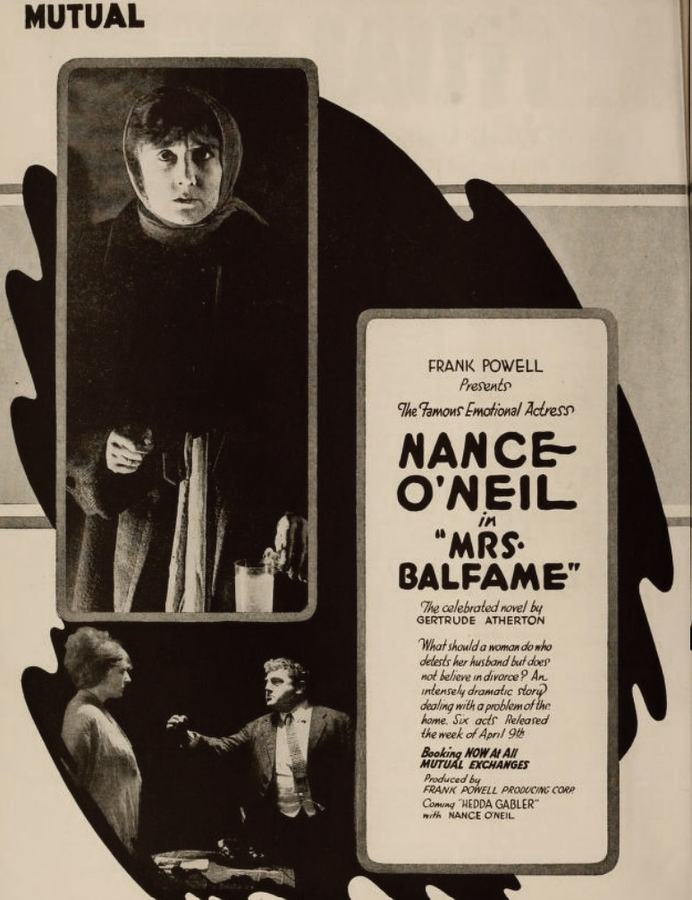
At the epicenter stands Nance O’Neil—a tragedian once compared to Sarah Bernhardt by reviewers who had clearly never seen Bernhardt. O’Neil’s Mrs. Balfame is a study in glacial composure: eyes half-lidded as if perpetually calculating cubic centimeters of poison. When she finally breaks, the fracture is microscopic—a single tear caught in the sprocket holes, never permitted to fall.
Agnes Ayres, years before she romanced Valentino in The Sheik, essays Alys Crumley with a nervous vibrato. Watch her fingers worry a paintbrush during the courtroom scenes, each stroke a silent sonnet of jealousy. As Dwight Rush, Hickman supplies the film’s only warmth, yet even he lets devotion calcify into possession, a transformation the actor signals by hardening his once-soft baritone into legalistic staccato.
Special mention must go to Anna Raines’s Frieda, the maid whose spectacles betray a mind ticking faster than her station allows. In a film obsessed with façades, Frieda alone sees through them, and Raines plays her like Cassandra trapped downstairs.
Shot in and around the old Biograph studios on 11th Avenue, Mrs. Balfame exploits minimal sets for maximal unease. Powell and cinematographer Aubrey Beattie bathe interiors in umber pools, letting kerosene lamps carve caverns of shadow beneath characters’ cheekbones. Note the moment Mrs. Balfame descends her staircase: the banister casts a zebra pattern across her dress, presaging the prison bars she will soon inhabit.
Outdoor footage—winter gardens, Hudson River bluffs—was captured on bleary weekends when the company could bribe railway men for passage north. The resulting grainy tableaux feel documentary, as though fate itself were filming on the sly.
Viewed today, the film vibrates with uncanny contemporaneity. Replace poison with succinylcholine, replace revolver with Glock, and you have a headline ripped from any true-crime podcast. Atherton’s thesis—that marriage can domesticate a woman into a co-conspirator against her own soul—remains sadly au courant. When Dr. Steuer rails against “beasts who make war possible,” one hears an echo of #MeToo courtroom battles where survivors must launder their rage into palatable testimony.
Yet the film refuses easy hashtag catharsis. Mrs. Balfame is neither unblemished victim nor triumphant avenger; she is, like most humans, an unreliable alloy of grievance and grace. Her final act—sending Rush to Alys—reads less as self-sacrifice than as abdication from narratives that demand women be either sainted or condemned.
As of 2024, no pristine 4K restoration exists; the surviving 35 mm print resides in the Library of Congress, viewable by appointment and accompanied by a jaunty piano score that undercuts the doom. A murky DVD-R circulates among silent-film forums, transferred from a 1970s acetate and marred by vinegar syndrome blooming like lavender mold.
For tonal cousins, seek Ambition—another Powell dissection of social scalpel-work—or The Deep Purple, where domestic claustrophobia likewise mutates into crime. If you crave European flavor, Monsieur Lecoq offers a Gallic twist on the poison motif, while Danish chiller Mysteriet paa Duncan Slot proves that Scandinavians cornered the market on moral frostbite long before noir.
Mrs. Balfame is less a museum relic than a stick of dynamite with a century-long fuse. Its sexual politics detonate in the mind long after the final intertitle. O’Neil’s performance, Powell’s chiaroscuro, Atherton’s serrated prose—all conspire to ask whether justice and legality share any DNA at all. The answer, like the lemonade in the tumbler, remains clouded, unsettled, and potentially lethal.
Seek it out, but sip carefully.
IMDb —
1918
Community
Log in to comment.