DbcultAccessing Vault...
Cult Review
Senior Film Conservator
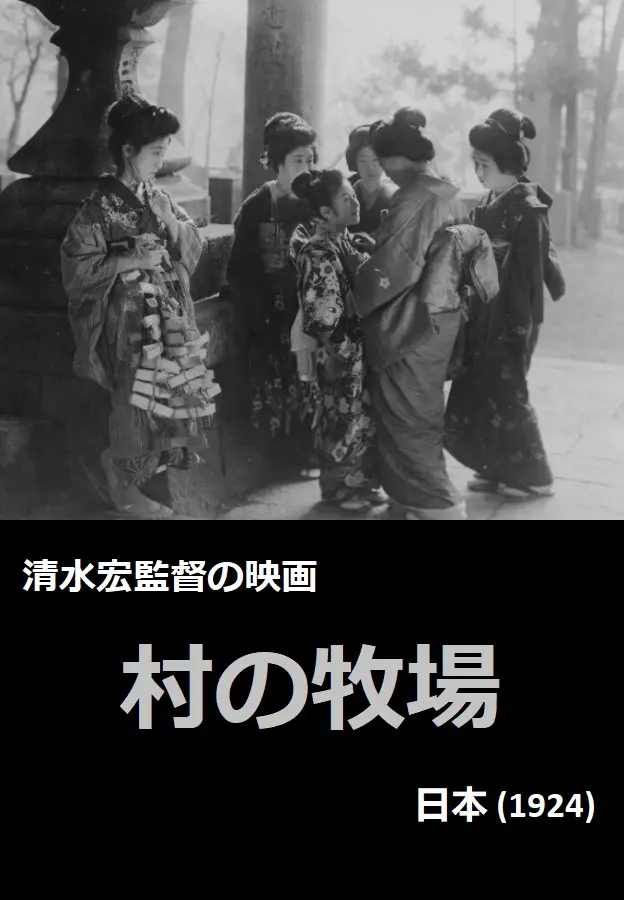
The year 1924 marks a pivotal intersection in the history of Japanese cinema, a moment when the medium began to shed its theatrical skin—the residue of Kabuki and Shinpa—to embrace a more intrinsically cinematic language. At the heart of this metamorphosis lies Mura no bokujô, a film that resonates through the decades not merely as a historical artifact, but as a living, breathing exercise in pastoral poetics. Directed by the often-underappreciated Hôtei Nomura, this work serves as the cradle for one of the most significant careers in world cinema: the debut of Kinuyo Tanaka.
Nomura’s lens captures the village ranch with a degree of tactile intimacy that was rare for its era. While Western contemporaries like Bull Arizona - The Legacy of the Prairie were mythologizing the rugged, lawless expanse of the American frontier, Mura no bokujô turns inward. It treats the ranch not as a stage for adventure, but as a crucible of labor and legacy. The cinematography, though limited by the technology of the mid-twenties, utilizes natural light to create a chiaroscuro effect that highlights the weathered faces of the cast, including Masaharu Tanaka and Soichi Kunijima.
The film eschews the grandiosity found in epic silent narratives like Armenia, the Cradle of Humanity under the Shadow of Mount Ararat. Instead, it finds its grandeur in the mundane. The way the wind ripples through the high grass, the heavy silence of the stables, and the deliberate movements of the workers all contribute to a sense of 'mono no aware'—a pathos for the ephemeral nature of things. This is a film where the landscape is a primary protagonist, exerting a gravitational pull on the humans who inhabit it.
To watch Mura no bokujô today is to witness the birth of a titan. Kinuyo Tanaka, who would later become the muse of Mizoguchi and a formidable director in her own right, possesses even here a preternatural screen presence. Unlike the exaggerated performances often seen in silent comedies like A Pair of Sixes or the slapstick energy of Le peripezie dell'emulo di Fortunello e compagni, Tanaka’s performance is one of startling restraint. Her eyes convey a depth of internal conflict that the intertitles barely need to augment.
She portrays a character caught in the crosswinds of expectation. In the 1920s, the "Modern Girl" (moga) phenomenon was beginning to stir in urban centers, but in the village ranch of Nomura’s vision, tradition remains the dominant currency. Tanaka’s character isn't the rebellious spirit seen in Don't Call Me Little Girl; rather, she is a figure of quiet endurance, representing the millions of Japanese women whose lives were defined by the boundaries of the family unit. This role set the template for the resilient, suffering heroines she would perfect over the next four decades.
Nomura, working from a script he also had a hand in shaping, displays a sophisticated understanding of pacing. The film does not rely on the frantic editing of a crime thriller like Fantomas - On the Stroke of Nine. Instead, it adopts a circular, seasonal structure. This choice mirrors the life on a ranch, where time is not a linear progression toward a climax but a repetitive cycle of birth, growth, and harvest. This inherent rhythm provides the film with a hypnotic quality, drawing the viewer into the slow-burn drama of the Tanaka and Kunijima families.
The conflict arises from the subtle shifts in these families' fortunes. There is a palpable tension regarding the future of the ranch—a theme that echoes through later Japanese cinema. It asks: what happens to the soul of a nation when its agrarian roots are severed? While a film like Pure Grit might resolve its tensions through a display of physical prowess, Mura no bokujô resolves them through emotional negotiation and the acceptance of one’s place in the social hierarchy.
In the broader context of 1924, Mura no bokujô stands as a counterpoint to the escapist entertainment flooding global markets. While audiences in the West were distracted by the urban antics of Call a Taxi or the high-society whimsy of June Madness, Nomura was documenting the grit of the Japanese countryside. There is a sociological honesty here that predates the neorealist movements of the post-war era. The film doesn't shy away from the economic pressures facing the ranch, illustrating the precariousness of rural life without descending into melodrama.
The interactions between Yasuro Shiga and Reikichi Kawamura provide a window into the patriarchal structures of the time. Their performances are grounded in a realism that contrasts sharply with the heightened theatricality of Michael Strogoff. In Nomura’s world, the stakes are not the fate of an empire, but the survival of a household. This micro-focus allows for a much deeper exploration of character psychology, as every gesture and every shared meal becomes weighted with significance.
Hôtei Nomura’s direction is characterized by a remarkable sense of spatial awareness. He uses the depth of field to place characters within their environment, often framing them through doorways or against the vast backdrop of the grazing lands. This technique emphasizes their connection to the land while simultaneously highlighting their isolation. It is a visual strategy far more sophisticated than the straightforward staging found in episodic works like Beatrice Fairfax Episode 9: Outside the Law.
Furthermore, the film’s use of intertitles is sparse and poetic, allowing the visual storytelling to carry the emotional weight. This "pure film" approach was a hallmark of the Shochiku Kamata studio's style, which sought to distance itself from the explanatory nature of the Benshi (live narrators). By forcing the audience to read the emotions on the actors' faces, Nomura creates a more immersive and empathetic experience. Even in moments of levity, such as those that might appear in Monty Works the Wires, there is an underlying gravity in Mura no bokujô that reminds us of the fragility of the characters' peace.
The tragedy of silent cinema is the loss of so many foundational works. Mura no bokujô is a precious survivor that offers a window into a vanished world. It captures a specific moment in Japanese history—the Taisho era—when the country was suspended between its feudal past and its industrial future. The film’s preoccupation with the ranch is a metaphor for the nation itself: a place of nurturing and growth, but also one of enclosure and strict boundaries.
When comparing this film to the romanticized struggles of Her Moment or the moral dilemmas of What Love Will Do, the authenticity of Nomura’s work becomes even more apparent. It doesn't offer easy answers or Hollywood endings. Instead, it offers a slice of life, raw and unadorned. The final frames of the film, much like the beginning, emphasize the continuity of the land. The ranch remains, indifferent to the personal dramas of those who toil upon it.
In the final estimation, Mura no bokujô is an essential text for any serious student of cinema. It is the point of origin for Kinuyo Tanaka’s legendary path and a testament to Hôtei Nomura’s ability to find the universal in the particular. It is a film of quiet power, a pastoral elegy that continues to bloom in the mind long after the final fade to black. It demands our attention not just for what it represents historically, but for the profound, silent humanity it radiates.
IMDb —
1925
Community
Log in to comment.