DbcultAccessing Vault...
Cult Review
Senior Film Conservator
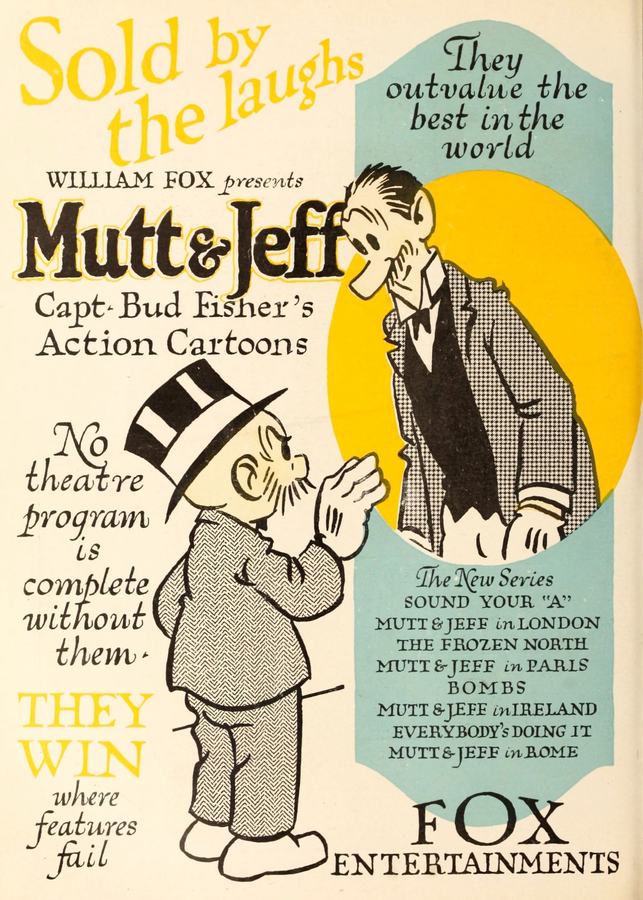
In the annals of early cinema, few duos captured the public imagination with the same anarchic glee as Mutt and Jeff. Born from the ink-stained pages of Bud Fisher's pioneering comic strip, their transition to the silver screen marked a significant moment in the evolution of animated and live-action comedy. Mutt and Jeff in Paris, a delightful romp through the City of Lights, stands as a testament to their enduring appeal and the burgeoning possibilities of cinematic humor in its nascent stages. This isn't just a film; it's a historical artifact, a vibrant snapshot of a bygone era's comedic sensibilities, delivered with a kinetic energy that still resonates today.
The premise is deceptively simple, yet brilliantly effective: transplant two distinctly American archetypes, the tall, perpetually scheming Mutt and his shorter, more impulsive sidekick Jeff, into the sophisticated, often bewildering, milieu of Parisian culture. The ensuing clash is less a gentle collision and more a spectacular detonation of cultural misunderstandings and slapstick chaos. Bud Fisher, credited as both writer and appearing as himself, masterfully leverages the inherent comedic potential of this fish-out-of-water scenario, allowing the characters' established personalities to ignite a series of uproarious situations against the backdrop of one of the world's most romantic cities.
Our intrepid protagonists arrive in Paris with an audacious, if entirely impractical, mission: to inject American-style 'efficiency' into the very heart of Parisian café culture. This ambition, born of a typically American can-do spirit utterly unburdened by cultural sensitivity, sets the stage for a series of escalating comedic disasters. Jeff, with his characteristic impulsiveness, is immediately entranced by a flamboyant street artist, convinced he possesses the innate talent to replicate the painter's artistry. His subsequent attempts, a whirlwind of flailing limbs and accidental splatters, are a visual symphony of incompetence, a delightful counterpoint to the city's artistic gravitas.
Mutt, ever the 'brains' of the operation, endeavours to secure a prime café location, his negotiations a hilarious pantomime of misconstrued gestures and linguistic blunders. The beauty of Fisher's writing, even without spoken dialogue, lies in its ability to convey the sheer absurdity of these interactions. His characters speak a universal language of exaggerated facial expressions and frantic body language. Their attempts to 'streamline' a bustling bistro quickly devolve into a catastrophic ballet of spilled wine, flying pastries, and increasingly exasperated patrons. The scene is a masterclass in escalating chaos, a finely tuned engine of destruction that leaves the café in utter disarray and a bewildered gendarme scratching his head.
A twist of fate, involving a misplaced top hat and a pilfered invitation, propels them into the upper echelons of Parisian society, where they are mistakenly identified as eccentric American millionaires. This accidental infiltration provides fertile ground for further comedic exploits, as they navigate the unfamiliar world of high-society soirées with their customary lack of grace. The ensuing chase across Paris, from the iconic iron lattice of the Eiffel Tower to the hallowed galleries of the Louvre, is a testament to the film's kinetic energy. It’s a breathless pursuit, punctuated by narrow escapes and accidental encounters, all while a tenacious waiter, a symbol of their mounting debt, hounds their every step.
The climax is a glorious crescendo of mayhem, as Mutt and Jeff's 'efficiency' contraptions, intended to revolutionize Parisian life, instead wreak havoc upon a haute couture fashion show. Elegant gowns become entangled, models are sent sprawling, and the world of high fashion is reduced to a chaotic, uproarious spectacle. It’s a fitting end to their Parisian adventure, leaving a trail of glorious pandemonium and, perhaps, a tiny, unintended spark of American-style expediency in the heart of the City of Lights. The narrative, though episodic, maintains a relentless comedic drive, each scene building upon the last in a symphony of escalating absurdity.
Bud Fisher's influence on early 20th-century entertainment cannot be overstated. As the creator of Mutt and Jeff, he pioneered the daily comic strip format, establishing characters whose personalities were instantly recognizable and universally loved. Bringing them to the screen, whether through animation or live-action portrayals, was a natural progression. In Mutt and Jeff in Paris, Fisher's genius lies in understanding the visual language of silent film. The comedy is rarely subtle; it relies on broad physical gags, exaggerated reactions, and the universal humor of cultural clash. This isn't a film that demands deep introspection, but rather an unrestrained embrace of pure, unadulterated fun.
The performances, particularly by those embodying Mutt and Jeff (likely Fisher himself or actors carefully coached to mimic the strip's distinct physicality), are a masterclass in silent-era comedic timing. Every gesture, every wide-eyed stare, every frantic dash is precisely calibrated for maximum comedic effect. There's an inherent charm in the simplicity of their motivations – usually, a desire for easy money or an easier life – that makes their inevitable failures all the more endearing. Their resilience in the face of constant setbacks is part of their enduring appeal, a testament to the human spirit's capacity for boundless, if often misguided, optimism.
To fully appreciate Mutt and Jeff in Paris, it's essential to place it within the broader landscape of early silent cinema. While it might lack the intricate narrative depth of later dramatic features like The Moth or the suspenseful tension of The Black Envelope, its strengths lie squarely in its comedic innovation. This film belongs to a lineage of visual humor that would pave the way for iconic figures like Charlie Chaplin and Buster Keaton, demonstrating how much could be conveyed without a single spoken word.
Compared to the more straightforward action of something like The Phantom Buccaneer or the earnest simplicity of Wee Lady Betty, Mutt and Jeff in Paris opts for a relentless pace of gags and escalating situations. It's less concerned with intricate character development or profound social commentary and more focused on delivering consistent laughs. This isn't to say it lacks depth, but its depth is found in its joyous embrace of human foibles and the universal humor of misunderstanding.
The visual storytelling is remarkably adept for its time. The use of iconic Parisian landmarks isn't just scenic backdrop; they become active participants in the chase sequences and comedic set pieces. The film, despite its age, possesses a vibrant energy that can still captivate a modern audience, particularly those with an appreciation for the foundational elements of cinematic comedy. It represents a period where filmmakers were still discovering the grammar of their new medium, and Fisher, with Mutt and Jeff, was certainly among the most articulate.
What makes Mutt and Jeff in Paris, and indeed the entire Mutt and Jeff oeuvre, so enduring? It’s arguably their universal relatability. Who hasn't, at some point, felt like a fish out of water, struggling to navigate unfamiliar customs or communicate across a language barrier? Their perpetual optimism, even in the face of utter failure, is a charming, almost aspirational quality. They are the everymen of early 20th-century America, transplanted into grand adventures, always with their hearts in the right place, even if their methods are utterly chaotic.
While other films like The Commuters or Die blaue Laterne might offer more serious social commentary or dramatic narratives, Mutt and Jeff in Paris offers something equally valuable: pure, unadulterated escapism and laughter. It reminds us of a time when cinema was still a novelty, a magical flickering of images designed to transport audiences to new places and elicit genuine joy. The simplicity of its humor belies the sophistication of its execution, particularly in how it leverages the visual medium.
The film's pacing is brisk, a series of rapid-fire gags that keep the audience engaged. There's no fat on this comedic bone; every scene serves to advance the escalating chaos or highlight another cultural misunderstanding. This economical storytelling, a hallmark of early silent comedies, ensures that the energy never flags. Even without the benefit of sound, the film’s narrative clarity is remarkable, a testament to Fisher's understanding of visual communication.
In an era where films like He Leads, Others Follow might explore themes of leadership and hierarchy, Mutt and Jeff subvert such notions with their brand of accidental leadership and perpetual followership. They are not heroes in the traditional sense, but rather lovable rogues whose primary goal is often self-preservation or personal gain, which invariably leads to broader societal disruption. Their dynamic, with Mutt as the often-foiled planner and Jeff as the impulsive catalyst, is a timeless comedic pairing that continues to influence character dynamics in popular culture.
The sheer inventiveness of the gags, even by today's standards, is commendable. From the domino effect in the café to the fashion show debacle, the film employs physical comedy with a precision that belies its early production date. It’s a joyous celebration of slapstick, executed with a clear understanding of what makes audiences laugh. The film doesn't attempt to be anything more than what it is: a hilarious, energetic, and utterly charming silent comedy that perfectly encapsulates the spirit of its beloved comic strip source material.
Mutt and Jeff in Paris is more than just a relic of early cinema; it's a vibrant, laugh-out-loud experience that showcases the foundational elements of visual comedy. It’s a delightful journey back in time, offering a glimpse into the innocent yet ingenious humor that captivated audiences a century ago. Bud Fisher's vision, brought to life on screen, ensures that these two iconic characters continue to entertain and remind us of the simple pleasures of a well-executed gag and the universal hilarity of cultural collision.
While it might not possess the dramatic weight of films like Paying the Price or the adventurous scope of Speedy Meade, its contribution to the comedic landscape is undeniable. It's a film that asks nothing more than for you to sit back, suspend disbelief, and revel in the sheer joy of two lovable fools causing delightful havoc in one of the world's most beautiful cities. It’s a testament to the enduring power of simple, effective storytelling and the timeless appeal of a good laugh. A must-see for anyone interested in the origins of screen comedy and the pioneering spirit of early filmmakers.
IMDb —
1923
Community
Log in to comment.