DbcultAccessing Vault...
Cult Review
Senior Film Conservator
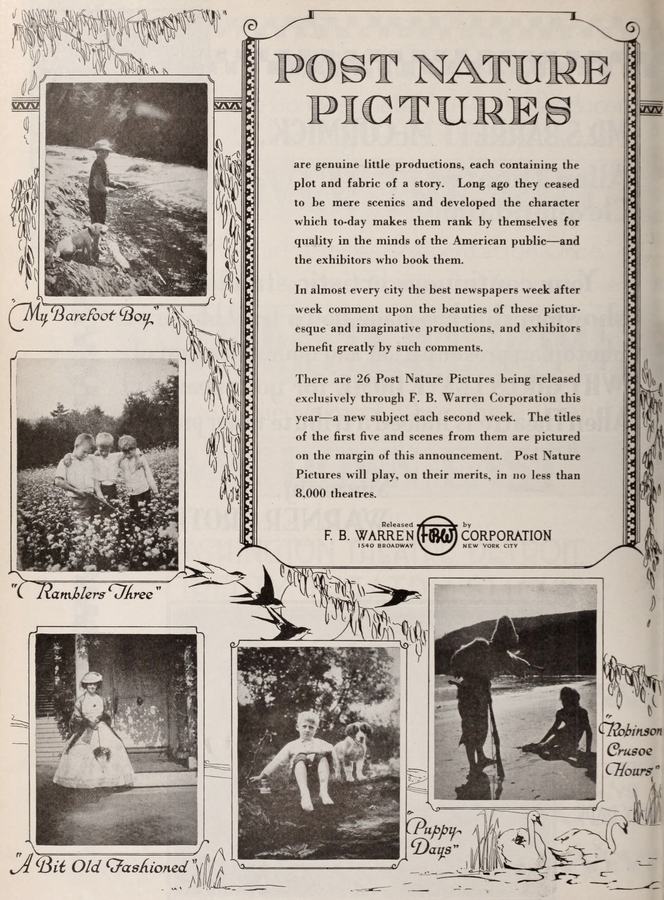
My Barefoot Boy (1924) is a relic of cinematic history that, despite its age, pulses with a timeless urgency. Directed by Clyde E. Elliott, this silent film emerges as a hauntingly beautiful exploration of the human condition, rendered through the lens of a young man’s unyielding struggle against the socioeconomic tides of his time. The film’s title alone—a phrase that evokes both vulnerability and defiance—sets the tone for a narrative steeped in the raw, unvarnished realities of early 20th-century America. This is not a story of heroes and villains but of survival, a testament to the quiet courage of the forgotten.
At its core, My Barefoot Boy is a film of contrasts. The protagonist, a child whose feet bear the scars of poverty and perseverance, is introduced in a sequence that mirrors the film’s central motif: the earth as both adversary and ally. His bare feet, calloused and weathered, are not merely a physical detail but a symbol of his existence—rooted in the soil, unshod by the comforts of modernity. Elliott’s direction is meticulous in this regard; every frame is composed with the precision of a painter, ensuring that the boy’s journey is as much an aesthetic experience as an emotional one. The cinematography, bathed in the amber glow of dawn and the indigo hues of twilight, transforms the boy’s hardships into a visual symphony of resilience.
What sets My Barefoot Boy apart from its contemporaries is its refusal to sanitize poverty. Unlike Shoes (1916), which similarly addresses the plight of underprivileged youth, Elliott’s film does not offer redemptive arcs or neatly resolved conflicts. Instead, it lingers in the ambiguity of human struggle, allowing the audience to grapple with the uncomfortable truth that survival is often a matter of circumstance rather than merit. The film’s script, penned by an anonymous hand, is a masterclass in subtlety. Dialogue is minimal, replaced by the language of the body—the hitch in the boy’s breath, the tremor in his hands, the way his gaze lingers on a loaf of bread in a market stall. These moments, rendered with the precision of a poet, are the film’s true narrative engine.
The visual style of My Barefoot Boy is a revelation. Elliott employs a restricted color palette—earth tones, muted grays, and the occasional flash of a child’s red coat—to evoke a world where color is a commodity, not a given. This choice, coupled with the film’s use of long takes and natural lighting, creates an almost documentary-like authenticity. The boy’s interactions with the environment are particularly striking: his feet pressing into muddy fields, his hands tracing the bark of a tree, his shadow merging with the horizon. These images are less about illustrating a story than about embodying an emotion, a technique that owes a debt to the German Expressionist school while remaining wholly distinct in its execution.
One sequence that lingers in the mind is the boy’s encounter with a river. The water, clear and indifferent, reflects his face in a way that is both literal and metaphorical. Here, Elliott’s use of reflection becomes a visual metaphor for the boy’s duality: a child in body but a man in spirit. The scene is devoid of dialogue, yet the emotional impact is profound. This is the power of My Barefoot Boy—its ability to convey complex narratives without uttering a single word.
When placed alongside other films of the era, My Barefoot Boy occupies a unique niche. While The Melting Pot (1914) grapples with national identity and True Nobility (1922) explores class divides, Elliott’s film is singular in its focus on the individual. It shares thematic DNA with Sally’s Blighted Career (1921), another work about societal pressures, but diverges in its unflinching portrayal of poverty as a persistent, inescapable force. The film’s influence can be glimpsed in later works such as Below the Surface (1937), which similarly mines the human condition for its raw, unvarnished truths.
What is most remarkable about My Barefoot Boy is its prescience. The film’s themes of economic struggle and resilience anticipate the narratives of the Great Depression, even though it predates them by a decade. In this sense, it is both a product of its time and a harbinger of the future. The boy’s journey—his moments of despair, his fleeting triumphs—is a mirror for the collective experience of a generation on the brink of upheaval.
For modern audiences, My Barefoot Boy is a reminder of cinema’s power to transcend time. Its silent language speaks volumes, its images etch themselves into the memory like the lines on the boy’s face. This is a film that demands to be seen not just in the dim glow of a projector but in the context of its own historical moment—a time when the world was changing, and the camera became a tool to capture both its beauty and its brutality. To watch My Barefoot Boy is to witness the birth of a cinematic language that continues to evolve, echoing through the decades in the work of filmmakers who still seek to give voice to the voiceless.
In an era saturated with digital spectacle, My Barefoot Boy stands as a quiet, unassuming monument to the power of simplicity. It is a film that does not need to shout to be heard, does not need to dazzle to leave an impression. Its strength lies in its restraint, in its ability to find poetry in the mundane and meaning in the marginalized. For those willing to listen—and to look—this film offers a profound, unadorned truth about what it means to be human, barefoot and unyielding, in a world that often forgets its most vulnerable.
IMDb 5.7
1935
Community
Log in to comment.