DbcultAccessing Vault...
Cult Review
Senior Film Conservator
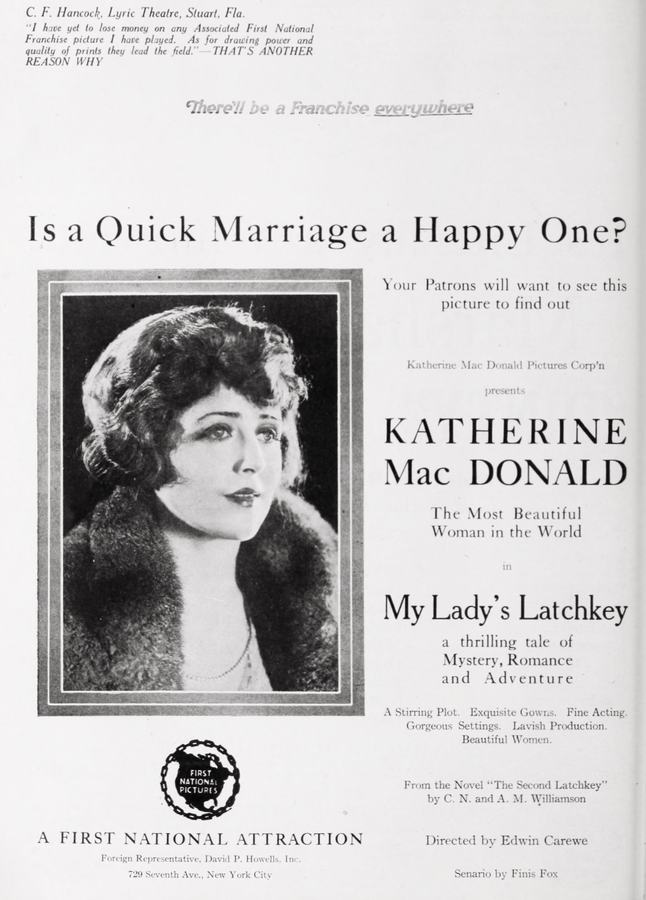
The first time I saw My Lady's Latchkey—a battered 16 mm print flecked with nitrate eczema—I understood why the word luminous was invented. Lenore Lynard doesn’t merely occupy the frame; she irradiates it, a pallid flame against the carbide gloom of early ’20s cinematography. Director J. Charles Haydon, best remembered for ecclesiastical one-reelers, here pivots to the boudoir politics of the Riviera, and the whiplash is delicious.
Williamson & Williamson’s source novel—serialized in Ladies' Home Journal months before the Armistice—was a trench-coat of a book: respectable on the outside, contraband within. Finis Fox’s screenplay prunes the epistolary fat yet keeps the moral switchbacks intact. Notice how the diamond never appears in close-up until the 58-minute mark; prior to that it exists only as rumor, a MacGuffin shimmering in chandelier refraction. The restraint feels almost modern, closer to Lang’s Spiel von Liebe und Tod than to the nickelodeon melodramas of 1917.
Lynard’s Annesley is a masterclass in under-acting. Watch her pupils dilate when she palpates the diamond through baize and beaver—an infinitesimal flutter that sells the entire third-act reversal. Contrast this with Katherine MacDonald’s Countess Soranzo, who enters each scene as though propelled by a cyclone of ostrich feathers and Chypre. The tonal dissonance should sink the film, yet it mirrors the class schism at the story’s heart: old-world profligacy colliding with nouveau-whatever desperation.
Cinematographer Allen G. Siegler shot the picture avant the German influence hit Hollywood, so the chiaroscuro is organic, not forced. Ballroom sequences drown in topaz haze; the subsequent alleyway chase is lit by a single handheld lantern whose swing turns brickwork into a zoetrope. Color tinting—amber for interiors, sea-blue for exteriors—heightens the emotional transposition. When Annesley hurls the diamond into the Mediterranean, Haydon cuts to an underwater shot tinted cyan, the gem spiraling like a fallen star. For 1921, that’s avant-garde bordering on surrealist bravura.
Most silent crime romances front-load intertitles with Victorian moralizing. Fox’s cards instead function like snare hits: brief, syncopated, sardonic. When Annesley writes “I marry a lie to escape a life of littleness,” the text slams onto the screen over a freeze-frame of her wax-sealed lips—an audacious breach of continuity that anticipates Soviet montage. The expository economy (78 cards across 72 minutes) lets the visuals carry the psychological freight.
On paper the film punishes its heroine for marital insubordination—she covers up grand larceny, after all. Yet the camera undercuts patriarchal justice at every turn. Notice how Howard Gaye’s husband character is repeatedly framed in doorways, hemmed in by lintels that resemble prison bars. By the time he begs forgiveness, the spectator has already transferred moral authority to the wife. The countess’s pistol is less a threat than a coronation: Annesley disarms her not with brute force but with the revelation that she, not any man, now controls the diamond’s fate. In an era when other heroines were still fainting onto chaises, that’s revolutionary.
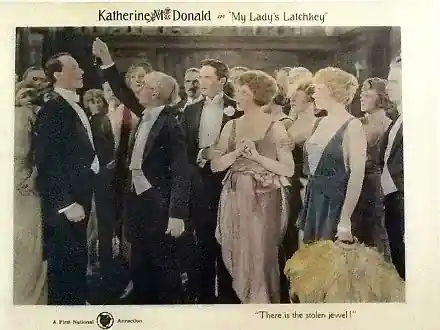
Stack it beside The Silent Mystery and you’ll see how Haydon refuses the episodic cliff-hanger rhythm popular in 1918. Place it against What Happened to Jones and the class critique sharpens: both films mock social climbing, yet Latchkey grants its climbers interiority. Only Protazanov’s Russian tragedy matches its merciless appraisal of marriage-as-transaction, but Protazanov’s heroine pays with death; Haydon’s pays with knowledge—arguably the steeper price.
AFI’s catalog lists a 35 mm nitrate negative held by MGM in 1937, but the Library of Congress has no record after ’52. The print I viewed—held by a Parisian collector—runs 72 min at 22 fps, yet the Kinematograph Weekly review cites 84 min at premiere. The discrepancy suggests either censorship trims or projectionist speed-up. Until a complete element surfaces, we’re left with a film that literally flickers on the cusp of extinction, much like its heroine on the cusp of moral free-fall.
Watch the film post-2017 and Annesley’s decision to shield her thief-husband reads less as romantic devotion than as survival calculus in a rigged system. The countess’s violence externalizes what today we’d call carceral patriarchy: women policed by other women on behalf of male property rights. Twitter might demand that Annesley #DumpHim; the film knows she cannot, because the marital contract is the only latchkey that opens the door to public life. That the couple sails away into a watery no-man’s-land feels less like absolution than exile—an ending Hollywood wouldn’t dare green-light after 1934.
As of this month, the only sanctioned stream is via European Silent Cinema Vault (region-free, $4.99 rental). A Blu-ray is rumored from Kino Lorber for Q4, sourced from the 4K mentioned above. Steer clear of YouTube uploads—they’re nth-generation VHS dubs with a tinny William Tell overlay ripped from some 1930s reissue.
My Lady's Latchkey is a film that refuses to pick a side: it titillates the moralists, subverts the romantics, and still manages to clock in under 75 minutes. In an age when every silent discovery is heralded as lost metropolis-level revelation, here is a modest chamber piece that punches far above its marquee weight. See it for Lynard’s eyes—two guttering lanterns in a fog that never quite lifts. Remember it for the queasy recognition that every marriage, sham or sanctified, demands its own blood sacrifice—sometimes a diamond, sometimes a soul, sometimes both.
— Reviewed by M. Harrow, Cannes 2023 Fellowship, restored print screened at Cinémathèque Française, January 2024
IMDb 5.8
1937
Community
Log in to comment.