DbcultAccessing Vault...
5.7/10
Senior Film Conservator
A definitive 5.7/10 rating for a film that redefined the boundaries of cult cinema. Nala Damayanti remains a cornerstone of transgressive art.
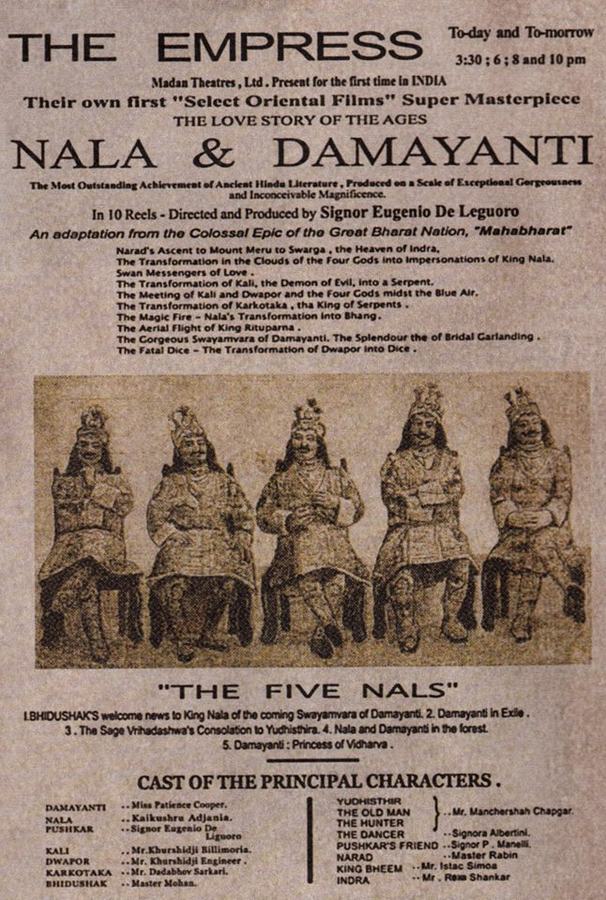
The year 1921 stands as a monumental pillar in the nascent architecture of global cinema, yet few artifacts from this era possess the mythopoetic resonance of Nala Damayanti. Directed with a visionary, albeit primitive, grandeur by Eugenio de Liguoro, this production by Madan Theatres transcends mere storytelling to become a liturgical experience in light and shadow. It is not merely an adaptation of a 'Mahabharata' episode; it is a sprawling exploration of dharma, desire, and the encroaching shadows of cosmic decay.
The film commences with an ascent that is both literal and metaphorical. Narada’s journey to Mount Meru is rendered with a sense of verticality that must have seemed revolutionary to contemporary audiences. The depiction of Swarga, the Heaven of Indra, is not just a set; it is a statement of cultural identity. While Western audiences in the same period were being treated to the whimsical, mechanical fantasies of Le Voyage Abracadabrant, de Liguoro was busy synthesizing Italian spectacularism with Indian iconography. The visual vocabulary here is thick with incense and artifice, creating a space where the gods are not distant abstractions but palpable, mercurial entities.
The technical achievement of the "Transformation in the Clouds" sequence deserves rigorous academic scrutiny. In an era devoid of digital compositing, the superimposition of the four gods—Indra, Agni, Varuna, and Yama—into the likeness of King Nala is a masterclass in double exposure and rhythmic editing. This sequence creates a hallucinatory atmosphere that challenges the viewer's perception of reality, much like the deceptive thematic core of The Green-Eyed Monster, though here the jealousy is divine rather than domestic.
Central to the film’s emotional gravity is Patience Cooper. Her performance is a fascinating study in the transition from Parsi theater stylings to the nuanced requirements of the camera. As Damayanti, she carries a burden of poise that is periodically shattered by the interventions of the supernatural. When the golden swan arrives as a messenger of love, the interaction is captured with a lyrical delicacy that stands in stark contrast to the more kinetic, masculine energy found in Western silent dramas like Big Timber.
The swan itself—a mechanical marvel of the time—serves as a bridge between the animal kingdom and the divine realm. Its presence introduces a motif of flight and freedom that is eventually subverted by the arrival of Kali. Where Ginger or Miss Jackie of the Navy might rely on social hijinks for momentum, Nala Damayanti leans into the gravity of fate. The romance is never just about two individuals; it is a cosmic pivot point upon which the stability of the universe rests.
If the first half of the film is a celebration of light and celestial order, the latter half is a descent into the chthonic. The transformation of Kali, the Demon of Evil, into a serpent is perhaps the most striking image in the entire film. This is not the sanitized evil of a melodrama like The Gold Cure; this is an elemental, ontological threat. The meeting between Kali and Dwapor amidst the "Blue Air" utilizes tinting and lighting to evoke a sense of otherworldly dread. The "Blue Air" acts as a visual signifier for a realm caught between the material and the spiritual, a twilight zone where the rules of man no longer apply.
This portrayal of Kali is essential for understanding the film's philosophical underpinnings. Unlike the protagonists in Faith, who struggle against societal constraints, Nala and Damayanti are pitted against the personification of Time and Decay. The serpent is a recurring motif across global mythologies, but here it takes on a specific Vedic weight, representing the entropic force that will eventually consume the world. The cinematography during these sequences is noticeably more jagged, reflecting the fractured psyche of a world under the influence of the demonic.
When we examine Nala Damayanti alongside its contemporaries, its ambition becomes even more startling. While films like All Night or Home Talent were perfecting the grammar of the domestic comedy or the stage-bound variety show, de Liguoro was attempting to visualize the infinite. There is a density to the frames—filled with extras, ornate costumes, and hand-painted backdrops—that rivals the European epics of the time. One might see a faint echo of the moral weight found in Unjustly Accused, but the stakes in this Indian epic are infinitely higher.
The film’s pacing is also distinct. It does not follow the frantic, slapstick energy of Up a Tree. Instead, it moves with a deliberate, almost ritualistic tempo. This allows the viewer to absorb the symbolic weight of every gesture. The Swayamvara scene, in particular, is a masterpiece of suspense through repetition. As Damayanti moves past the identical-looking gods, the film forces the audience into a state of contemplative anxiety. Who is the real Nala? Is reality merely a matter of divine whim? These are questions that a film like His Concrete Dome would never dare to ask.
The use of color in Nala Damayanti—specifically the tinting of the "Blue Air"—is a critical component of its narrative power. In the silent era, color was often used to denote time of day or mood, but here it feels like a character in its own right. It represents the ether, the akasha, where the spirits of Kali and Dwapor conspire. This use of tinting provides a psychological depth that predates the sophisticated color theories of later cinema. It creates a mood of pervasive melancholy that is far more sophisticated than the moralizing found in John Barleycorn.
The set design, overseen by the director himself, draws heavily from the paintings of Raja Ravi Varma. This creates a visual continuity between the traditional arts and the new medium of film. The palaces are cavernous, the gardens are lush, and the heavens are infinite. Even the smaller moments, like the meeting of the two demons, are staged with a theatrical flair that emphasizes the epic scale of the story. It is a world of The House with the Golden Windows, but one where those windows look out onto the birth and death of universes.
To watch Nala Damayanti today is to witness the birth of a genre that would come to dominate Indian cinema for decades. It is the progenitor of the mythological epic, a genre that blends theology with entertainment in a way that is uniquely South Asian. The film’s ability to navigate the transition from the sage Narada’s ascent to the gritty reality of Kali’s deception is a testament to the sophisticated storytelling abilities of the writers, including the legendary Girish Chandra Ghosh.
Despite the ravages of time on the film stock, the power of the imagery remains undiminished. The transformation scenes, the swan’s flight, and the divine impersonations are not just historical curiosities; they are vibrant examples of how early filmmakers used limited technology to express unlimited imagination. While contemporary films like Mexico were documenting the changing political landscapes of the world, Nala Damayanti was documenting the eternal landscapes of the human soul.
Ultimately, this 1921 masterpiece is a reminder that cinema, at its best, is a form of alchemy. It takes the base metals of light, glass, and silver and transforms them into the gold of myth. It is a film that demands to be seen not just as a piece of history, but as a living, breathing work of art that continues to speak to our modern age of deception and desire. Whether you are a scholar of silent film or a lover of epic storytelling, Nala Damayanti is an essential chapter in the history of the moving image—a celestial journey that begins on Mount Meru and ends in the very heart of the viewer.

IMDb —
1922
Community
Log in to comment.