DbcultAccessing Vault...
Cult Review
Senior Film Conservator
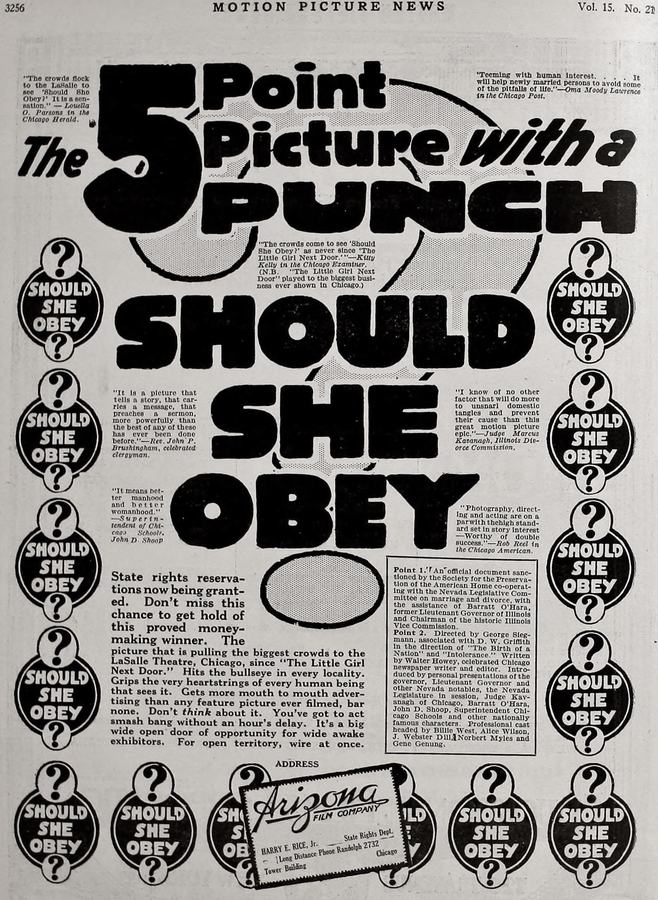
Stepping back into the annals of early cinema, one encounters films like Should She Obey? (1917), a title that immediately conjures an era grappling with evolving social norms and the often-conflicting expectations placed upon individuals, particularly women. This silent drama, a product of its time, delves into the treacherous landscape of ambition, fidelity, and the surprisingly resilient spirit of those wronged. It’s a narrative tapestry woven with threads of aspiration, moral decay, and eventual, albeit hard-won, justice, offering a fascinating window into the anxieties and moral compass of the early 20th century.
At its core, the film presents William Gordon, initially a man adrift, lacking purpose and drive. His transformation, however, is not self-ignited but rather a testament to the profound influence of his wife, Lorna. It is her unwavering belief, her quiet strength, and perhaps her subtle nudges that inspire him to tap into an latent inventive genius. Gordon’s discovery of a revolutionary welding process isn't just a scientific breakthrough; it's a social one, catapulting him from obscurity to the pinnacle of corporate power. He becomes the president of a sprawling enterprise, a symbol of American ingenuity and the limitless possibilities of the burgeoning industrial age. This meteoric ascent, however, paradoxically lays the groundwork for his moral disintegration, a common theme in tales of sudden wealth, echoing the cautionary narratives sometimes found in films exploring the corrupting influence of money, much like certain aspects of Artie, the Millionaire Kid.
The narrative then introduces a stark contrast to Gordon's trajectory in the form of Henry Blake, a relic from Gordon's shiftless past. Blake’s story begins with an unwelcome obligation: a forced marriage to Mamie after she bears his child. The daughter, a silent casualty of circumstance, is swiftly dispatched to the austere confines of a convent, a convenient solution to a societal problem, highlighting the often-harsh realities faced by women and illegitimate children in that era. This act of familial abandonment foreshadows Blake's progressively darker path, cementing his role as a figure operating on the fringes of morality, driven by self-interest and a profound lack of empathy. His actions immediately set him apart from Gordon's initial, albeit misguided, ambitions, painting a picture of two men diverging sharply in their moral compasses, a question of who truly is The Better Man in a world of compromise.
Gordon's newfound status, rather than grounding him, seems to loosen his moral moorings. The allure of the stage, personified by the captivating actress Marie Gibson, proves irresistible. He succumbs to an infatuation that blinds him to his domestic duties, leading him to abandon Lorna and their son, William Jr. This abandonment is not merely a personal betrayal but a public declaration of his intent to elevate Marie into the very society that once celebrated his ingenuity. It's a classic tale of the self-made man undone by hubris and carnal desire, a narrative arc that continues to resonate in countless stories of societal climbing and moral compromise. The world of actresses, as depicted in films like Polly of the Circus or Wanted - A Film Actress, often serves as a backdrop for such moral quandaries, where beauty and ambition frequently intertwine with scandal and public scrutiny.
Meanwhile, Blake's descent accelerates. His illicit dance hall, a hub of questionable entertainment, is raided, forcing him into a corner. It's here that his opportunistic nature fully blossoms. Discovering Gordon's scandalous liaison with Marie, Blake seizes the moment, transforming this private indiscretion into a powerful weapon of blackmail. The ill-gotten gains from this extortion become his ticket to a new, albeit equally morally dubious, venture. He callously abandons Mamie, leaving her to fend for herself, and establishes his own opulent dance hall. The sheer audacity of his next move, however, plunges his character into truly reprehensible depths: he retrieves his own daughter from the convent, not to offer her a loving home, but to exploit her as an entertainer for the jaded, idle rich frequenting his establishment. This act of paternal betrayal is arguably the most chilling aspect of the film, a stark commentary on the commodification of innocence and the lengths to which desperation and avarice can drive an individual. The narrative, in this regard, hints at the dark underbelly of societal 'truths' that often remain hidden, a theme that might find resonance with The Truth Wagon, albeit through different mechanisms of revelation.
The turning point, the moment when the narrative shifts from individual tragedies to collective empowerment, lies in the unexpected alliance forged between Lorna and Mamie. Both women, having sought liberation through the nascent legal pathways of divorce in Reno – a progressive step for the era – find themselves sharing a home and, more importantly, a common understanding of betrayal. Their shared experiences of being wronged by the same system of masculine privilege and moral failing creates a powerful bond. When they uncover Blake's ultimate plan – to force his daughter into a financially advantageous but emotionally bankrupt marriage – their individual grievances coalesce into a unified resolve for justice. This moment is critical; it transforms them from passive victims into active agents of change, challenging the very notion of who should obey and to what extent.
The climax, a daring rescue of the innocent daughter, is more than just a dramatic set-piece; it's a symbolic reclamation of agency. It represents the women's refusal to let the cycle of exploitation continue, particularly when it targets the most vulnerable. This act of defiance sets in motion the final act of societal reckoning. The film’s resolution, though perhaps melodramatic by modern standards, delivers a clear moral message: society, despite its imperfections, ultimately has a mechanism for judgment. Gordon's attempt to legitimize his new relationship with Marie through marriage is met with collective repudiation. The social elite, once enamored with his success, now ostracize him and his paramour, driving them into exile in Europe. This final scene, rather than a simple happy ending, serves as a powerful statement on the consequences of moral transgression, suggesting that even immense wealth and influence cannot fully shield one from the judgment of their peers. It’s a narrative where social capital, once lost, cannot be easily regained, and where the 'virtue' of individuals, especially women, is often a commodity, a theme explored in depth in films like The Auction of Virtue.
The strength of Should She Obey? lies not just in its dramatic plot but in its nuanced exploration of character and societal pressures. Gene Genung as William Gordon navigates the character's arc from indolence to ambition, then to moral decay, his expressive gestures conveying the internal turmoil typical of silent film acting. Margaret McQuarrie, as Lorna, embodies the quiet dignity and eventual steeliness of a woman wronged but not broken, her portrayal providing a crucial emotional anchor. The supporting cast, including James Harrison as the morally ambiguous Henry Blake, effectively fills out this world of contrasting ethics. The direction, while perhaps not groundbreaking in its cinematic language compared to later masterpieces, effectively serves the narrative, ensuring the audience grasps the dramatic stakes and emotional beats through clear storytelling and impactful intertitles.
The film’s title itself, Should She Obey?, is a rhetorical question that probes the very fabric of early 20th-century gender roles. It challenges the passive obedience expected of women like Lorna and Mamie, who ultimately choose defiance and self-determination. Their journey from individual suffering to collective action is a subtle yet powerful commentary on the nascent feminist stirrings of the era, suggesting a growing awareness of women's rights and their capacity for agency beyond the domestic sphere. The film effectively uses the melodrama inherent in its genre to highlight serious social issues: marital infidelity, child exploitation, and the corrupting influence of unchecked ambition. It’s a compelling piece of social commentary masquerading as entertainment, prompting audiences to consider the moral obligations of individuals to their families and to society at large.
In conclusion, Should She Obey? stands as a compelling artifact from the silent film era, a testament to the enduring power of storytelling to reflect and critique societal values. It is a narrative that, despite its period setting, resonates with timeless themes of human frailty, the pursuit of happiness at any cost, and the ultimate triumph of justice, however circuitous its path. For those interested in the evolution of cinematic narrative, the portrayal of early 20th-century morality, and the burgeoning strength of female characters on screen, this film offers a rich and thought-provoking experience. It reminds us that even in an age of perceived innocence, the complexities of human nature and the struggle between vice and virtue were as potent and captivating as they are today.
IMDb 6.4
1937
Community
Log in to comment.