DbcultAccessing Vault...
4.2/10
Senior Film Conservator
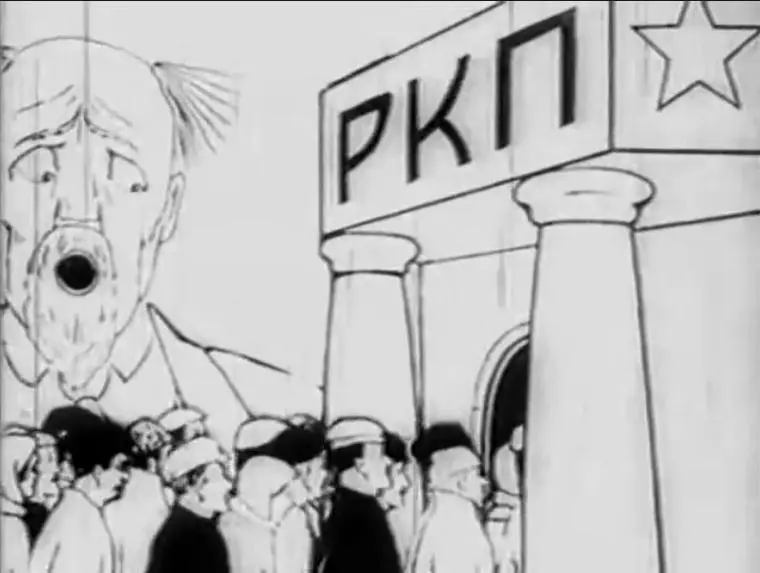
A definitive 4.2/10 rating for a film that redefined the boundaries of cult cinema. Nash otvet na zloradstva burzhuaznogo mira remains a cornerstone of transgressive art.
Stepping into the temporal vortex of early Soviet cinema, one encounters works that transcend mere entertainment, functioning instead as vital ideological instruments, pulsating with the fervent spirit of a nation in flux. Dziga Vertov’s 1922 animated short, Nash otvet na zloradstva burzhuaznogo mira (Our Answer to the Malice of the Bourgeois World), is precisely such a film: a potent, unapologetic declaration rendered in a visual language both primitive and profoundly impactful. It emerges not just as a piece of cinematic history, but as a direct, visceral response to a moment of profound national grief and international scrutiny following the passing of Lenin. This isn't a film designed to gently persuade; it is a cinematic fist raised in defiance, a testament to unwavering conviction in the face of perceived global schadenfreude.
The very title, bristling with combative energy, sets the stage for what unfolds. Vertov, a figure synonymous with radical cinematic experimentation and the 'Kino-Eye' theory, harnessed the nascent power of animation to articulate a complex political message with stark clarity. At a time when illiteracy was still prevalent and mass communication infrastructure rudimentary, animation offered an unparalleled medium for disseminating powerful, easily digestible narratives. The film’s premise, depicting the enduring loyalty of the populace to communist ideals despite Lenin’s death and the gloating of foreign powers, is deceptively simple. Yet, within this framework, Vertov constructs a sophisticated tapestry of symbolism and emotional resonance, aiming to galvanize internal resolve and project an image of unshakeable unity outward.
The animation itself, characteristic of its era, possesses a raw, almost childlike directness, yet it is imbued with an extraordinary expressive force. Figures are often stylized, almost archetypal, representing broader concepts rather than individual personalities. This abstraction serves the propaganda's purpose perfectly, allowing the viewer to project themselves onto the collective 'people' or to recognize the 'bourgeois' as a universal antagonist. The visual metaphors employed are both literal and subtle. We see personifications of foreign nations, often depicted with caricatured features, reveling in what they perceive as the Soviet Union's impending collapse. Their glee, however, is short-lived, systematically undermined by the animated evidence of Soviet resilience. This counter-narrative is the film's core strength, transforming abstract political concepts into tangible, moving images.
Vertov’s genius, even in this early animated endeavor, lies in his understanding of cinema’s capacity for direct ideological transmission. He wasn’t just showing events; he was actively shaping perception, constructing a reality. The film doesn't merely state that people remain loyal; it *shows* their loyalty, through animated sequences of industry, agriculture, and collective action. These depictions are not passive observations but active affirmations, designed to inspire and confirm the viewer's own adherence to the cause. The use of animation, free from the constraints of live-action realism, allows for heightened symbolism, for the direct visualization of abstract ideas like 'loyalty,' 'malice,' and 'ideological steadfastness.' This unbridled creative freedom, characteristic of early experimental cinema, makes Nash otvet a fascinating artefact not only of political history but of cinematic innovation.
The historical context is paramount to appreciating Nash otvet. Lenin’s death in 1924 (though the film was made in 1922, anticipating the period of grief and uncertainty, or perhaps responding to his deteriorating health and the anxieties it caused) plunged the young Soviet state into a period of profound introspection and vulnerability. External powers, many deeply suspicious or outright hostile to the communist experiment, would undoubtedly have viewed this as an opportune moment for the nascent regime to crumble. Vertov's film directly addresses this external perception, turning it on its head. It’s a pre-emptive strike, a cinematic rebuttal designed to quash any hopes of Soviet collapse and to project an image of internal strength and unwavering ideological commitment.
The film's depiction of 'foreign countries' and their 'gloating' is particularly insightful, revealing the acute awareness within the Soviet Union of its isolated position on the global stage. These animated antagonists, often rendered with exaggerated, almost grotesque features, serve as a clear 'other,' against whom the unity and purity of the communist ideal can be sharply contrasted. This binary opposition is a classic propaganda technique, simplified for maximum impact, and Vertov wields it with considerable skill. The message is clear: despite the loss of a great leader, the collective will of the people, guided by communist principles, remains undiminished and impenetrable to outside malice.
While often associated with non-fiction and the documentary form, Vertov’s involvement in Nash otvet demonstrates the fluidity of his cinematic vision. His 'Kino-Eye' philosophy, which advocated for capturing 'life unawares' and assembling fragments of reality into a new, dialectical truth, finds an interesting echo even in animation. Here, instead of 'capturing' reality, he is constructing a symbolic reality, one that aims to represent a larger truth about the Soviet spirit. The animation, in its raw, unfiltered style, strips away superficiality to present core ideological messages directly, much like the Kino-Eye aimed to strip away bourgeois artifice to reveal essential truths.
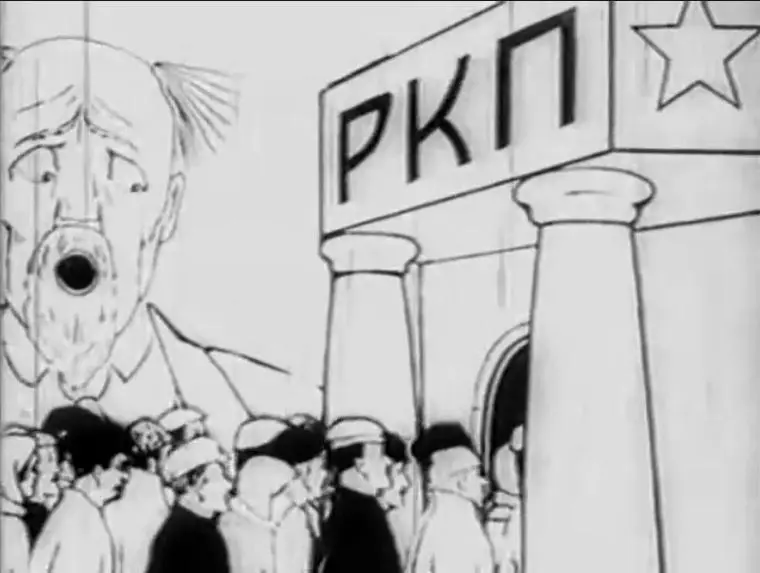
The film’s aesthetic, while simple, is never simplistic in its intent. Each frame, each movement, is charged with purpose. There is a relentless forward momentum, an unwavering confidence that permeates the entire piece. This kinetic energy is a hallmark of Vertov's broader oeuvre, seen perhaps most famously in Man with a Movie Camera, but present even in this earlier, less celebrated work. The animation doesn't merely illustrate a narrative; it embodies an ideological drive, a relentless march towards a communist future. The vibrant, almost stark color palette (if one were to imagine it in color, given the monochrome reality of early film, the implied vibrancy of its message is palpable) would have further enhanced its immediate impact on audiences, cutting through the visual noise of everyday life.
Examining films like Nash otvet na zloradstva burzhuaznogo mira offers a crucial window into the foundational period of political cinema. This wasn't just about telling stories; it was about nation-building, about forging a collective identity and purpose through the new, mesmerizing medium of film. While overtly propagandistic, its historical significance cannot be understated. It represents a bold experiment in using emerging technology for mass communication and ideological dissemination, predating many of the more sophisticated propaganda efforts of later decades.
In a broader cinematic context, this film stands as a testament to the diverse applications of early animation. While many early animated shorts focused on comedic gags or whimsical narratives, Vertov, along with other Soviet animators, quickly recognized its potential for serious, even solemn, political discourse. This divergence from Western animation trends of the time highlights a fundamental difference in how cinema was perceived and utilized in the Soviet Union – not merely as entertainment, but as an integral tool for social engineering and ideological education. The very act of creating such a film, with its clear message and target audience, underlines the Soviet state's recognition of cinema's immense power to shape public opinion and galvanize collective action. It's a stark reminder that the moving image, from its earliest days, was understood as a formidable weapon in the arsenal of political discourse.
The audacious simplicity of the visual storytelling in Nash otvet resonates with the nascent, often experimental spirit of early 20th-century filmmaking across the globe. Just as films like The Challenge or Playing with Fire, though dramatically different in genre and intent, relied on clear visual cues and heightened emotional stakes to engage their audiences, Vertov’s animated short leveraged a similar directness. However, where those films sought to entertain or evoke personal drama, Nash otvet aimed for a collective emotional and ideological response. It stripped away complex narrative arcs in favor of immediate, symbolic impact, a strategy that underscores the raw, unpolished, yet incredibly potent communication capabilities of cinema in its formative years. The lack of dialogue, common to the silent era, further amplified the reliance on universally understood visual language, making the film's message accessible across linguistic barriers, albeit within its specific ideological framework.
Today, viewing Nash otvet na zloradstva burzhuaznogo mira is more than an academic exercise; it is an encounter with a pivotal moment in both cinematic and political history. It reminds us of a time when the lines between art, politics, and public education were not just blurred, but intentionally erased. The film serves as a powerful artifact, illustrating the early Soviet state’s commitment to utilizing all available media to consolidate its power and propagate its ideology. It’s a testament to Vertov's innovative spirit, demonstrating his willingness to push the boundaries of cinematic form, even within the confines of state-mandated messaging.
Beyond its explicit political message, the film’s innovative use of animation for serious, didactic purposes continues to resonate. It challenges our contemporary understanding of animation as primarily a medium for children or lighthearted entertainment, demonstrating its potential for profound social and political commentary. The boldness of its visual rhetoric, the clarity of its ideological stance, and its historical placement make it an indispensable piece for anyone studying the evolution of propaganda, the history of animation, or the early years of Soviet cinema. It’s a work that, despite its age and specific historical context, still pulsates with a raw, undeniable energy, offering a direct line to the fervent ideological battles of a bygone era.
In conclusion, Nash otvet na zloradstva burzhuaznogo mira is far more than a historical curiosity. It is a vibrant, if politically charged, example of cinematic artistry at a crucial juncture. It encapsulates the audacious spirit of a revolutionary state finding its voice through a new medium, a voice that was unyielding, defiant, and utterly convinced of its own righteousness. Vertov's contribution here, though less discussed than his later documentary work, is a foundational stone in the edifice of Soviet cinema, demonstrating the power of the animated image to shape minds and fortify spirits in the tumultuous aftermath of great loss and amidst the watchful, often hostile, gaze of the world.
Community
Log in to comment.