DbcultAccessing Vault...
Cult Review
Senior Film Conservator
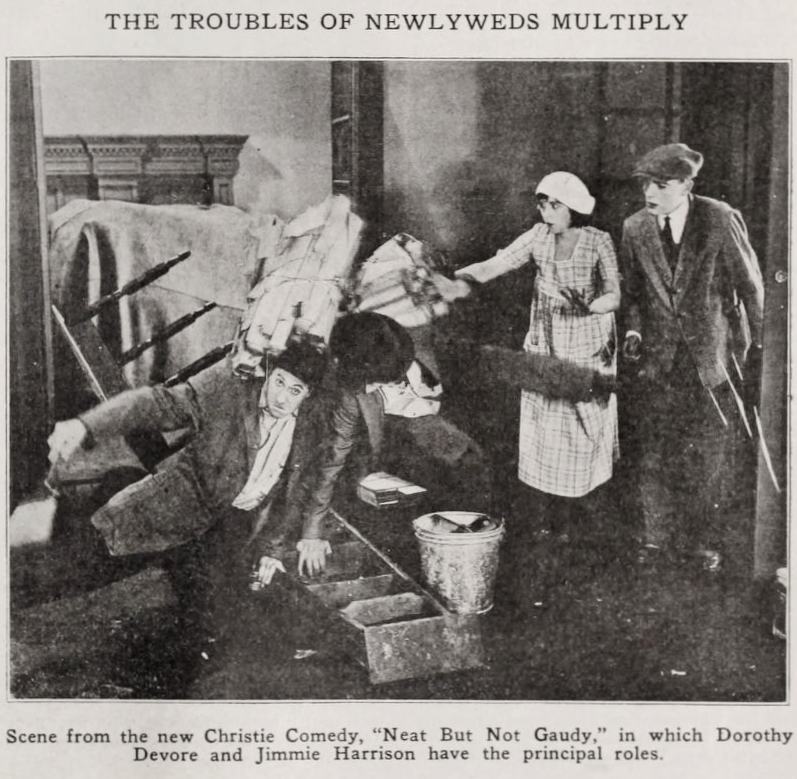
The first time I saw Neat But Not Gaudy I was wedged into a folding chair at a dilapidated bijou where the projector clattered like a coffee grinder; the print, speckled and sun-bleached, still detonated with enough chromatic madness to leave my retinas humming. Ninety-odd years after its quiet birth, this 1924 trifle feels less like a quaint curio and more like a dare—an invitation to watch propriety get mugged by absurdity while love tap-dances through the wreckage.
James Harrison embodies the would-be decorator with the elastic bewilderment of a man who has read every style manual yet never peeled a single strip of wallpaper. His eyes—half pleading, half plotting—dart across the mansion’s drawing room as though hunting for an exit that taste forgot. The ruse is paper-thin, but Harrison sells it with the fervor of a stage magician convinced his next trick will actually fool someone. One eyebrow hovers in permanent apology; the other arches toward glory.
Dorothy Devore, as the object of his sham profession, glides through the early reels swaddled in a skepticism so immaculate it could be couture. Her sidelong glances slice like embroidery scissors. She suspects the impostor’s “aesthetic” is as authentic as a three-dollar Corinthian column, yet the flicker in her pupils betrays a wish to be hoodwinked—just this once—by something giddy and implausible.
Then arrive the twin tempests: Eddie Barry and an uncredited partner in slapstick sin, brandishing buckets of paste and the attention span of caffeinated squirrels. They are the film’s centrifugal id, spinning every careful composition into a delirious fresco of crooked fleurs-de-lis and blistered damask. Once their ladders lurch and their brushes fling, the narrative surrenders any pretense of order; the house becomes a fever dream hatched by a color-blind Medici.
Director William A. Seiter—working in that liminal zone between refined farce and barn-door broadness—lets the calamity mount in cascading crescendos. He favors medium two-shots where bodies ricochet across the frame, then whips in a close-up of a single hand frantically smoothing a bubble of wallpaper that swells like an impertinent thought. The pacing is symphonic: adagio of elegance, scherzo of destruction, prestissimo of reconciliation, all wrapped in intertitles that snap like well-ironed witticisms.
Visually the picture is a study in chiaroscuro ambush. The early interiors bask in creamy grayscale, every teacup and doily etched with Puritan restraint; once the havoc erupts, the palette seems—impossibly—to scream in tangerine and arsenic green even within the monochrome spectrum. Shadows smear like wet paint, and the mansion’s grand staircase becomes a torrent of stripes that swallow propriety whole. One shot lingers on a chandelier trembling under a confetti of paper shreds: a crystal maiden embarrassed by her own gaudy new petticoat.
Comparisons? Imagine the social sting of Die Narbe am Knie folded into the domestic chaos of Penge, then injected with the screwball velocity of The Four-Flusher. Yet Neat But Not Gaudy lacks the melancholy scar tissue of those titles; its bruises are only skin-deep, its bandage a bowtie.
Devore’s gowns deserve curatorial reverence. In reel one she drifts through rooms in a dropped-waist number that whispers restraint; by reel three, fringe and rogue rosettes sprout as though the wallpaper’s bacchanalia has metastasized onto her seams. Costuming becomes character arc: the more the house loses its mind, the more her silhouette loosens, until she practically vibrates like a peacock feather caught in a doorjamb.
Meanwhile Harrison’s tailored façade frays by increments. Watch his cravat wilt in real time; observe how the pocket square, once crisp as a banker’s vow, eventually droops like a surrender flag. The film understands that sartorial slippage is existential slippage—every crooked seam is a confession.
The score—when screened with a live Wurlitzer—snaps from genteel waltz into galloping ragtime without warning, mirroring the on-screen chromatic riot. If you’re consigned to a home viewing, queue up something equally bipolar: perhaps a mash-up of Satie and early Dixieland. Trust me, the cognitive dissonance will feel like champagne poured over cornflakes.
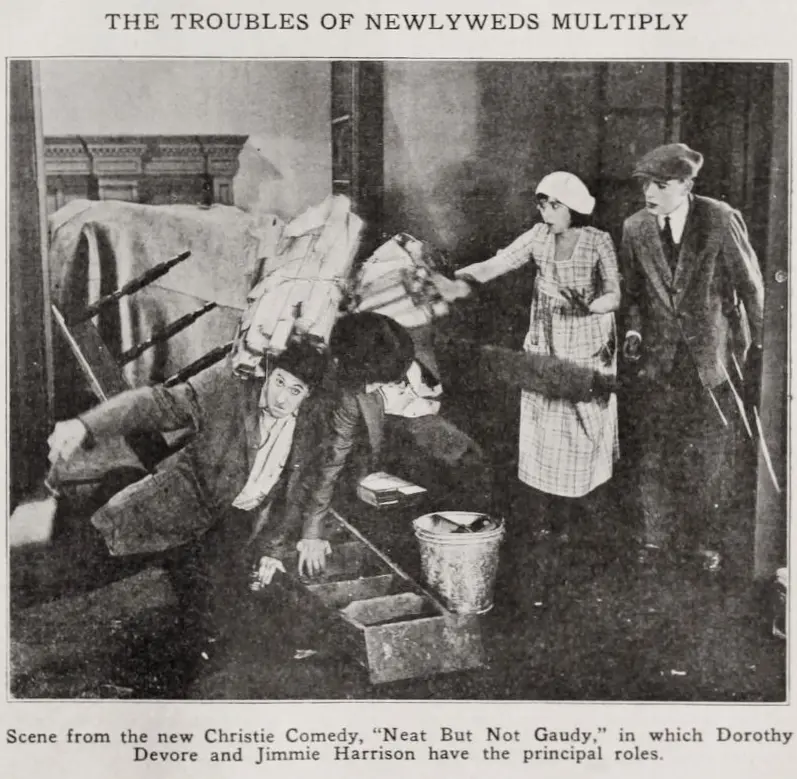
Scholars sometimes slot this romp beside The Princess' Necklace or Incantesimo because all three toy with masquerade and class anxiety. The difference: those films treat disguise as existential roulette; Neat But Not Gaudy treats it as a mere party game that got hilariously out of hand. The stakes feel featherweight, yet the emotional payoff lands with surprising wallop—proof that confection, when spun with enough centrifugal glee, can still bruise the heart.
Where the picture truly startles is in its tacit interrogation of taste as currency. The protagonist’s fraudulent expertise exposes the arbitrariness of “good” design: hang a medallion here, daub a gilt accent there, and suddenly you’re savant royalty. The mansion’s owner—a doddering plutocrat who signs checks with the flourish of a man knighting himself—never questions the sham because the label decorator carries more authority than evidence. The film thus skewers the priesthood of aesthetics a full decade before A Beggar in Purple would lampoon art-world pretensions with heavier cynicism.
And then there is the matter of glue. Gallons of it. The viscous substance becomes a character in its own right—oozing, gumming, bonding hearts and lapels alike. In one delirious tableau a strip of wallpaper slithers across a mahogany table like a runaway python and slaps itself onto the derrière of the butler, who then waddles through the remainder of the scene as a walking mural. Slapstick? Certainly. Yet the moment also evokes the era’s labor unrest: the help, literally wallpapered into anonymity, becomes part of the décor he once policed.
Gender politics, you ask? Refreshingly sideways. The heroine engineers the final détente, dispatching a telegram that rescues the hero from public ignominy while she re-positions a fainting couch like a strategic queen. Her agency glints sharper than any chisel in the house. Meanwhile the men—covered in paste, pride deflating—are grateful to be salvaged. It’s a quiet inversion wrapped in ruffled farce, predating the more overt empowerment arcs in She's Everywhere by a comfortable margin.
Technically the film survives only in a 16 mm reduction print, so nitrate connoisseurs will mourn the lost shimmer. Yet the existing graininess adds a layer of ghostliness, as though we’re watching someone else’s half-remembered dream. Scratches flicker like match heads; the emulsion pulses like a nervous heartbeat. Imperfection becomes aesthetic—an accidental metaphor for a romance built on lies that somehow stick.
Want reference points beyond the ones already flagged? Chase the domestic pandemonium of A Fight for Love, crossbreed it with the social climbing jitters of The Scarlet Road, then garnish with the carnival hue—albeit monochromatic—of Drankersken. Yet none of those quite capture the fizzy levity that keeps Neat But Not Gaudy bobbing like a cork on Prosecco.
Seiter’s camera movement—minimal yet telling—leans in for the kill at precisely the instant disaster peaks. Note the dolly-in on Harrison’s face as he beholds a parlor transformed into a hallucinogenic kaleidoscope: the camera glides three inches, just enough to let the audience feel the floor tilting under his hubris. It’s a blink-and-you-miss-it flourish, but it encapsulates the film’s philosophy: elegance undone by millimeters, not miles.
As for the title, it drips with ironic glee. “Neat but not gaudy” was once a popular colloquialism for understated chic; by the final frame the phrase lies in tatters, trampled beneath pastel boot prints. The intertitle card that bids us farewell winks: “Neatness is in the eye of the beholder—so is love, and sometimes both need re-pasting.” Corny? Perhaps. Yet delivered with such silken smugness it feels like Dorothy Parker on a bender.
Contemporary viewers, marinated in the cynicism of post-ironic comedy, may smirk at the innocence. Resist that reflex. The film’s optimism is not naïveté but discipline—a deliberate refusal to capitulate to despair. When the lovers finally share a single unvarnished kiss amid the shredded damask, the moment lands with the insurgent sweetness of a trumpet solo in a silent room.
Bottom line: Neat But Not Gaudy is a champagne cocktail laced with laxative—effervescent going down, chaotically liberating on the way out. It will not rewire your philosophy; it will, however, leave you grinning like a fool at the sheer audacity of a world where taste is negotiable and love is the only pattern that refuses to peel.
Seek it out the next time some pompous cineaste claims silent comedy peaked with a certain tramp in size-46 shoes. Bring friends, bring paste, bring expectations low and spirits high. If you exit the screening without a reflexive urge to redecorate your life in clashing damasks, congratulations—you’re neater than the film, and probably gaudier than you think.
IMDb —
1920
Community
Log in to comment.