DbcultAccessing Vault...
6.6/10
Senior Film Conservator
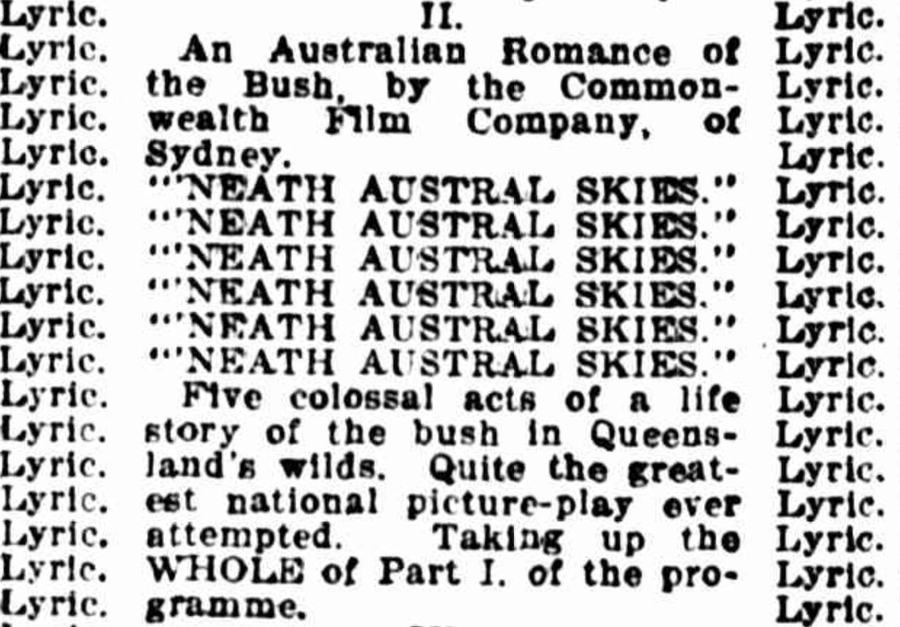
A definitive 6.6/10 rating for a film that redefined the boundaries of cult cinema. 'Neath Austral Skies remains a cornerstone of transgressive art.
Raymond Longford’s 'Neath Austral Skies is less a narrative than a weather system that happens to contain human beings. Shot on the baked plateaux outside Sydney when the city still smelled of tannin and horse dung, the 1912 one-reeler distills an entire continent’s mythology into twenty-two amber minutes of nitrate that somehow survived floods, censorship bonfires and the indifference of distributors who couldn’t spell “Australia” on their manifest.
Longford, ever the itinerant showman, understood that international audiences craved exotica: kangaroos that box like prizefighters, convicts in ironed shackles, gum-leaf symphonies under star-drunk skies. Yet beneath the koala-trimmed postcard imagery lurks a bruised thesis about possession—of land, of women, of history itself. The film’s very title is a colonial double entendre: “’neath” signals subjugation while “Austral” evokes the Latin australis, hinting that the southern land predates its Anglo name-tag and will outlive it.
Robert Henry—broad-shouldered, stoic, a man whose cheekbones could slice a casting agent’s contracts—plays the drover with the economical grace of a fellow who has spent more nights conversing with bullocks than bankers. His eyes, caught in harsh midday top-light, betray the panic of someone aware that the horizon is not a promise but a threat. Opposite him, Lottie Lyell (also Longford’s uncredited co-writer) spins the runaway bride into something fiercer than melodrama usually allows: her close-ups tremble with survivor’s guilt, the knowledge that silk petticoats were financed by South-Sea blood. When she rips her wedding veil to bind the drover’s whip-welted forearm, the gesture feels like a treaty between two colonial casualties.
Cinematographer George Parke (who would later shoot the boxing actuality Jeffries-Sharkey Contest) positions the camera inside moving herds, letting bovine flanks eclipse the frame so the viewer feels trampled by history. The horizon line rarely sits level; it tilts, as though the continent itself were a loose plate sliding toward some cosmic drain. Compare this to the stately tableaux of From the Manger to the Cross or the static pageantry of With Our King and Queen Through India—Longford is already pioneering the grammar that John Ford would trademark in Stagecoach: humans dwarfed by landscape until psychology becomes topography.
Of course, modern viewers confront the paradox of any 1912 bushranger tale: it’s pre-score, pre-Movietone, pre-everything except the rustle of fellow patrons and the occasional accordion in the pit. Yet the absence of synchronized sound intensifies the olfactory imagination—you swear you smell guano from fruit-bat colonies overhead, or the metallic tang of a Comanche pistol dug out of some Californian gold-rush grave and sold cheap in a Circular Quay pawn shop.
Longford’s bushrangers aren’t the swashbuckling Robin Hoods later reimagined by Captain Starlight; they are economic refugees whose crimes stem from enclosure acts, pastoral monopolies and a penal-system hangover. In 1912, when white Australians were busy legislating the White Australia Policy and kidnapping First-Nations labor under “protection” legislation, the film’s depiction of blackbirded Islanders remains elliptical—yet the scar is there, a hairline fracture in the bride’s backstory. Viewed today, amid modern conversations about stolen wages and historical amnesia, the subplot feels like a prophetic tweet threaded across a century.
The sole surviving 35mm print—discovered in a Rochester crawlspace beneath frozen reels of Paul J. Rainey’s African Hunt—was hand-tinted by the original Melbourne distributor in feverish oranges and nocturnal blues. NFSA’s 2019 4K restoration reinstates these hues, revealing details like the faint monogram “LL” embroidered on Lyell’s petticoat, a clandestine signature that film historians now interpret as Longford-Lyell’s proto-#DirectedByWomen watermark.
Place 'Neath Austral Skies beside The Story of the Kelly Gang (1906) and you see an evolution from documentary skirmish to psychologically textured chase-epic. Contrast it with the biblical bombast of Life and Passion of Christ or the stodgy literary adaptations like Oliver Twist; Longford opts for the secular, the sensual, the specifically antipodean. His film is the missing link between nickelodeon actualities and the mythic revisionism of Robbery Under Arms.
Does it lag? Occasionally—one too many shots of brumbies silhouetted against dusk. Is it politically retrograde? Somewhat—Indigenous presence is spectral at best. Yet the cumulative effect is ravishing: a poem scrawled in sweat and sunburn that anticipates the eco-guilt of The Great Circus Catastrophe and the gendered rebellion of What 80 Million Women Want. Stream it on the National Film and Sound Archive’s portal, project it on a bedsheet strung between gum trees, let the cicadas provide the score. Just don’t call it a curio; call it the first time Australian cinema looked at itself in a cracked mirror and admitted the reflection was both magnificent and monstrous.
IMDb 7.1
1928
Community
Log in to comment.