DbcultAccessing Vault...
Cult Review
Senior Film Conservator
Is Nero (1925) worth watching today? Short answer: yes, but with significant caveats that demand a specific kind of viewer. This silent film is a fascinating, if often baffling, relic best suited for ardent cinephiles, historians of early comedy, and those with a high tolerance for the absurd. Casual viewers seeking polished narratives, sophisticated humor, or historical accuracy will likely find its anachronisms and broad strokes more bewildering than entertaining, perhaps even frustrating.
It’s a film that exists in its own peculiar dimension, a testament to the wild, experimental spirit of early cinema. You won't find the nuanced character work of a Chaplin or the intricate plotting of a Keaton here, but you will encounter a brazen disregard for conventions that can feel surprisingly modern in its audacity.
This film works because: It offers a rare, unfiltered look into early cinematic comedic sensibilities, showcasing a bold, almost Dadaist approach to historical narrative that is surprisingly prescient in its absurdity. William Irving's portrayal of Nero is a masterclass in silent-era physical comedy, embodying a truly unhinged despot.
This film fails because: Its plot is often nonsensical, its humor relies heavily on slapstick that hasn't aged gracefully, and its historical inaccuracies are so blatant they can be distracting, even for a satire. The pacing, while frenetic, can feel disjointed, preventing any real emotional investment.
You should watch it if: You are a film student, a silent film enthusiast, or someone deeply curious about the evolution of comedic storytelling and early cinematic techniques. It’s an academic curiosity with moments of genuine, if bizarre, hilarity. Avoid if you prefer modern pacing, coherent plots, or historically accurate portrayals, or if you're looking for a straightforward, accessible comedy.
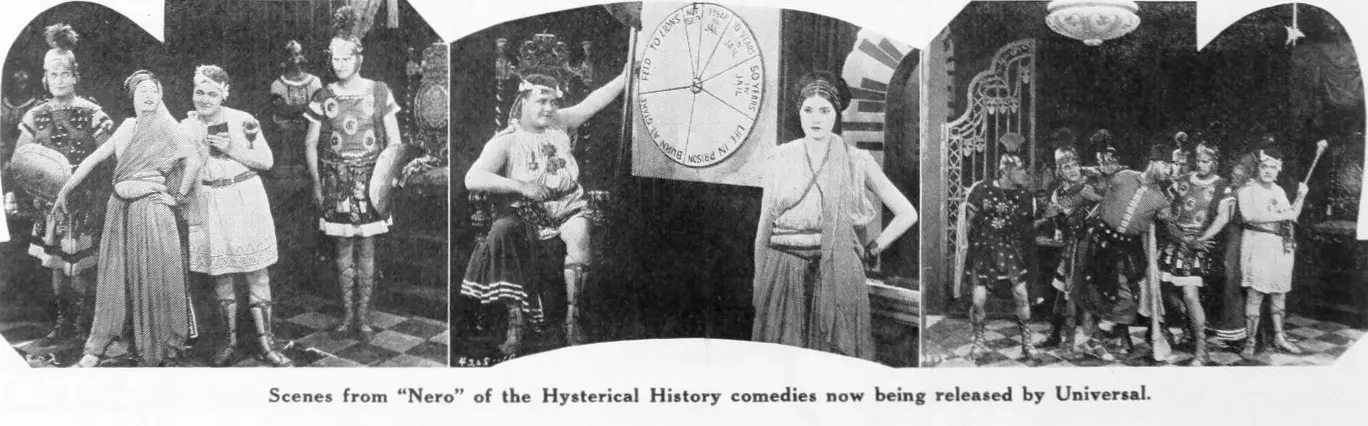
The narrative of Nero (1925), penned by William Watson, is less a cohesive story and more a series of escalating farcical events centered around history's most infamously fiddling emperor. We open with Nero’s petulant desire for a fiddle, a seemingly trivial want that sets off a chain reaction of indignity for his long-suffering prime minister. The sight of Nero smashing a bass viol over his minister's head, all because it wasn't the 'nice little fiddle' he envisioned, establishes the emperor's volatile, childish nature immediately. It’s a moment of pure, unadulterated slapstick that defines the film's comedic register.
The subsequent quest to San Francisco for a 'Simon-pure violin' is perhaps the film's most glaring and delightful anachronism, a clear signal that historical accuracy is not just secondary, but entirely irrelevant to its comedic ambition. This isn’t a film that accidentally gets history wrong; it actively mocks it. The prime minister’s revenge via an explosive birthday cake, leaving Nero covered in frosting, feels like a direct ancestor to countless cartoon gags, demonstrating a surprising timelessness in its physical humor, even if the execution is rudimentary.
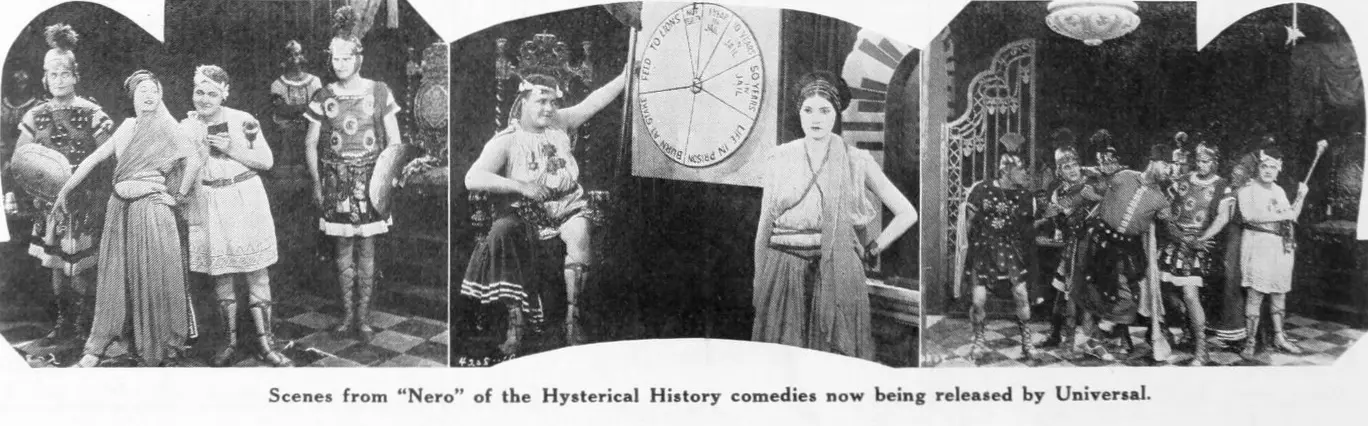
Nero’s courtroom, where sentences are decided by a rigged roulette wheel, further solidifies his character as a petty, absolute ruler whose whims supersede justice. It's a darkly comedic touch that highlights the absurdity of unchecked power, a theme that resonates even today. The arrival of the strolling troubadour, who manages to charm Nero with his music, offers a brief respite from the emperor’s tyranny, only to plunge him into a different kind of chaos: a game of craps. This sequence, where Nero gambles away his palace and owes a billion shekels, is the ultimate manifestation of his reckless impulsivity.
The infamous burning of Rome, presented here as a consequence of Nero's bad luck and an expired insurance policy, is perhaps the film's most audacious reinterpretation of history. It transforms a historical tragedy into a punchline, a direct result of the emperor’s personal failings rather than a grand, malevolent act. This recontextualization is bold, bordering on irreverent, and serves as the film’s ultimate comedic mic drop. The plot, for all its disjointedness, maintains a relentless commitment to its own brand of outlandish humor.
William Irving, as Nero, is the undeniable center of this comedic hurricane. His performance is a masterclass in silent-era physical comedy, relying heavily on exaggerated gestures, wide-eyed expressions, and a theatrical physicality that speaks volumes without a single intertitle. Irving doesn't just play Nero; he embodies a caricature of imperial petulance and unchecked ego. His Nero is less a historical figure and more a giant, spoiled child in a toga.
Consider the scene where he receives the picture from the youngest Bouillon Sister. Irving’s transition from grumpy despot to smitten schoolboy, a flurry of ecstatic gestures and delighted grins, is instantly understandable and genuinely funny. It’s a performance that demands the audience to lean into the absurdity, to accept the broad strokes as the language of the film. He doesn't attempt realism; he embraces the theatricality inherent in silent film.
His rage, too, is spectacular, from the bass viol incident to his frosting-covered fury after the cake explosion. These moments are delivered with an almost cartoonish intensity that anticipates later comedic archetypes. While some modern viewers might find this style of acting over-the-top, it’s crucial to remember the context of 1925 cinema, where clarity of emotion and intent often necessitated such grand gestures. Irving’s Nero is not subtle, but he is undeniably charismatic in his villainy, a compellingly silly tyrant.
While William Watson is credited as the writer, the directorial hand (likely his, given the era's common practice) on Nero (1925) favors a rapid-fire, almost sketch-like approach to storytelling. The film moves with a frenetic energy, jumping from one ridiculous scenario to the next without lingering. This pacing contributes significantly to its comedic effect, preventing the audience from dwelling too long on any logical inconsistencies. It's a relentless assault of gags and plot twists, designed to keep the viewer off-balance.
The transitions are often abrupt, mirroring the impulsive nature of Nero himself. One moment we are at a party, the next in a judgment hall, then suddenly embroiled in a dice game. This lack of smooth narrative flow, while potentially jarring for contemporary audiences accustomed to more seamless editing, gives the film a unique, almost avant-garde feel. It feels less like a traditional narrative and more like a series of comedic vignettes strung together by the sheer force of Nero's personality.
There's a deliberate choice here to prioritize comedic impact over narrative coherence. The director understands that the humor lies in the unexpected, the sudden escalation of absurdity. This is evident in the swift, almost brutal, resolution of the prime minister’s various predicaments or the sudden introduction of the troubadour and the craps game. It’s a directorial style that reflects the early days of cinema, where the novelty of moving pictures often trumped sophisticated storytelling.
The cinematography of Nero (1925) is, as expected for a film of its vintage, relatively straightforward. Static shots, clear but often flat lighting, and a focus on capturing the full physical performance of the actors dominate the visual style. There are no sweeping crane shots or complex tracking movements here. The camera acts largely as an observer, allowing the exaggerated performances and the ludicrous scenarios to play out within the frame.
Despite its technical simplicity, the film manages to convey a consistent tone of lighthearted, almost anarchic, comedy. The visual gags are clear, and the character expressions are unmistakable. Even in the scene depicting the burning of Rome, which could easily be somber, the tone remains one of detached amusement, underscored by Nero’s joyful fiddling. The visual contrast of the city in flames and the emperor’s oblivious glee is a powerful, if darkly humorous, image that sticks with the viewer.
The use of intertitles is sparse but effective, often delivering punchlines or crucial plot points with concise wit. They serve to bridge the gaps in the visual storytelling, rather than overwhelm it. The overall aesthetic is one of early cinematic innocence, a time when the medium itself was still finding its voice, and comedic conventions were being established through trial and error. It’s a rough-hewn charm that can be appreciated by those who understand the context of its creation.
Yes, for specific audiences. No, for general entertainment. It offers historical insight. It lacks modern appeal. Consider it an academic exercise. Or a curio. It’s a film that demands patience. It rewards curiosity. If you are deeply invested in silent film history, it's essential viewing. If you prefer contemporary pacing and humor, you'll likely struggle. It's a unique piece of cinematic archaeology.
Perhaps the most defining characteristic of Nero (1925), and certainly its most debatable, is its wholesale embrace of anachronism. From the prime minister’s journey to San Francisco for a violin to the emperor’s use of a roulette wheel for justice and a game of craps, the film gleefully ignores historical accuracy. This isn't merely a stylistic choice; it's the very foundation of its comedic identity.
One could argue this is a failure of historical research, a lazy writer's shortcut. However, I believe it's a deliberate, almost proto-surrealist choice, designed to heighten the absurdity and highlight the timeless nature of human folly, regardless of the era. By placing modern concepts like insurance policies and craps into ancient Rome, the film creates a jarring, disorienting effect that forces the audience to confront the ridiculousness of the situation on a deeper level. It's an unconventional observation, but the film's 'blunders' are arguably its greatest strength, transforming it from a mere historical comedy into something far more bizarre and memorable.
This approach predates the more sophisticated historical satires that would emerge decades later. It suggests that even in 1925, filmmakers were willing to play fast and loose with facts for the sake of a good laugh. It’s a bold artistic statement, even if unintentional, that makes the film stand out from its contemporaries like The Innocence of Lizette or Love's Boomerang, which adhered more closely to conventional narratives. The film’s audacity in this regard is genuinely surprising, a testament to its unique place in cinematic history.
Pros:
- A rare glimpse into early silent comedy, offering historical value.
- William Irving's performance is a memorable, energetic caricature.
- The film's blatant anachronisms are surprisingly charming and unique.
- Moments of genuine, if bizarre, humor and clever visual gags.
- Boldly experimental in its disregard for conventional storytelling.
Cons:
- The plot is often nonsensical and lacks strong coherence.
- Pacing can feel too frenetic and disjointed for modern tastes.
- Humor occasionally falls flat or feels dated.
- Limited character development beyond Nero's exaggerated persona.
- Technical limitations of the era are evident.
Nero (1925) is not a film for everyone. It’s a curious watch. Flawed, but unforgettable. It exists as a fascinating artifact, a silent comedy that boldly, perhaps even naively, defies historical accuracy and narrative convention for the sake of pure, unadulterated farce. William Irving’s performance as the titular emperor is a whirlwind of physical comedy, anchoring a film that otherwise threatens to spin entirely out of control. It works because of its sheer audacity, its willingness to be utterly ridiculous.
While it certainly won't appeal to those seeking a polished, modern cinematic experience, its value lies in its historical context and its peculiar charm. For film historians and silent cinema enthusiasts, it offers a window into the uninhibited creativity of the era. It’s a film that challenges expectations, a comedic fever dream that, despite its rough edges, manages to carve out a unique niche in the annals of early film. Go in with an open mind, a sense of humor for the absurd, and an appreciation for cinematic history, and you might just find Nero (1925) to be a surprisingly engaging, if utterly bizarre, experience. It’s a rare and peculiar beast, and for that alone, it deserves a look.
IMDb 5.2
1932
Community
Log in to comment.