DbcultAccessing Vault...
Cult Review
Senior Film Conservator
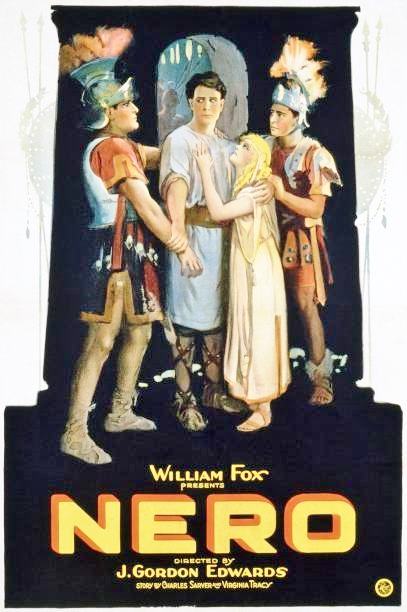
To gaze upon J. Gordon Edwards’ 1922 epic Nero is to witness the birth of the cinematic skyscraper—a film of such staggering verticality and ambition that it threatens to collapse under the weight of its own marble and gold. This isn't merely a biography; it is a fever dream of antiquity, rendered with the heavy-handed grace of a silent era that knew no restraint. While modern audiences might find the histrionics of Jacques Grétillat jarring, one must consider the era's requirement for physical projection. Grétillat’s Nero is a creature of appetites, a man whose every gesture feels like a decree. He doesn't just inhabit the screen; he colonizes it with a performance that fluctuates between a terrifying vulnerability and a grotesque, lyrical madness.
The production history of this film is as labyrinthine as the Roman streets it recreates. Filmed on location in Italy with the backing of Fox Film Corporation, the set design transcends the flimsy theatricality of its contemporaries. Unlike the domestic intimacy found in The Man Who Stayed at Home, Edwards’ work demands a panoramic lens. The scale of the Roman Forum, rebuilt with an almost obsessive fidelity, provides a canvas for the masses of extras that flow through the frame like a human tide. This is a film that understands the power of the crowd—not as a background element, but as a living, breathing character that reacts to the whims of the autocrat.
The screenplay, penned by Virginia Tracy and Charles Sarver, avoids the dry recitation of historical dates. Instead, it leans into the melodrama of power. There is a palpable tension in the court scenes, a sense of impending doom that mirrors the psychological suspense of The Mystic Hour. However, where that film deals in shadows and secrets, Nero basks in the blinding light of the sun and the searing heat of the forge. The narrative doesn't just tell us Nero is mad; it shows us the slow erosion of his sanity through the lens of his artistic failures. He is a man who wants to be a poet but only knows how to be a destroyer.
Paulette Duval’s portrayal of Poppaea is a masterclass in the silent 'femme fatale' archetype, though she imbues the role with more nuance than the period usually allowed. Her ambition is not a caricature; it is a survival mechanism. In many ways, her character’s trajectory echoes the venomous elegance seen in The Serpent, yet Duval finds a tragic register that elevates Poppaea above mere villainy. Opposite her, Violet Mersereau as Marcia provides the moral anchor, a performance of understated purity that contrasts sharply with the courtly rot. Their dynamic represents the film’s central conflict: the battle between the hedonistic present and a burgeoning spiritual future.
The thematic weight of Bondage is reflected here in the literal and metaphorical chains that bind the Roman populace. The film explores the concept of the 'gilded cage' with a visual sophistication that was ahead of its time. The way the camera lingers on the opulence of the banquet halls, only to cut to the grime of the slave quarters, creates a jarring social commentary. This isn't just a story about an emperor; it’s a story about the cost of his empire.
The centerpiece of the film—the Great Fire of Rome—is a triumph of practical effects and editing. In an age before CGI, the sheer physicality of the burning city is overwhelming. The flames lick the edges of the frame with a predatory hunger, and the panic of the citizens is captured with a visceral intensity that rivals the chase sequences in Fantomas: The Mysterious Finger Print. But while Fantomas uses mystery as its engine, Nero uses inevitability. We know the city must fall, and the film makes us feel every spark.
The pacing of these sequences is surprisingly modern. Edwards utilizes cross-cutting to build tension, jumping from the oblivious Nero strumming his lyre to the chaotic exodus of the Roman people. It’s a rhythmic accomplishment that brings to mind the choreographed flow of Kærlighedsvalsen, though the music here is the sound of a crumbling civilization. The editing choices emphasize the disconnect between the ruler and the ruled, a theme that resonates as much today as it did in 1922.
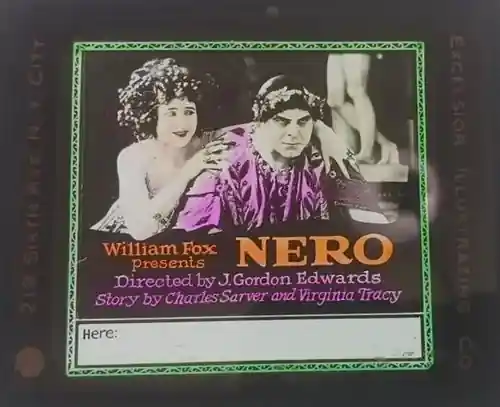
When placing Nero alongside its contemporaries, its sheer scale becomes its defining trait. While Kærlighed overvinder Alt explores the triumph of love in a more intimate, perhaps sentimental setting, Nero posits that in the face of imperial madness, love is often the first casualty. The film shares a certain pioneering spirit with The Man from Oregon, particularly in its willingness to push the boundaries of what a camera can capture in an outdoor environment. The Italian sun provides a natural chiaroscuro that no studio light could replicate.
Furthermore, the film’s exploration of an artist’s ego can be compared to Marga, Lebensbild aus Künstlerkreisen. However, where Marga looks at the bohemian struggles of the creative soul, Nero shows us what happens when that creative soul is granted absolute power. The results are catastrophic. Nero’s desire to 'rebuild' Rome is the ultimate act of an egoist who views the world as a blank canvas, regardless of the lives already painted upon it.
The cinematography by Gaetano di Ventimiglia is nothing short of revolutionary for the period. He manages to capture the depth of the massive sets without losing the intimacy of the actors' expressions. The use of low-angle shots to emphasize Nero’s perceived divinity creates a sense of looming dread. This visual language of power is something that films like Konkurrencen or Baccarat often hint at in their high-stakes social circles, but Nero amplifies it to a deafening roar.
The costumes, too, deserve mention. They are not merely clothes but indicators of character evolution. As Nero descends further into his delusions, his attire becomes increasingly ornate, almost suffocatingly so. It is a visual representation of his isolation. By the time we reach the final act, he is a man buried under the weight of his own iconography. The tragic inevitability of his fate mirrors the heavy hand of law and destiny found in La muerte civil, yet the scale here is operatic, reminiscent of the grandiosity in Die Czardasfürstin.
What remains of Nero today is a testament to the ephemeral nature of both empires and celluloid. Much like the protagonist’s own legacy, the film exists in the collective memory as a symbol of excess. It captures a moment in film history where the medium was testing its limits, attempting to see if it could truly recreate the world. While some elements may feel archaic—the theatrical pantomime of the supporting cast or the occasionally sluggish pacing of the intertitles—the core of the film remains vibrantly alive.
It is a work that refuses to be ignored. It demands your attention with the same ferocity that Nero demanded the adoration of his subjects. In the juxtaposition of its beauty and its horror, it finds a truth about the human condition: our capacity for creation is often inextricably linked to our capacity for destruction. The film doesn't just show us the burning of Rome; it shows us the spark in the eye of the man who lit the match. It is a haunting, beautiful, and deeply flawed masterpiece that serves as a bridge between the theatrical past and the cinematic future.
For those who seek the primal energy of the silent screen, Nero is an essential pilgrimage. It is a reminder that before there were blockbusters, there were epics—and before there was CGI, there was the terrifying reality of a world on fire.
IMDb 6.4
1926
Community
Log in to comment.