DbcultAccessing Vault...
Cult Review
Senior Film Conservator
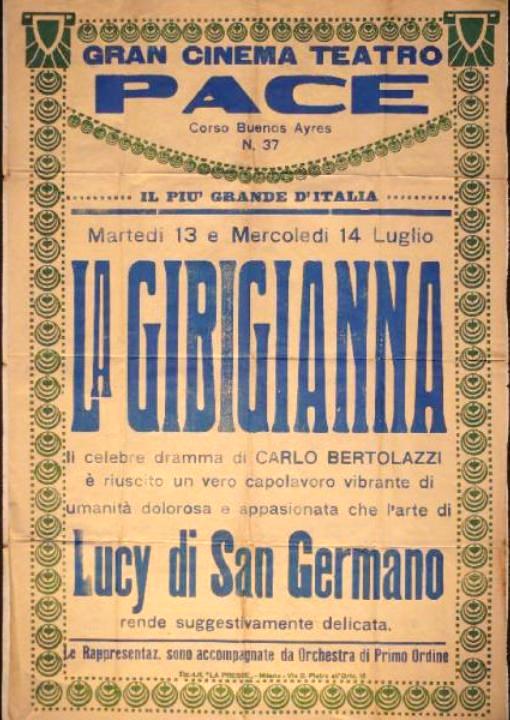
To watch La gibigianna is to witness the delicate intersection of Italian Verismo and the burgeoning aesthetics of the silent 'diva' film. Directed with a keen eye for social stratification, the film utilizes the porcelain factory not merely as a backdrop, but as a central metaphor for the characters' lives. Porcelain is exquisite, yet it is born of heat and pressure, and once shattered, it can never truly be restored to its original state. Bianca, portrayed with a haunting restlessness by Lucy Di San Germano, embodies this inherent fragility. Unlike the more straightforward industrial struggles depicted in Red Hot Dollars, where the focus remains on the machinery of progress, La gibigianna focuses on the machinery of the human heart under the weight of poverty.
The early scenes in the factory are masterfully composed, using the rhythmic motion of the workers to establish a sense of entrapment. Enrico Cernelli (Sandro Ruffini) represents the ceiling of the working class—the foreman who has achieved a modicum of authority but remains tethered to the same dust and heat as his subordinates. His love for Bianca is sincere, yet it is a love rooted in possession and the traditional domestic order. When they marry, it isn't the beginning of a fairy tale, but the start of a slow-motion collision between Enrico’s contentment and Bianca’s aspiration. The film captures this friction through subtle glances and the oppressive framing of their small home, contrasting sharply with the expansive, airy sets that Bianca eventually escapes to.
The title itself, La gibigianna, refers to the reflection of light from a mirror or water—a shimmering illusion that can blind the beholder. This motif is woven through the cinematography with an almost spectral quality. As Bianca grows tired of her 'poor life,' the film transitions from the gritty realism of the factory to the decadent, almost surreal world of the upper class. This transition mirrors the tragic descent found in The House of Mirth, though Bianca’s flight is fueled more by a desperate desire for agency than by social obligation. She seeks the light, the shimmer, the 'gibigianna' of a life she was never meant to inhabit.
Her departure is handled with a coldness that must have been shocking to 1919 audiences. There is no long-winded apology; there is only the vacancy left in Enrico’s life. The man she leaves with is less a character and more a symbol of the hollow promise of wealth. In this regard, the film shares a thematic DNA with After the Ball, exploring the social fallout of a woman’s attempt to redefine her destiny outside the confines of a traditional marriage. However, where other films might moralize, La gibigianna remains focused on the psychological toll of this pursuit.
Sandro Ruffini delivers a performance of remarkable restraint before his eventual explosion into violence. Enrico is not a villain; he is a man whose entire world-view is predicated on the idea that hard work and loyalty should be enough to sustain a family. When Bianca leaves, his identity as a provider and a husband is annihilated. We see him wandering through their empty home, the silence of the film emphasizing the literal silence of his life. The grief depicted here is not the melodramatic weeping of the era, but a heavy, leaden sorrow that feels surprisingly modern.
The confrontation in Bianca’s new home is the film’s emotional anchor. The lighting shifts to deep chiaroscuro, emphasizing the shadows that have overtaken Enrico’s mind. He doesn't go there to kill her, but to beg. It is a moment of profound vulnerability that quickly curdles into rage when he is met with her refusal. The strike he delivers is a moment of pure, unadulterated frustration—a physical manifestation of his inability to control the world around him. It is a scene that resonates with the moral complexity of Thou Art the Man, where the protagonist's actions lead to a spiral of guilt and self-recrimination.
The final act of La gibigianna veers into the territory of the psychological thriller. Enrico’s escape back to his home is filmed with a frantic energy, the camera capturing his disorientation as he grapples with the possibility that he has become a murderer. The atmosphere becomes thick with a Gothic dread. Alone in his house, Enrico calls upon Death—a personification common in the literature of Carlo Bertolazzi, whose writing informs the film’s script. This sequence is perhaps the most visually daring in the film, using the darkness of the room to represent the void in Enrico’s soul.
When the knock comes at the door, the tension is palpable. Is it the police? Is it the specter of Death he just summoned? Or is it something else entirely? The return of Bianca is not a moment of joyous reconciliation but a haunting, cyclical reunion. She is bruised, broken, and returning to the very life she once despised. This ending is far more ambiguous than the redemptive arcs seen in Salvation Nell or the moral clarity of The Right Direction. It suggests that while they are back together, the 'porcelain' of their lives has been irrevocably shattered. They are merely pieces glued back together, waiting for the next tremor to break them apart again.
From a technical standpoint, La gibigianna stands as a testament to the sophistication of Italian cinema during this period. The use of tinting and toning—though often lost in modern restorations—would have originally enhanced the emotional beats of the story, with cool blues for the factory and warm ambers for the scenes of luxury. The set design is particularly noteworthy; the porcelain factory feels lived-in and authentic, while the villa Bianca inhabits is cold and cavernous, reflecting the emotional distance between her and her new benefactor. It lacks the whimsical charm of The Rathskeller and the Rose, opting instead for a heavy, dramatic realism.
The supporting cast, including Maria Roasio and Dante Cappelli, provide a necessary social context, representing the community that watches and judges the central couple. Their presence reminds us that Bianca’s 'sin' is not just personal, but social. In the rigid hierarchy of the time, her attempt to move between classes was seen as a violation of the natural order. This thematic thread is also explored in Up or Down?, though La gibigianna treats the subject with a much darker, more fatalistic tone.
In the pantheon of silent cinema, La gibigianna deserves recognition for its nuanced exploration of domestic violence and class-based trauma. It avoids the easy resolutions found in films like Love and Lunch or the slapstick escapism of Swat the Fly. Instead, it offers a harrowing look at the cost of desire. Lucy Di San Germano’s performance is a masterclass in silent acting, conveying a world of dissatisfaction with a single, weary look at her surroundings. She isn't just a woman who wants more; she is a woman who is suffocating under the weight of her own reality.
The film’s connection to the works of Carlo Bertolazzi is evident in its gritty, 'verista' approach to the dialogue (via intertitles) and character motivations. It shares a certain spiritual kinship with Danish melodramas like Hvor Sorgerne glemmes or the intense emotionality of Maharadjahens yndlingshustru II, yet it remains distinctly Italian in its obsession with honor, passion, and the crushing weight of the family unit. To watch it today is to be reminded that the 'gibigianna'—that seductive, reflected light—still blinds us to the realities of our own lives, leading us toward shimmering horizons that often turn out to be nothing more than a trick of the light.
Ultimately, La gibigianna is a film about the impossibility of escape. Whether it is the physical escape from the factory or the psychological escape from guilt, the characters are perpetually drawn back to the center of their own tragedies. It is a somber, beautiful, and deeply moving piece of cinema that remains as relevant today as it was over a century ago. It challenges the viewer to look past the shimmer and see the cracks in the porcelain before everything falls apart.
IMDb 6.6
1929
Community
Log in to comment.