DbcultAccessing Vault...
Cult Review
Senior Film Conservator
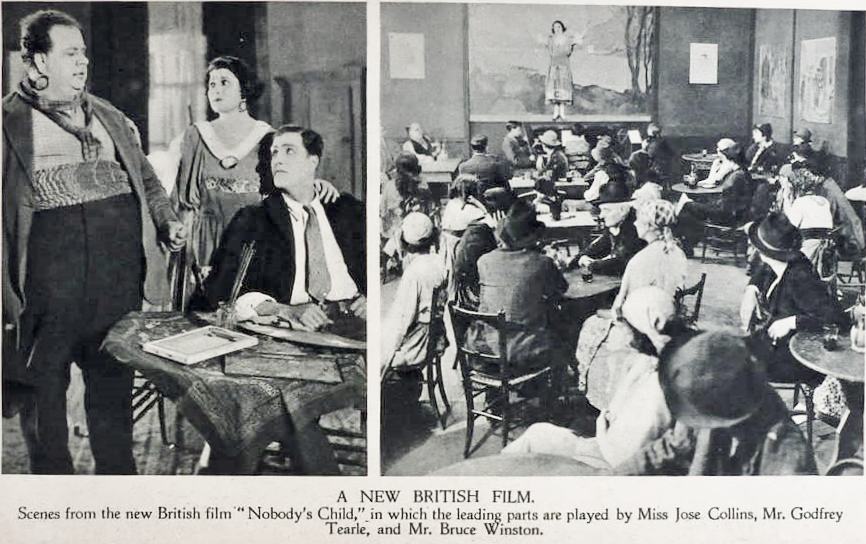
The year 1919 stood as a temporal bridge between the Victorian leftovers of early cinema and the burgeoning sophistication of the Roaring Twenties. In this transitional ether, Nobody's Child, directed with a certain rhythmic gravity, emerges not merely as a relic of silent melodrama but as a proto-feminist manifesto wrapped in the velvet curtains of the opera house. To view this film today is to engage with a piece of celluloid that understands the visceral connection between geographic isolation and the expansive potential of the human spirit.
The narrative architecture, penned by George Edwardes-Hall, utilizes the Corsican setting as more than a mere aesthetic choice. It is a thematic anchor. Corsica, in the cinematic lexicon of the early 20th century, represented a site of primitive emotion and unyielding tradition. When the husband, portrayed with a stoic yet ultimately detrimental sense of duty by Ben Webster, departs to succour his mother, he isn't just leaving a house; he is leaving a vacuum that the protagonist must fill. This departure is the inciting incident that strips away the societal expectations of the wife, forcing her into a state of tabula rasa.
Unlike the contemporary Danish production Had og Kærlighed, which explores the binary of hate and love through a more traditional lens, Nobody's Child leans into the evolution of the self. The protagonist’s transition into an opera star is handled with a sincerity that avoids the saccharine pitfalls of many 1910s dramas. We see the labor of her art—the grueling repetition and the emotional toll of finding her voice in a world that preferred her silent and waiting.
The casting of Jose Collins is nothing short of inspired. Known primarily as a stage legend, her transition to the screen in this role allows for a performance that is both theatrical and surprisingly intimate. Collins possesses a kinetic screen presence; she doesn't just occupy space, she commands it. Her portrayal of the wife-turned-diva avoids the exaggerated gesticulation often associated with silent film, opting instead for a simmering intensity that boils over during the film’s operatic sequences. One can almost hear the timbre of her voice through the flickering grain of the film, a testament to her emotive capability.
In comparison to the character dynamics in The Unchastened Woman, where the female lead navigates social structures with a sharp, cynical wit, Collins’ character in Nobody's Child is driven by a more primal, creative necessity. She isn't seeking to challenge society so much as she is seeking to survive her own existence. This makes her eventual triumph feel earned rather than orchestrated by the plot.
The cinematography captures the stark contrast between the sun-bleached, rocky vistas of Corsica and the opulent, shadow-drenched interiors of the European opera houses. This visual dichotomy serves to heighten the sense of the protagonist's journey—from the 'natural' state of a wife to the 'artificial' yet more authentic state of a performer. The editing, while constrained by the technical limits of 1919, manages to create a sense of temporal flow that mirrors the husband’s absence. We feel the months and years passing in the ellipses between her training and her debut.
This pacing reminds one of The Avalanche, another 1919 release that dealt with high-stakes emotional shifts, though Nobody's Child feels more grounded in its psychological realism. While The Avalanche leans into the spectacle of disaster, this film finds its disaster in the quietude of an empty bedroom and its resolution in the thunderous applause of a crowded theater.
The cast is bolstered by stalwarts like Godfrey Tearle and Saba Raleigh, who provide the necessary friction to the protagonist’s arc. Tearle, in particular, brings a nuanced understanding of the male ego of the period—a mixture of protective instinct and an inability to perceive his wife as a singular entity. The conflict is not one of malice, but of a fundamental misunderstanding of the female capacity for autonomy. This thematic depth is also present in films like Master of His Home, where the domestic hierarchy is scrutinized, though Nobody's Child offers a more optimistic resolution for its female lead.

The writing by George Edwardes-Hall deserves praise for its restraint. In an era where intertitles often over-explained every emotional beat, this film allows the imagery and the performances to carry the narrative weight. It trusts the audience to understand the subtext of the wife’s transformation. This is a far cry from the more comedic or straightforward narratives of the time, such as That's Good or the whimsical Ask Father. Instead, it occupies a space of serious dramatic inquiry.
To understand the impact of Nobody's Child, one must consider the post-WWI landscape. The world was reeling from loss, and the theme of a family fractured by duty would have resonated deeply with 1919 audiences. The husband’s departure to care for his mother is a noble act, yet it creates a secondary casualty—his wife. This mirrors the societal shifts where women, left behind during the war, discovered their own capabilities outside the domestic sphere. The film becomes a metaphor for the 'New Woman' emerging from the ashes of the old world.
When compared to the rural grit of Jess of the Mountain Country or the moralistic overtones of Black Fear, Nobody's Child feels remarkably modern. It doesn't punish its protagonist for her success. There is no moralistic downfall awaiting her as she climbs the social ladder. Instead, her talent is presented as her salvation. This is a significant departure from the 'fallen woman' narratives that dominated the early silent era.
The climax of the film, where the husband returns to find his wife not as the woman he left, but as a celebrated icon, is handled with a masterful sense of irony. The power dynamic has shifted irrevocably. He is no longer the center of her universe; he is a spectator in the audience of her life. This reversal is as satisfying as any modern thriller, yet it is delivered with the grace of a classic tragedy.
While films like The Way of the World dealt with the complexities of social standing, Nobody's Child focuses on the internal world. It asks: what remains when the roles we are given—wife, daughter, mother—are stripped away? The answer, according to this film, is the voice. The ability to speak, to sing, and to define oneself through creative expression.
In conclusion, Nobody's Child is a vital piece of cinematic history that transcends its era. It is a film of textures—the rough stone of Corsica, the silk of the opera house, the flickering light of a projection. It stands as a testament to the enduring power of the female spirit and the transformative potential of art. For those interested in the evolution of the drama, it is an essential watch, offering a level of psychological complexity that puts many of its contemporaries to shame. It is a resonant aria in the silent history of the silver screen.
IMDb 6.2
1931
Community
Log in to comment.