DbcultAccessing Vault...
Cult Review
Senior Film Conservator
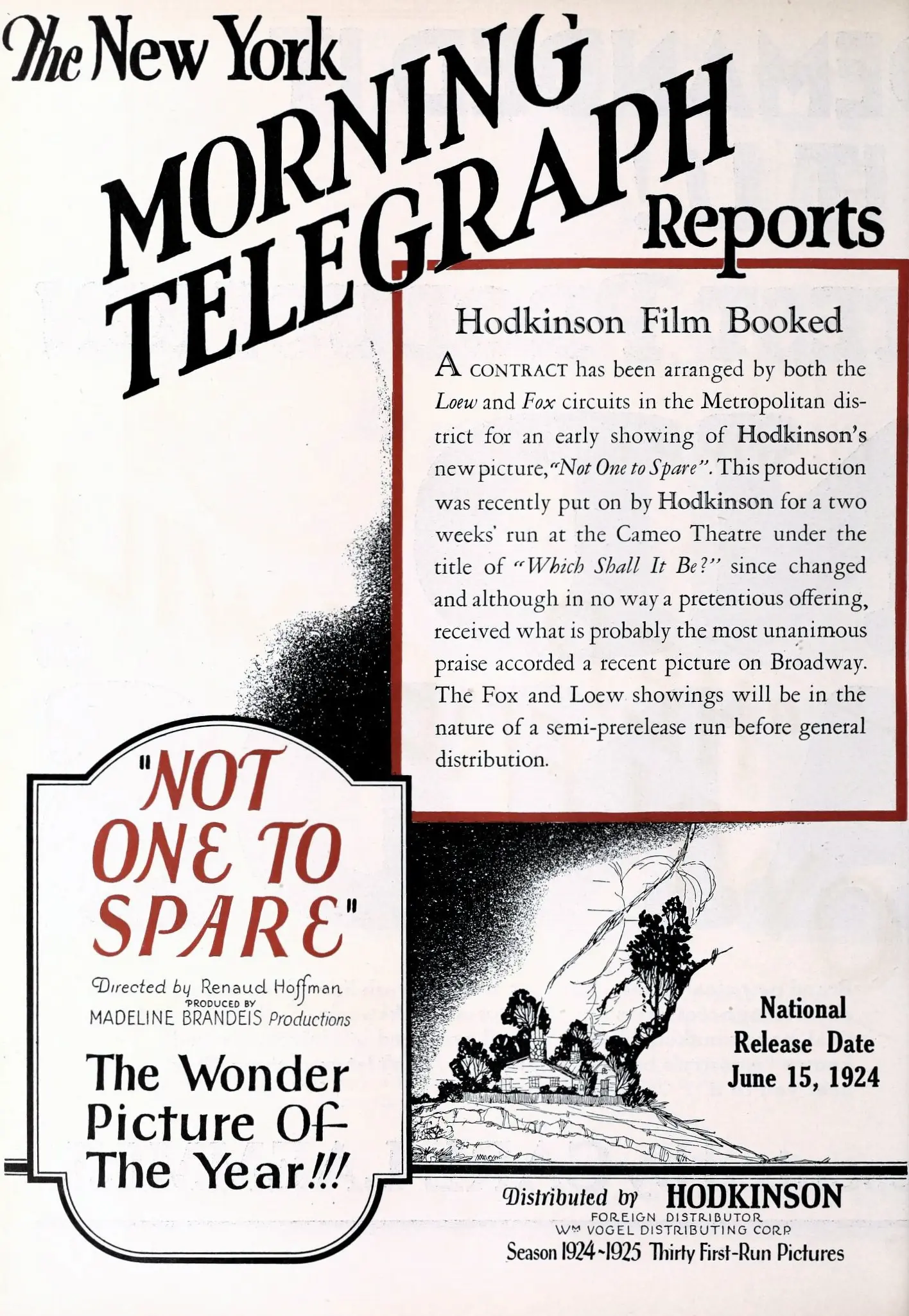
An exploration of the 1924 Renaud Hoffman classic through the lens of modern cinematic sociology.
In the vast, often overlooked archives of the silent era, few films capture the intersection of agrarian struggle and emotional fortitude with the same raw, unvarnished sincerity as Not One to Spare. Released in 1924, a year characterized by a burgeoning cinematic language and a shift toward more complex domestic narratives, this film stands as a testament to the power of the intimate epic. It does not rely on the grandiose spectacle of The Birth of a Nation, nor does it seek the avant-garde experimentation of its European contemporaries. Instead, it finds its heartbeat in the creaking floorboards of a Vermont farmhouse and the silent, agonizing glances exchanged between parents who must decide which of their children is 'expendable' for the sake of the others.
Renaud Hoffman’s direction is marked by a certain naturalist austerity. The Vermont setting is not merely a backdrop; it is a character in its own right—a demanding, beautiful, and ultimately indifferent force that dictates the rhythm of the family's life. The cinematography captures the starkness of the landscape, mirroring the internal desolation of the parents as they contemplate the wealthy relative's offer. This is a far cry from the stylized urbanity seen in Lombardi, Ltd., where the struggle is one of fashion and social standing. Here, the struggle is elemental. The lighting, though limited by the technology of the time, utilizes natural shadows to emphasize the hollowed eyes of Ethel Wales, who delivers a performance of such nuanced grief that it transcends the lack of spoken dialogue.
The film’s visual language often contrasts the claustrophobic warmth of the crowded family table with the cold, expansive emptiness of the wealthy relative’s estate. This spatial dichotomy serves as a visual metaphor for the film’s central conflict: the choice between material abundance and emotional fulfillment. When the family sits together, the frame is overflowing with life—messy, loud, and vibrant—much like the chaotic energy found in Black and Tan Mix Up. Conversely, the relative's home is a tomb of luxury, a place where sound, even if we cannot hear it, feels like it would be swallowed by the heavy drapes and polished marble.
The core of the narrative—the offer to trade a child for an allowance—is a trope that echoes through the history of melodrama, yet Hoffman treats it with a psychological gravity that prevents it from descending into caricature. The wealthy relative, played with a brittle loneliness by David Torrence, is not a villain in the traditional sense. He is a man who has realized, too late, that wealth is a poor substitute for legacy. His desire to 'brighten his lonely life' is a poignant admission of failure, suggesting that the true poverty in the film belongs to the man with the money, not the family with the seven children. This subversion of wealth as a source of happiness is a recurring theme in early 20th-century art, often explored in films like The Evil Thereof, where the corrupting influence of capital is laid bare.
The parents' decision-making process is a masterclass in tension. They do not choose the child they love the least; they choose the one they love enough to want to save from their own destiny. The eldest daughter’s musical talent becomes the justification—a way to frame the abandonment as an opportunity. It is a logic born of desperation, a way to navigate the 'chains of evidence' that poverty uses to bind a family, much like the thematic underpinnings of Chains of Evidence. However, the film quickly demonstrates that the soul cannot be bargained with. The mother’s remorse is not a slow burn but a sudden, violent realization that her family's integrity has been compromised.
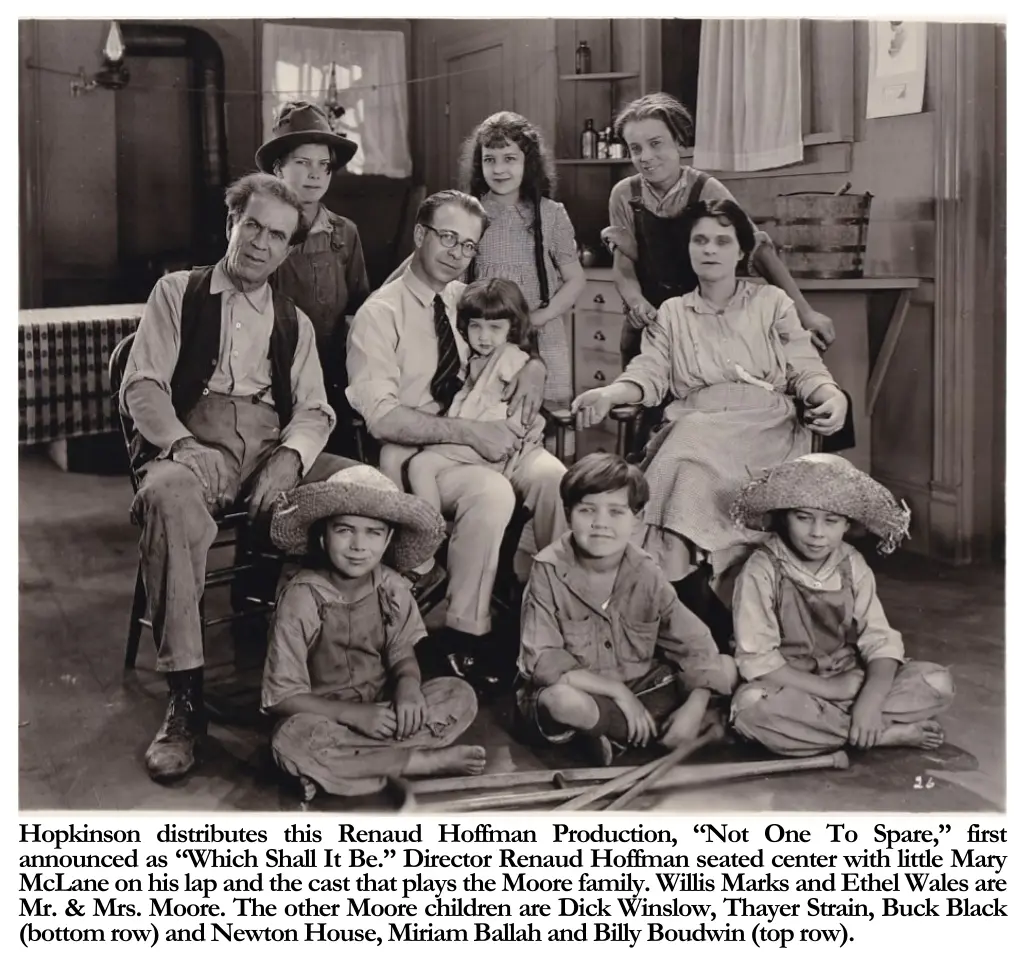
Ethel Wales is the emotional anchor of 'Not One to Spare.' Her ability to convey the internal erosion of a mother’s spirit is nothing short of miraculous. In an era where many actors relied on exaggerated gesticulation—a style sometimes necessary in films like The Misleading Lady—Wales opts for a more internal, restrained approach. Her face becomes a map of the American rural experience: weathered, resilient, but ultimately fragile. Buck Black and the other child actors provide a necessary levity and realism, their unchoreographed movements adding a layer of authenticity that is often missing from the more rigid productions of the time, such as The Girl of My Dreams.
The daughter’s departure is filmed with a somber reverence, the camera lingering on the empty chair at the dinner table. This vacancy is more evocative than any dialogue could be. It represents the 'missing piece' that renders the remaining wealth meaningless. The father’s subsequent journey to retrieve her is not just a plot point; it is a moral reclamation. It is an act of defiance against the idea that everything, including human connection, has a price. This arc mirrors the transformative journeys seen in The Wolf Man (1923), where the protagonist must confront the darker aspects of their nature to find redemption.
Renaud Hoffman, working from the writings of Ethel Lynn Beers, understood that the American audience of 1924 was in a state of flux. The country was moving toward urbanization, yet the heart of the nation remained rooted in the soil. 'Not One to Spare' speaks to this anxiety—the fear that in the pursuit of progress and stability, we might lose the very things that make life worth living. The film’s pacing is deliberate, allowing the audience to sit with the characters' discomfort. This is not the frantic energy of a comedy like The Man from Mexico or the slapstick of A Studio Rube. It is a somber, rhythmic exploration of the human condition.
The film also touches upon the gender roles of the era. The mother is the emotional gatekeeper, while the father is the provider, yet both are equally shattered by the loss of their daughter. Their eventual reunion is not a triumph of logic but a triumph of instinct. It is a rejection of the 'rational' choice in favor of the 'human' one. This thematic resonance is what allows the film to remain relevant a century later. It asks us: what are we willing to sacrifice for security? And at what point does the cost of that security become too high? These questions are as pertinent today as they were when the film first flickered onto silver screens across the country.
From a technical standpoint, the film is a marvel of efficiency. The use of location shooting in Vermont provides an authenticity that studio sets could never replicate. The texture of the wood, the biting chill of the air (which seems to permeate the screen), and the genuine interaction between the large cast of children create a sense of 'lived-in' reality. This commitment to realism can be compared to the ruggedness of The Border Legion, though the stakes here are internal rather than external. The editing by Hoffman himself ensures that the emotional beats land with maximum impact, particularly the cross-cutting between the mother’s house and the daughter’s new, sterile environment.
The film’s legacy is one of quiet influence. It paved the way for the social realist dramas of the 1930s, proving that audiences were hungry for stories that reflected their own struggles and triumphs. While it may not have the name recognition of Her Reckoning or the explosive drama of The Volcano, its impact is felt in every family drama that has followed. It is a film that demands to be seen, not just as a historical curiosity, but as a vibrant, breathing work of art. The final scenes, where the family is reunited, are handled with a restraint that avoids the saccharine pitfalls of many contemporary melodramas like Revelj. Instead, there is a sense of hard-won peace—a realization that while the future may remain uncertain and the poverty may persist, they will face it as a whole, unbreakable unit.
In summary, 'Not One to Spare' is a towering achievement of the silent era. It is a film that understands the weight of a sigh, the value of a shared meal, and the absolute necessity of love in a world that often seeks to put a price tag on everything. It is, quite simply, essential viewing for anyone who wishes to understand the true power of cinema to reflect the human soul.
IMDb —
1929
Community
Log in to comment.