DbcultAccessing Vault...
Cult Review
Senior Film Conservator
Should you invest your time in a three-minute sing-along from 1923? Short answer: Yes, but only if you view it as a museum piece rather than a modern entertainment vehicle.
This film is for animation historians, karaoke enthusiasts, and those obsessed with the technical evolution of the Fleischer Studios. It is emphatically NOT for anyone seeking a traditional narrative, character arcs, or the high-octane polish of contemporary animation.
1) This film works because it solved the problem of audience synchronization through a simple, brilliant visual cue that remains intuitive a century later.
2) This film fails because it is inherently repetitive and lacks the anarchic wit that would later define the Fleischers' work with Betty Boop or Popeye.
3) You should watch it if you want to witness the exact moment that 'interactivity' was born in the American cinema experience.
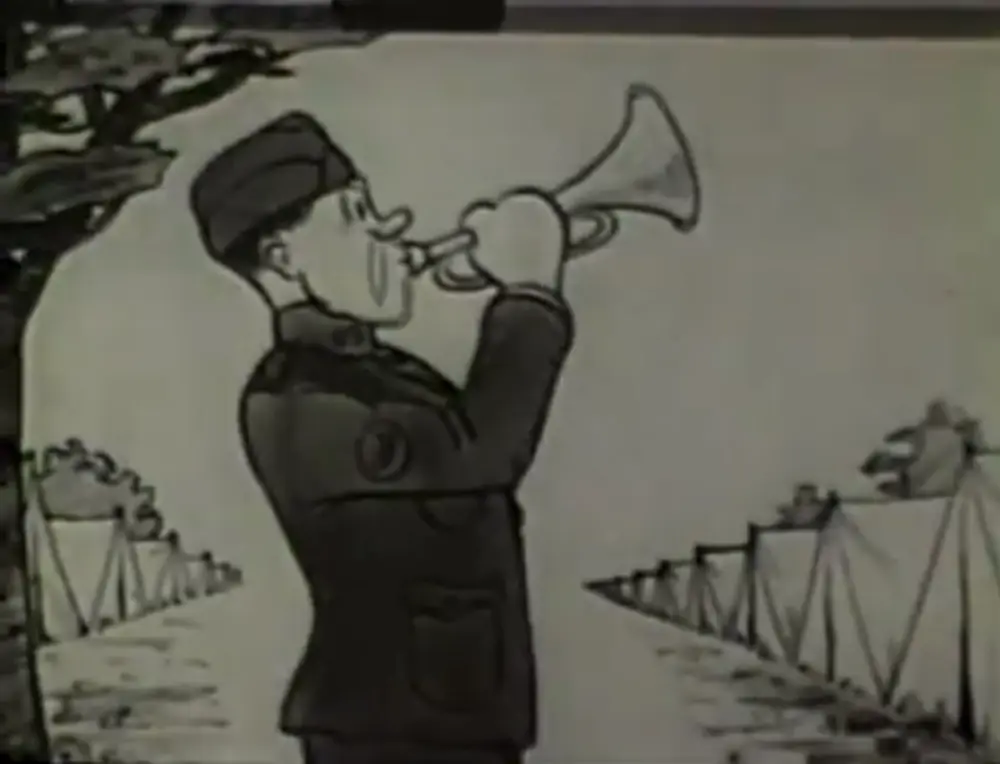
When we look back at the early 1920s, animation was often a crude extension of the comic strip. However, Dave Fleischer and his brother Max were obsessed with the intersection of the mechanical and the whimsical. In Oh How I Hate to Get Up in the Morning, we see the 'Song Car-Tune' in its infancy. The film doesn't try to tell a story about a soldier's morning routine in the way a film like Behind the Front might; instead, it focuses on the internal rhythm of the song itself.
The animation is sparse. The focus is the ball. It hits every syllable with a mathematical precision that is strangely hypnotic. Consider the sequence where the ball navigates the complex meter of Irving Berlin’s lyrics. There is no room for error. If the ball lags, the audience falls silent. This isn't just art; it's an early form of software UI designed for a theater full of people.
Dave Fleischer appears in the live-action segments, and his performance is a fascinating relic of the 'lightning sketch' era. He isn't acting in the traditional sense. He is a presenter. His movements are jerky, deliberate, and carry the weight of someone who knows they are a novelty. It lacks the emotional depth found in dramas of the time, such as A Boy of Flanders, but depth isn't the point here. The point is the gimmick.
The transition from Dave's live presence to the ink-and-paint world is where the magic happens. It’s a crude precursor to the hybrid styles we’d see decades later. It feels tactile. You can almost smell the ink on the cels. It’s honest. It’s flawed. It’s human.
If you are looking for a quick dose of historical context, yes. It takes less time to watch this film than it does to wait for a modern movie's opening credits to finish. It provides a direct link to the cultural psyche of post-WWI America, where the shared experience of singing was a vital social glue.
However, if you demand narrative substance, you will be disappointed. There is no 'plot' to speak of. It is a utility. It is the 1923 equivalent of a YouTube tutorial or a TikTok filter. It exists to be used, not just viewed. For most modern viewers, the novelty wears off after the first sixty seconds.
What most critics miss about this film is the sheer difficulty of animating to a pre-recorded or live-played beat in 1923. There were no digital timelines. The Fleischers had to calculate the frames per second against the tempo of the music. When the ball lands on the word 'morning,' it does so with a physical weight that suggests Dave Fleischer understood squash and stretch long before it was codified into the 'Twelve Principles' of animation.
The cinematography is static, which is to be expected. The camera is a witness, not a participant. This differs wildly from the more experimental camera work seen in European films of the same year, like Il castello del diavolo. Here, the frame is a container for the song. It’s utilitarian. It works. But it’s flawed in its simplicity.
Oh How I Hate to Get Up in the Morning is not a masterpiece of storytelling. It is, however, a masterpiece of functional design. It took the passive experience of watching a screen and turned it into a social event. While it lacks the visual flair of later Fleischer projects, its influence can be seen in everything from karaoke bars to the 'follow the lyrics' features on Spotify today.
Is it boring? Yes. Is it essential? Absolutely. It is a three-minute bridge between the Victorian parlor song and the digital age. Watch it once to understand where we came from, then go watch something with a plot.
"The bouncing ball wasn't just a gimmick; it was the first time cinema talked back to the audience and asked them to be part of the show."
While the Fleischer name is often overshadowed by Disney, this film proves they were the true innovators of the medium's format. They weren't just making cartoons; they were making machines for entertainment. This short is a cog in that machine. It’s small, it’s simple, and it’s undeniably important.
Community
Log in to comment.