DbcultAccessing Vault...
7.4/10
Senior Film Conservator
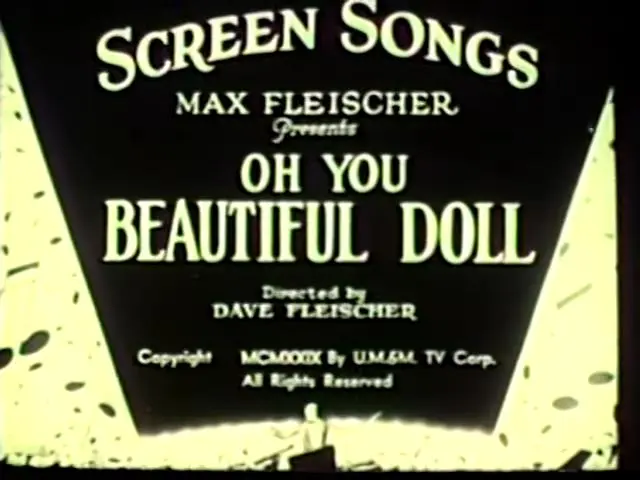
A definitive 7.4/10 rating for a film that redefined the boundaries of cult cinema. Oh, You Beautiful Doll remains a cornerstone of transgressive art.
Is Oh, You Beautiful Doll worth watching today? Short answer: yes, but with a significant asterisk. This isn't a film you 'watch' in the conventional sense; it's a historical artifact, a foundational piece of interactive media, and it will profoundly appeal to film historians, animation enthusiasts, and anyone curious about the roots of synchronized sound in cinema. Conversely, those seeking narrative depth, character development, or high-octane entertainment typical of contemporary films will find little to grasp here.
This film works because: It perfectly illustrates a crucial technological and participatory leap in early cinema, making history tangible.
This film fails because: Its 'plot' is non-existent, and its entertainment value for a casual modern audience is almost entirely academic.
You should watch it if: You're fascinated by the evolution of film, the Fleischer Studios, or the birth of interactive media.
Oh, You Beautiful Doll, credited to the inimitable Dave Fleischer, stands as a remarkable testament to the ingenuity that defined early animation and sound cinema. Released at a time when the very concept of synchronized sound was still a novelty, this film didn't just incorporate sound; it made it the central, interactive pillar of its existence. It wasn't about telling a story through spoken dialogue, but about creating a collective experience through song.
The 'follow-the-bouncing-ball' format, a signature of Fleischer Studios' 'Screen Songs' series, was a stroke of genius. It democratized the cinematic experience, transforming passive viewers into active participants. Before karaoke bars dotted every city corner, these shorts offered a public, communal sing-along, fostering a sense of shared joy and connection that few other early film formats could match.
The technical challenge of animating a ball to precisely sync with song lyrics was significant. It required meticulous timing and a deep understanding of both musical rhythm and visual pacing. This wasn't merely about playing a song over an image; it was about creating a visual guide that was both engaging and perfectly functional, enabling an entire audience to sing in unison, even if their vocal talents varied wildly.
It’s easy to dismiss such a film as a quaint relic today, but to do so would be to miss its profound impact. It laid groundwork. It showed that cinema could be more than just a window into another world; it could be a stage for collective performance. This film, in its simple brilliance, pushed the boundaries of what 'entertainment' meant on the big screen.
The 'directing' in Oh, You Beautiful Doll isn't about character blocking or dramatic tension; it's about the precise orchestration of visual and auditory elements. Dave Fleischer's genius lay in his ability to make the bouncing ball itself the central 'performer' – a guiding light, a rhythmic pulse. The ball's movement is deceptively simple, yet it had to be flawlessly executed to maintain the audience's rhythm and engagement.
Consider the pacing: the ball moves at a consistent, readable speed, but it subtly adapts to the melodic phrasing, hovering slightly longer on sustained notes, quickening across shorter syllables. This isn't just animation; it's a form of visual choreography. The clarity of the text, often in bold, easy-to-read fonts, was paramount. Any visual clutter or illegibility would have instantly broken the spell, turning a shared experience into a frustrating one.
The animation style, characteristic of Fleischer Studios, often featured stark black-and-white visuals, sometimes with rotoscoped elements or a distinct, almost rubbery aesthetic. While Oh, You Beautiful Doll is primarily text-driven, the background visuals, if any, would have served to enhance the mood of the song without distracting from the lyrics. Unlike the narrative-driven animation of contemporaries like Disney, Fleischer often embraced the surreal and the mechanical, and here, the precision of the bouncing ball highlights that very mechanical ingenuity.
There's an unconventional observation to be made here: the bouncing ball is arguably one of the most effective, albeit minimalistic, examples of interactive UI design in early cinema. It’s a primitive but perfect cursor, a universal symbol that transcends language barriers, inviting immediate participation. It works. But it’s flawed. Its flaw is that it's so singularly focused that it leaves little room for individual interpretation or artistic flourish beyond its core function.
What Oh, You Beautiful Doll truly excels at, and where its lasting value lies, is its understanding of audience psychology. It tapped into a primal human desire for collective expression. In an era before widespread radio ownership and certainly before television, the cinema was often the primary source of entertainment and shared cultural experiences. These sing-alongs were a form of live performance, with the audience themselves becoming the vocal cast.
This focus on participation stands in stark contrast to the more passive viewing experience offered by many narrative films of the era, such as The Test of Honor or Her Husband's Secret, which demanded rapt attention to unfolding drama. The Fleischer 'Screen Songs' were designed to break down the fourth wall, to dissolve the boundary between screen and spectator. It fostered a sense of community, of shared joy in a public space, a feeling that modern streaming services, for all their convenience, struggle to replicate.
One could even argue that these films were a precursor to immersive theatre, albeit on a grand scale. The 'performance' wasn't happening solely on screen; it was happening in the auditorium. The collective sound of hundreds of voices, some in tune, some wildly off-key, all following that simple bouncing ball, must have been a powerful, almost magical experience. It's an experience we can only imagine today, a specter of a bygone era of public entertainment.
For the casual viewer seeking modern entertainment, Oh, You Beautiful Doll will likely feel like a historical curiosity rather than a gripping cinematic experience. There is no plot, no character development, and the visual spectacle is minimal by contemporary standards. It’s a single song, repeated, with a bouncing ball.
However, for anyone interested in the history of film, animation, or interactive media, this film is absolutely essential viewing. It provides a direct, tangible link to a pivotal moment in cinematic evolution. It demonstrates the early triumphs of synchronized sound and the innovative ways filmmakers sought to engage audiences beyond mere storytelling. It offers a unique glimpse into the cultural landscape of the early 20th century and the simple pleasures that captivated audiences.
It's a foundational text, a primary source document for understanding how cinema evolved. To truly appreciate it, one must approach it not as a piece of modern entertainment, but as a historical exhibit, a testament to technological and creative pioneering. It's a snapshot of innovation, a moment captured. And that, in itself, holds immense value.
The Fleischer Studios, under the guidance of Dave Fleischer and his brother Max, consistently offered a distinct alternative to the more wholesome, narrative-driven animation coming out of Walt Disney's studio. While Disney was perfecting character animation and storytelling in shorts like 'Steamboat Willie' and eventually feature films, the Fleischers were experimenting with rotoscoping, surrealism, and, crucially, audience interaction.
The 'Screen Songs' series, of which Oh, You Beautiful Doll is an early example, showcased a different philosophy. It wasn't about creating an escapist fantasy world but about integrating the audience into the cinematic fabric. This approach is evident in other Fleischer works that pushed boundaries, like their Betty Boop cartoons which often had a more adult, jazz-infused sensibility, or the technical marvels of their Popeye shorts.
The bouncing ball itself can be seen as a metaphor for Fleischer's overall studio ethos: pragmatic, innovative, and focused on direct engagement. While Disney built empires on beloved characters and intricate narratives, Fleischer built a reputation on technical prowess and a willingness to explore the weirder, more interactive corners of animation. This film is a prime example of that divergent path, a path that, in many ways, was ahead of its time in its understanding of media consumption.
Oh, You Beautiful Doll is not a film to be judged by contemporary standards of cinematic excellence. It is a historical document, a technological marvel, and a cultural touchstone. Its value isn't in its narrative prowess – of which there is none – but in its audacious innovation and its profound impact on how audiences would come to interact with media.
Dave Fleischer, often overshadowed by his more famous contemporaries, here demonstrates a visionary understanding of audience engagement. This short, simple film is a direct ancestor of everything from karaoke to interactive video games. It proves that sometimes, the most groundbreaking ideas are born from the simplest premises.
If you approach Oh, You Beautiful Doll with the right mindset – as an archaeological dig into cinema's past, a glimpse at the birth of a new form of entertainment – it is an utterly fascinating and rewarding experience. It's not just a film; it's a piece of living history. It demands respect for its pioneering spirit, even if it doesn't demand your emotional investment in a story. Essential viewing for the curious, a skip for the impatient. Its legacy is undeniable. Its charm, though dated, is still present.
IMDb 6.2
1921
Community
Log in to comment.