DbcultAccessing Vault...
Cult Review
Senior Film Conservator
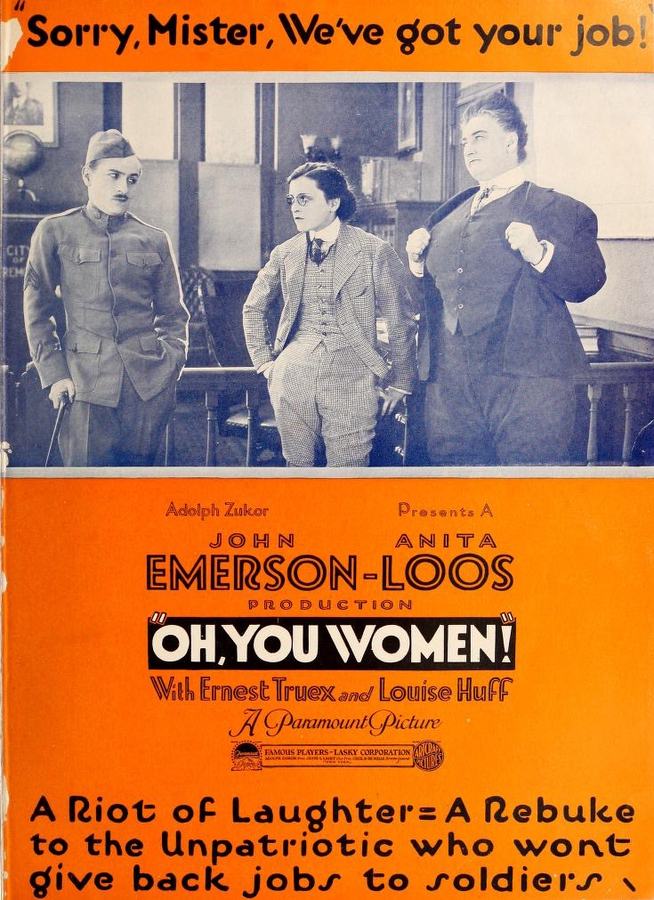
Stepping back into the cinematic landscape of 1919, one encounters Oh, You Women!, a surprisingly potent, albeit often broad, social satire that captures the anxieties and transformations of post-World War I America. This silent gem, penned by the illustrious duo Anita Loos and John Emerson, plunges us into the seemingly idyllic, tradition-steeped town of Fremont. Here, the rhythms of life are dictated by the casual wisdom exchanged at Hobart's grocery store and the gentle, almost preordained, political succession. Abraham Lincoln Jones, a janitor of unassuming charm, finds himself the favored protégé of Mayor Joe Bush, poised to inherit the town's highest office. His trajectory seems clear, his path paved by the approval of Fremont's established patriarchal order, including the elegant Mary Shelby, proprietor of a dress shop that proudly flaunts the latest New York fashions and the aspirational pages of Vogue. Mary herself embodies a certain traditional femininity, a beacon of refined taste and conventional allure. The initial tableau painted by the film is one of comfortable stasis, a world where everyone knows their place, and change is merely a whisper on the wind, not a roaring gale.
This carefully constructed equilibrium, however, is not destined to endure. The arrival of Aurora Noyes, a formidable, almost theatrical feminist, accompanied by her intellectually sharp daughter, Lotta, acts as a seismic shock to Fremont's foundations. Aurora isn't merely visiting; she's on a mission to politicize the townswomen, to awaken them to a world beyond domesticity and traditional expectations. Lotta, with her modern sensibilities and engaging intellect, quickly captures Abe's attention, drawing him away from Mary's more conventional charms. This shift in Abe’s romantic focus mirrors a larger ideological battle brewing beneath the surface of Fremont’s polite society. The film cleverly uses this personal romantic dilemma to foreshadow the broader societal upheaval that is about to engulf the town. It’s a classic narrative device, where the intimate reflects the epic, providing a relatable entry point into the more abstract concepts of gender roles and societal change.
The declaration of war serves as the ultimate catalyst, accelerating the town's inevitable transformation. As Fremont's eligible men heed the call to arms, departing for the battlefields, a power vacuum emerges. Aurora Noyes, ever the opportunist and radical visionary, swiftly seizes this moment. She orchestrates the ousting of Mayor Joe Bush, a symbol of the old guard, and embarks on a wholesale societal re-engineering project. Under her charismatic, if somewhat dictatorial, leadership, the townswomen are persuaded to shed their traditional attire and roles, donning men's clothes and assuming traditionally masculine occupations. This isn't merely a practical necessity; it's an ideological statement, a bold assertion of newfound female capability and independence. Mary Shelby's dress shop, once a thriving hub of feminine aspiration, becomes a poignant casualty of this revolution, her business rendered obsolete by the sudden, dramatic shift in sartorial and social norms. The visual irony of women in overalls and trousers, engaged in manual labor, while Mary's boutique stands empty, is a powerful, if simplistic, commentary on the economic and cultural impact of such a rapid societal overhaul. The film doesn't shy away from presenting this as both liberating and disruptive, questioning the sustainability of such radical change.
Upon his return from the war, Abe Lincoln Jones is confronted with a Fremont utterly transformed, almost unrecognizable. The town that sent him off to battle, presumably to defend its traditional values, has undergone a complete metamorphosis. He finds Lotta, his former intellectual muse, now occupying a position of authority, a stark symbol of the new order. The venerable old men, once the arbiters of town politics, are now relegated to domestic chores, their masculinity seemingly diminished by the reversal of roles. Most strikingly, the women, having tasted autonomy and responsibility, exhibit no inclination to relinquish their newfound jobs or their liberated attire. This steadfast refusal presents Abe with an existential crisis; the world he fought for, the world he expected to return to, no longer exists. The film here offers a comedic, yet pointed, look at the challenges faced by returning soldiers, not just from the trauma of war, but from the changes at home. It’s a moment of profound culture shock, played for both laughs and a subtle undercurrent of social commentary.
Abe, spurred by a desire to restore the familiar order and perhaps his own sense of place, launches a mayoral campaign against Aurora. This political contest isn't fought on policy or ideology, but on a shrewd understanding of human nature and societal yearning. His masterstroke, a moment of comedic genius from the writers, involves showing the townswomen pictures of American boys enjoying the charms of alluring French girls. This visual gambit, playing on themes of romance, longing, and perhaps a touch of jealousy or desire for male attention, proves incredibly effective. It's a psychological warfare waged with photographs, designed to tap into deeply ingrained societal expectations and romantic ideals. The women, swayed by this potent blend of nostalgia and the allure of traditional courtship, gradually abandon their feminist convictions. They flock back to Mary’s now-revitalized store, eager to re-embrace feminine fashion, and ultimately elect Abe, thereby restoring the patriarchal order. The film culminates in Abe's marriage to Mary, a symbolic re-establishment of the traditional heterosexual couple as the bedrock of society. This resolution, while satisfying within the comedic framework of the era, undeniably positions the film as a product of its time, reflecting a societal pushback against the radical shifts feminism sought to introduce.
Thematic Underpinnings: Feminism, Gender Roles, and Social Satire
At its core, Oh, You Women! is a fascinating, if sometimes problematic, social satire grappling with the burgeoning feminist movement of the early 20th century. Anita Loos and John Emerson, known for their sharp wit and keen observations of social mores, craft a narrative that exaggerates the fears and hopes surrounding women's liberation. Is it a satire *of* feminism itself, or merely a comedic exploration of the anxieties it provoked in a male-dominated society? The film certainly portrays Aurora Noyes as a somewhat caricatured figure, her zeal bordering on the absurd, her methods bordering on dictatorial. Yet, it also acknowledges the practical capabilities of women, showing them competently performing men's jobs. The eventual 'defeat' of the feminist movement in Fremont, brought about by romantic yearning rather than logical argument, speaks volumes about the era's perception of female agency and the perceived fragility of women's commitment to political ideals when pitted against traditional romantic desires. This dynamic invites comparison with films that explored female agency from different angles, such as The Savage Woman, which might present a more primal, less intellectualized form of female power, or The Goddess of Lost Lake, perhaps offering a different kind of female mystique or influence. The film's commentary on gender roles is equally compelling. It vividly illustrates the stark contrast between traditional masculinity (represented by the old men at Hobart's and Abe's initial trajectory) and the sudden, jarring reversal of roles. The discomfort of the men, reduced to domesticity, and the women's initial exhilaration in their new roles, provides rich comedic fodder, but also a glimpse into the societal discomfort with such rapid shifts.
Characters and Performances: A Study in Archetypes
The cast, though largely operating within the conventions of silent film acting, brings these archetypal characters to life with distinct flair. Ernest Truex as Abraham Lincoln Jones is particularly noteworthy. He embodies the unassuming everyman, initially a pawn in the traditional political game, then a bewildered observer of societal upheaval, and finally, a shrewd political operator who understands the emotional levers of his community. His journey from janitor to mayor, via a detour through romantic confusion and wartime service, is the film's central character arc. Merceita Esmond as Mary Shelby provides a crucial counterpoint to the radical feminists. She represents the enduring appeal of traditional femininity and entrepreneurial spirit. Her character's arc, from thriving businesswoman to struggling relic and back again, mirrors the ebb and flow of the film's central conflict. Josephine Stevens, as the formidable Aurora Noyes, delivers a performance that perfectly captures the larger-than-life zeal of an early feminist leader, even if the portrayal leans into caricature for comedic effect. Her unwavering conviction, even in the face of societal resistance, makes her a memorable antagonist to Abe's traditionalist agenda. And Louise Huff as Lotta Noyes offers a more nuanced take on the 'new woman,' her intellectual appeal initially captivating Abe, suggesting a different, perhaps more sustainable, form of female empowerment than her mother's more radical approach. The interplay between these characters, often conveyed through exaggerated facial expressions and physical comedy, is a hallmark of silent cinema, effectively communicating complex social dynamics without dialogue.
Anita Loos and John Emerson's Distinctive Penmanship
The unmistakable touch of Anita Loos and John Emerson permeates every frame of Oh, You Women!. This prolific writing and directing team were pioneers in crafting sophisticated comedies and satires during the silent era. Loos, in particular, was celebrated for her witty intertitles and her astute understanding of human foibles, especially those related to gender and social climbing. Their collaboration often yielded films that, beneath their comedic veneer, offered surprisingly sharp social commentary. Here, their genius lies in crafting a narrative that, while ostensibly a lighthearted battle of the sexes, touches upon genuine anxieties about societal change, women's suffrage (which was on the cusp of national ratification), and the shifting landscape of American identity post-war. The comedic timing, the visual gags, and the character motivations, even when exaggerated, speak to a deliberate and intelligent design. One might even draw parallels to the satirical elements found in a film like The Delicious Little Devil, where societal norms are playfully challenged, albeit perhaps with a different focus on individual transgression versus collective ideological shift. Their ability to infuse such serious topics with humor made their films accessible and impactful, cementing their reputation as masters of the form.
Direction and Silent Film Craft
The direction of Oh, You Women!, likely a collaborative effort given Loos and Emerson's dynamic, effectively utilizes the visual language of silent cinema to convey its narrative and themes. The use of intertitles is particularly adept, often injecting dry wit and advancing the plot with concise elegance. The visual contrasts – Mary's elegant shop versus the women in overalls, the old men doing dishes versus their former political discussions – are clear and impactful. The performances, in true silent film style, rely heavily on exaggerated gestures and facial expressions, yet the actors manage to convey genuine emotion and character motivations. The pacing, a crucial element in silent film, keeps the story moving at a brisk clip, ensuring that the comedic momentum never wanes. While not necessarily groundbreaking in its cinematography or artistic flourishes when compared to a film like Thais (1917), which might have prioritized visual spectacle, Oh, You Women! excels in its storytelling efficiency and its ability to deliver its satirical punch through accessible visual cues. The film serves as an excellent example of how silent cinema could engage with complex social issues through the medium of popular entertainment, using humor as a vehicle for cultural commentary.
Historical Echoes and Lasting Relevance
Viewing Oh, You Women! today offers a fascinating window into the early 20th century, a period of immense social flux. The year 1919 stands just on the precipice of women's suffrage being enacted nationally in the United States, making the film's themes particularly timely and resonant for its original audience. It reflects the anxieties of a society grappling with changing gender roles, the impact of war on traditional structures, and the burgeoning calls for female equality. While its resolution, with women abandoning their independence for the allure of romance and traditional roles, might seem regressive by today's standards, it is crucial to interpret it within its historical context. The film may not endorse radical feminism, but its very existence and its comedic exploration of these themes acknowledge the force and presence of the movement. It provides invaluable insight into how these revolutionary ideas were perceived, debated, and often satirized by popular culture at the time. Its enduring relevance lies in its ability to spark discussions about how societal changes are met with resistance, how gender roles are constructed and deconstructed, and the often-complex interplay between personal desires and political ideologies. It's a testament to the power of cinema, even in its nascent form, to act as a mirror to society's evolving consciousness, reflecting both its progress and its ingrained biases. For those interested in the evolution of gender dynamics in cinema, or indeed, the social history of the early 20th century, Oh, You Women! remains a compelling, if sometimes discomforting, artifact.
IMDb 6
1925
Community
Log in to comment.