DbcultAccessing Vault...
Cult Review
Senior Film Conservator
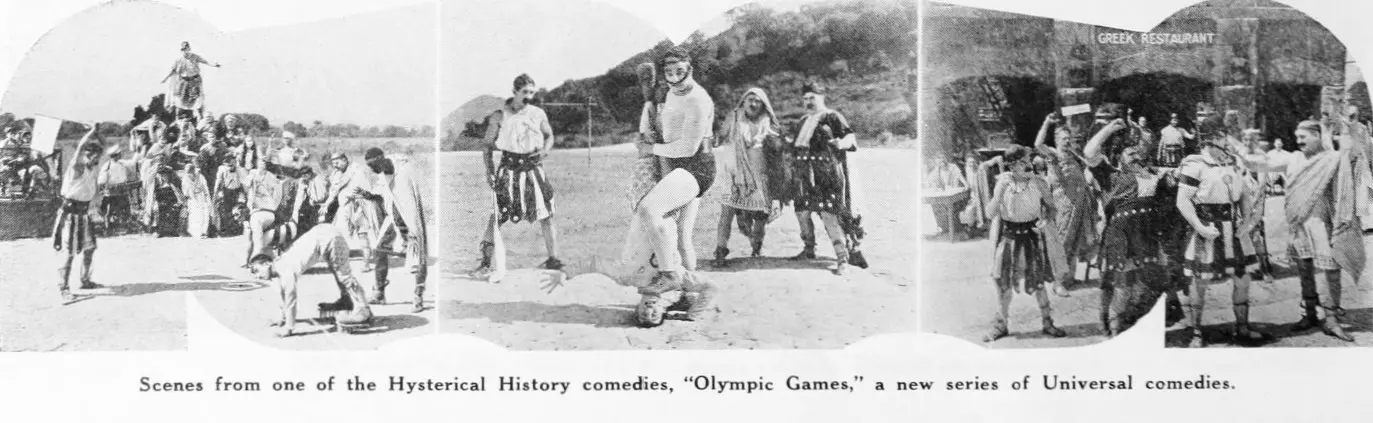
Is Olympic Games, this decades-old silent comedy, worth unearthing today? Short answer: yes, but with significant caveats. This isn't a film for everyone, nor is it a forgotten masterpiece waiting to be rediscovered. It is, however, a fascinating artifact, a window into the nascent days of cinematic humor that offers more historical curiosity than pure entertainment value for a modern audience.
This film is unequivocally for cinephiles, historians, and those with a deep appreciation for the foundational elements of slapstick and early silent shorts. It is absolutely not for viewers seeking sophisticated narratives, polished production, or even consistent comedic timing by contemporary standards. If you're looking for a casual watch to unwind, this isn't it.
To engage with Olympic Games is to step back into a cinema landscape where the very concept of film was still largely experimental. The film, a 'Hysterical History Comedy' by its own admission, operates on the most basic premise: two ridiculously named protagonists, Bronchitis and Tonsilitis, competing for a woman's hand. This setup, while inherently silly, is a foundational trope of early narratives, allowing for a string of physical gags without requiring complex character development.
The humor is broad, physical, and often relies on the absurdity of the situation rather than clever dialogue or intricate plotting. We see Bronchy, initially the dominant force, undone by external forces – specifically, 'balls of fire from a Roman Candle hitting his trousers.' This moment, while crude, encapsulates the film's comedic philosophy: chaos reigns, and the unexpected, often painful, twist is the punchline.
The film works because it commits to its own ridiculousness. There's an earnestness in its execution, a clear desire to simply make people laugh through physical comedy. It doesn't pretend to be anything more than a lighthearted diversion, and for its era, that was often enough.
This film fails because its humor is so deeply rooted in a bygone era that much of its intended impact is lost on modern sensibilities. The pacing feels sluggish by today's standards, and the visual gags, while historically significant, rarely elicit genuine laughter from a contemporary viewer.
You should watch it if you are a student of film history, a silent cinema enthusiast, or someone who wants to understand the origins of cinematic comedy. It's a valuable piece of the puzzle, even if it's not a particularly engaging one on its own merits.
Bryan Foy, credited in the cast, likely carries much of the film’s performative weight, a common practice in early shorts where a single actor might be the primary comedic engine. The acting style, typical of the era, is exaggerated, relying on pantomime and broad gestures to convey emotion and intent without the aid of spoken dialogue. This isn't nuanced acting; it's a performance designed for the back rows of a nickelodeon, where subtlety would be lost.
Consider Tonsy's struggle with his 'balky mule' during the chariot race, hacking it across the finish line. This is a moment of pure, unadulterated physical comedy, where the actor's struggle and the animal's stubbornness create the humor. It’s simple, effective within its context, and requires a certain theatricality that Bryan Foy likely delivered.
The direction, anonymous as it may be, is functional. It sets up the gags and captures the action without much flair. There’s no complex camera work or innovative editing to speak of. The camera is largely static, capturing the full frame of the action, allowing the physical comedy to unfold unimpeded. This direct approach was standard for early shorts, prioritizing clarity of action over stylistic flourishes.
“The real achievement of Olympic Games isn't in its comedic genius, but in its sheer existence, a testament to the relentless drive of early filmmakers to simply entertain.”
The cinematography of Olympic Games is, by modern standards, rudimentary. It's likely shot on black and white film, with natural or basic artificial lighting. The clarity of the image would have been dependent on projection quality and the initial film stock. There's no artistic intent evident in the framing or composition; it's purely documentary in its approach to capturing the action.
The pacing is another element that firmly places this film in its historical context. Silent films, particularly comedies, often had a rhythm dictated by the actions on screen and the live musical accompaniment. Without that live element, the film can feel slow. The progression from one event to the next, the build-up to Bronchy's downfall, and Tonsy's eventual, clumsy victory unfolds at a speed that demands patience from a modern viewer accustomed to rapid cuts and constant stimulation.
The scene where the 'maid winsomely loosens a wheel of Bronchy's conveyance' is a prime example of this pacing. The action is clear, but the build-up and execution are deliberate, allowing the audience to fully grasp the visual gag without rushing. It’s a style that prioritizes clarity over speed, a stark contrast to today's editing techniques.
One surprisingly modern element, or at least an element that offers an interesting subversion, is the agency of the 'fair maid.' In many early narratives, the female character is merely a prize, a passive object to be won. Here, however, she actively intervenes, 'winsomely loosens a wheel of Bronchy's conveyance,' directly influencing the outcome of the competition. This isn't a damsel in distress; it's a woman taking matters into her own hands, albeit for reasons that remain comically ambiguous.
This small detail elevates the film slightly beyond pure slapstick. It introduces a hint of character motivation and cunning, suggesting that even in the most basic comedic setups, there was room for a twist on traditional gender roles, or at least a playful acknowledgement of them. It's a subtle but powerful observation about the film's underlying structure, showcasing a spark of narrative wit that transcends mere physical gags.
For the casual viewer, probably not. For anyone with a genuine interest in film history, the evolution of comedy, or the foundational techniques of silent cinema, then absolutely. It serves as a valuable historical document.
It’s a brief, unpolished glimpse into a bygone era of entertainment. Its value is primarily academic and archival, offering insight into how early filmmakers approached storytelling and humor. It's not designed to compete with modern blockbusters or even more sophisticated silent comedies like those of Chaplin or Keaton.
Its primitive nature is its charm and its limitation. It works. But it’s flawed. It's a foundational text rather than a compelling narrative experience.
When placed alongside other early comedies, Olympic Games feels more like a direct ancestor to the vaudeville tradition than a precursor to the more nuanced character-driven slapstick that would soon emerge. While it shares the physical humor of films like Amor e Boemia or even early works featuring figures like Fatty Arbuckle, it lacks the polish or sustained inventive gags that would define the genre's titans.
Its legacy, if it has one, is as a footnote. It demonstrates the widespread experimentation of the era, where almost any premise could be turned into a short film. It reminds us that cinema's origins were humble, built on simple ideas executed with rudimentary tools. It contributes to the understanding of the silent era's diverse output, from dramatic fare like Tess of the D'Urbervilles to more adventurous comedic efforts.
One might argue that its unpretentious nature is its greatest strength. It makes no grand statements; it simply presents a series of absurd events for a quick laugh. This honesty, in a way, is refreshing in an age where every film is expected to be a profound statement.
Olympic Games exists as a curious relic, a testament to the raw, untamed energy of early cinema. It is not a film that will resonate with most modern viewers seeking entertainment, but it holds undeniable value for those with a scholarly or historical interest in the medium. It offers a clear, if rudimentary, example of how filmmakers in the early 20th century attempted to harness the visual medium for comedic effect. Its place is not on a list of must-see films for pure enjoyment, but rather in a curated collection of cinematic archaeology. It's a foundational brick, not a gleaming spire. Approach it with an academic lens, and you'll find something to appreciate; approach it as casual entertainment, and you’ll likely find yourself bewildered.
IMDb 7.5
1927
Community
Log in to comment.