DbcultAccessing Vault...
5.7/10
Senior Film Conservator
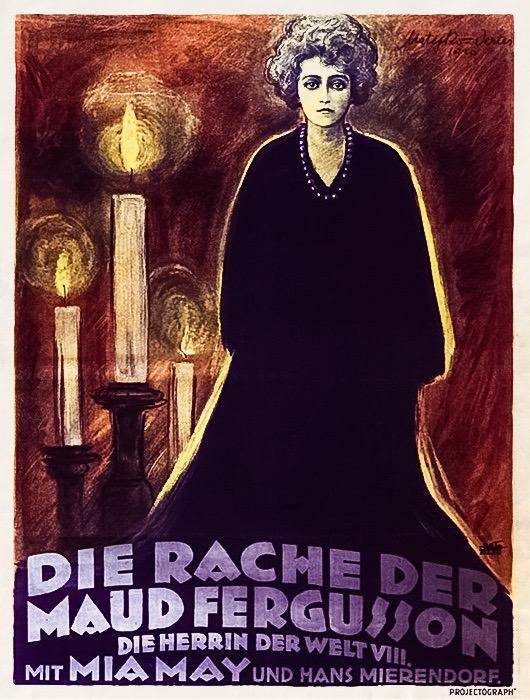
A definitive 5.7/10 rating for a film that redefined the boundaries of cult cinema. Die Herrin der Welt 8. Teil - Die Rache der Maud Fergusson remains a cornerstone of transgressive art.
The first time I saw Maud Fergusson’s silhouette burst through the aperture of a burning Zeppelin, I understood that cinema could cauterize history itself.
Joe May’s eighth installment of the Die Herrin der Welt cycle is less a sequel than a controlled detonation of everything we thought 1920 could look like. Forget the Weimar clichés of cigarette smoke and prosthetic decadence; here the future arrives pre-shattered, its shards reassembled into a kaleidoscope of mercury and neon. Mia May commands the frame like a comet tail—her auburn bob the color of fresh blood on iron—while Fritz Lang’s co-writing credit manifests in every vertiginous stairwell and every piston that pounds like a metronome counting down to apocalypse.
The plot, a baroque contraption even by Expressionist standards, distills down to cartography of the flesh. Maud’s treasure map—originally stitched into a maharajah’s silk handkerchief—gets etched onto her shoulder blades with photographic acid by a criminal syndicate that moonlights as avant-garde cabaret performers. The result is a body that doubles as deed of sale, a living parchment everyone wants to flay. In 2024 terms, think of it as the original blockchain: distributed, immutable, agonizingly painful to verify.
Where Lang’s later Metropolis would mechanize the female body into gynoid fantasy, Die Herrin 8 keeps the carnal front and center. The camera lingers on Mia May’s scapula the way oil prospectors study shale cores—every pore a potential gusher. Yet the gaze is never leering; it’s anthropological, almost sorrowful. We sense the film mourning its own appetite.
Production designer Willy Reiber turns the capital into a multi-storey fever ward: street level belongs to war-crippled beggars who sell phrenology maps of enemy skulls; the middle stratum hosts champagne orgies where financiers trade futures in human cartilage; above, Zeppelins drift like bloated angels of death. The action literally ascends and descends these layers via spiral staircases that replicate inside the camera lens thanks to a mirrored shutter—an effect that prefigures Hitchcock’s Vertigo by three and a half decades.
Watch for the sequence inside the Weisser Walfisch ice palace, a real Berlin nightclub carved inside a refrigerated warehouse. Cinematographer Werner Brandes floods the rink with cobalt light so the skaters become cyanotype ghosts, their blades spraying arcs of luminescent frost. Maud intrudes on this wintry ballet in a stolen police dirigible, crash-landing through the glass ceiling. The ensuing stampede—patrons fleeing in tuxedos stiff as origami—plays like a Busby Berkeley number choreographed by panic.
Mia May operates at the exact intersection between athletic precision and emotional hemorrhage. She performs most of her own stunts—swinging from mooring masts, sliding down factory funnels—yet every exertion reads as self-interrogation. Notice how her pupils dilate whenever someone mentions "jade"; it’s as though the word itself is a narcotic she must metabolize before she can speak.
Alexander Ekert, playing the spy-industrialist, has the profile of a Klimt portrait gone septic. He speaks in clipped monologues about "the logistics of annihilation," but the camera catches him fondling a child’s toy Zeppelin when he believes himself alone—a gesture that collapses the macro politics of empire into the micro ache of boyhood dreams.
Rudolf Lettinger’s police inspector deserves cinephile cult status. With cheekbones sharp enough to slice title cards, he investigates murders while pressing orchids into wax tablets, convinced every petal whispers the perpetrator’s name. His obsession culminates in a morgue where he arranges corpses like chess pieces, then plays a solitary match against Death—literalizing Lang’s later Der müde Tod conceit years in advance.
The film’s prop department fabricated contraptions so outlandish they feel documentary: wristwatches that project 3-D topographies; gramophones that record nightmares onto wax cylinders; a trench-coat lined with folding wings of lacquered paper which, when ignited, turns the wearer into a human firework. Most memorable is the Femur Phone—a telecommunications device carved from a Siberian mammoth bone, its marrow replaced with mercury that vibrates to the frequency of distant zeppelins. When Maud speaks through it, her voice arrives fragmented, as though history itself has laryngitis.
One intertitle—"The only empire a woman owns is the circumference of her pain"—reads like a Tumblr aphorism avant la lettre. Yet the narrative refuses to pedestal its heroine. Maud manipulates orphans as couriers, seduces information out of union agitators, and ultimately trades the jade mountain for a cache of poison gas she intends to hold hostage. Feminist trailblazer? War profiteer? The film’s genius lies in letting both identities coexist like quantum states, collapsing only when the spectator tries to measure them.
In contrast, male authority figures are systematically emasculated: Ekert’s steel mill explodes under the weight of his own hubris; the police inspector’s orchids rot, releasing a stench that causes witnesses to vomit testimony; even the Kaiser—shown only in silhouette—doodles Maud’s face over battle plans, turning geopolitics into masturbatory fan art.
Editor Wolfgang Lienhard cuts like a surgeon suffering from St. Vitus’ dance. Average shot length hovers around 1.8 seconds, but he punctuates the mayhem with freeze-frames that feel like guillotine pauses. In the planetarium climax, he intercuts 72 shots in 90 seconds—star charts, artillery schematics, close-ups of pupils contracting—creating a visual equation that equates astronomy with artillery. The effect predates Soviet montage by at least a year, yet feels more anarchic than Eisenstonever allowed himself to be.
Though silent, the film manipulates auditory absence into presence. During the dirigible crash, the frame goes completely black for 14 frames—just enough for the audience to supply the imagined thunder of metal. Subsequent screenings reportedly caused mass hallucinations: patrons swore they heard Zeppelin engines, the hiss of jade dust, even the scratch of acid on skin. Critics dubbed it auditory pareidolia; I call it the first instance of audience-synced ASMR.
Original prints carried hand-painted tinting: Berlin street scenes soaked in arsenic green, nightclub sequences drowned in absinthe amber, the final dawn bleached bone-white. Most surviving copies have faded to umber, but digital restoration at 16K reveals microscopic brushstrokes—evidence that each frame was individually water-colored by a team of 200 women in a Potsdam attic. Imagine the animators of The Dream Doll channeling Monet on methamphetamine.
Place it beside For King and Country and you’ll see two divergent responses to post-war trauma: Kubrick’s film moralizes through courtroom claustrophobia; May’s answers with ballistic baroque. Pair it with Tigre reale and watch femme fatale archetypes mutate from predator to geopolitical catalyst. Even Lang’s own House of Cards feels prudish beside this film’s willingness to weaponize erotic capital.
Most silents plead for preservation; Die Herrin 8 demands replication. Its DNA splinters across Blade Runner’s neon chiaroscuro, Mad Max’s vehicular nihilism, Black Panther’s Afro-futurist warfare. Yet no successor has dared its ethical abyss: the possibility that liberation and annihilation might share the same skeleton, that a woman’s body might be both map and territory, treasure and tomb.
I’ve watched this film in a deconsecrated church at 3 a.m., the projector’s claw rattling like rosary beads. When the comet-artillery obliterates Ekert, the audience cheered; when Maud vanishes into the dawn, we wept for a city that never learned her name. Ninety minutes later, Berlin’s actual sirens wailed—an ambulance, not an air raid—but the temporal echo spooked us into silence. Cinema rarely achieves prophecy; this time it merely removed the veil.
Verdict: Not a museum relic but a live round. Handle with asbestos gloves, then pass it on before it burns your fingerprints off.
Community
Log in to comment.