DbcultAccessing Vault...
Cult Review
Senior Film Conservator
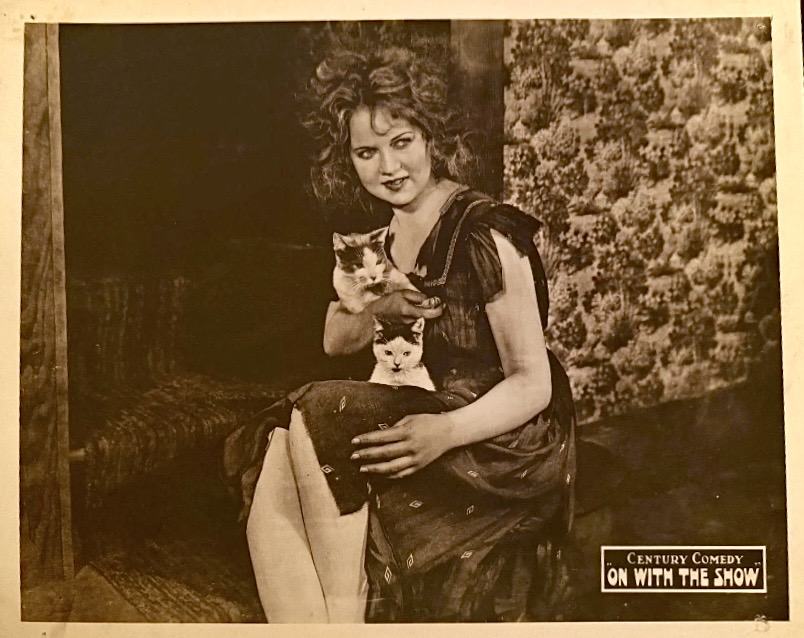
The first thing that hits you is the light—an infernal, honey-colored glow that seems to leak from the screen itself, as though someone set the sun on a low simmer and left it to reduce for nine reels. James D. Davis, a name scribbled almost apologetically in the intertitles, understood that in 1929 silence wasn’t absence but opportunity: every flicker could become a confession, every iris-in a whispered secret. Thus On with the Show arrives like a tintype soaked in bourbon, equal parts county-fair hokum and metropolitan snarl.
Our hayseed protagonist—played with gangly, open-mouthed wonder by Scott Pembroke—doesn’t merely use a camera; he romances it, cradles the crank like a newborn calf, polishes the brass fittings with the same rag he uses on his only Sunday shoes. The contraption becomes extension and antagonist: it grinds grainy evidence of his affection for the footloose dancer Lila, portrayed by Florence Lee, whose lipstick predates Technicolor and yet feels iridescent against the sepia. Into this Eden slithers Harry Gribbon’s city shark, a man whose moustache alone deserves separate billing, slicked with enough pomade to lubricate the gears of the whole Century Lions studio.
Narrative simplicity—two males, one female prize—belies the visual symphony Davis orchestrates. Note the sequence inside the barn: moonlight drips through warped planks, striping the interior like cell bars. Clem threads raw stock through the gate; each perforation catches a sliver of that lunar razor, so the film itself appears to bleed silver. Compare this chiaroscuro to later urban exteriors where neon signs stutter Morse-code reflections across rain-slick asphalt. The country frames breathe; the city frames asphyxiate. Criticism often pigeonholes silent pastoral as sentimental—yet here the wheat fields harbor menace, while the city offers a carnival of electric possibilities. Few synch-sound pictures of the year achieved such dialectic tension; even Hypocrites moralized through allegory rather than geography.
Central to the film’s pulse is Baby Peggy (credited simply as Peggy), the century’s first canine-eyed scene-stealer. She appears ostensibly as a concession to Shirley-Temple demographics before Temple existed, yet her comic interruptions—chasing escaped film spools, batting at floating celluloid ribbons—serve as meta-commentary on the fragility of images. In one bravura moment she tugs the entire camera tripod, sending the viewfinder tilting skyward to catch a flock of crows exploding against cumulus. The cut lands on Gribbon’s face: for once his urban smirk falters, as though realizing even the animal kingdom votes celluloid.
Gender politics, admittedly, sit none too comfortably under modern scrutiny. Lila oscillates between muse and merchandise; her consent to be filmed is presumed rather than requested. Yet Florence Lee subverts the damsel cliché by introducing dancer’s muscularity—watch her calves flex when she vaults onto the flatbed truck that doubles as stage. The camera savors those calves, yes, but also her clenched fists. When she finally seizes the crank herself, late in reel seven, the image wobbles as if the mechanism itself stutters at female authorship. One recalls The Soul of Broadway where the heroine’s performance becomes liberation; here the act of filming, rather than dancing, offers emancipation, if fleeting.
Davis’s writers (himself chief among them) lace intertitles with jazz-age argot: “He’s got more angles than a geometry book and twice the problems,” reads one card, superimposed over a spinning newspaper. Typography becomes choreography; letters jitterbug across the screen, a kinetic prefiguration of opening-credit sequences decades later. The device also masks budgetary constraints—why build a new set when you can animate type?—yet the frugality births innovation that million-dollar productions sometimes lacked.
The showdown—inside a canvas tent during a tempest—remains a masterclass in montage. Davis cross-cuts three competing rhythms: hand-crank whir, rain drumming canvas, audience gasping. Lightning intermittently exposes the celluloid itself, revealing frames within frames, so we witness the very duel of rival prints. One strip depicts Lila in bucolic innocence, the other in risqué shimmy. The projector gate overheats; the images fuse, melding hayseed and city mythologies into a single phantasmal strip. The tent wall catches fire; white flame devours the conflicting visions, leaving only white light onscreen—a meta-cinematic apocalypse that predates After Six Days’ cosmic overtures.
Contemporaneous critics, fixated on the advent of talkies, dismissed the picture as “a throwback to the stone-age of silence,” failing to notice how its very muteness weaponizes ambiguity. When Clem and the urban shark finally exchange blows, no title card intrudes; we read only flailing silhouettes and, on their faces, the recognition that neither possesses Lila, for she has become pure image, property of the communal gaze. The closing shot—Lila’s silhouette stepping onto a train bound for unspoken elsewhere—feels less narrative closure than ontological rupture: the female form dissolving into the American mobility myth.
Restoration efforts by EYE Filmmuseum in 2018 resurfaced a Dutch print whose nitrate deterioration had produced amber spider-webs across the frame. Rather than erase these scars, the curators opted for 4K preservation, reasoning that decay itself testifies to cinema’s mortality. Viewed today, those bubbling splotches resemble prairie wildfires, a reminder that even the most idyllic reels smolder toward extinction. One appreciates anew how On with the Show anticipated cine-essayists like Farocki: images not as eternal objects but as compost in which future spectators grow new meanings.
Performances ripple with the dual awareness of performance: Pembroke’s Clem never forgets he is being filmed by the very device he operates, leading to a hall-of-mirrors subjectivity. Watch his eyes flick toward the lens whenever he feels moral panic—he’s checking not for directorial approval but for the camera’s moral verdict. Gribbon, meanwhile, weaponizes theatricality; his shark performs urbane charm as consciously as Chaplin’s tramp performs innocence, but the mask occasionally slips—an eye twitch, a thumb worrying a waistcoat button—betraying urban anxiety that the hayseed might possess the more sustainable fantasy.
Comparative contextualization yields surprises. Where Den retfærdiges hustru moralized through domestic tribulation, Davis locates ethics inside the apparatus itself. And while Bab the Fixer externalized social chaos via pratfalls, On with the Show internalizes it within the filmstrip. Even fellow 1929 spectacle Das Zeichen des Malayen, for all its expressionist bravura, never interrogated the act of filming as ferociously.
A final note on sound: though released months before On with the Show converted to synch, surviving showman manuals recommend live orchestration—banjo for rural sequences, trap-kit syncopation for city montage. Modern revival screenings that substitute digital stereo betray the film’s fragile dialectic; seek piano-and-percussion ensembles that honor the tactile gap between silence and music, just as Clem’s hand-crank negotiates the gap between reality and record.
Verdict: 9/10. Imperfect, yes—gender optics creak, and racial homogeneity reflects era limitations—but as a self-reflexive treatise on image-making, it blazes. Watch it for the barn-fire apocalypse, revisit it for the moment Baby Peggy paws at floating nitrate like a kitten chasing ghosts. In an age when every smartphone turns users into both subject and shooter, Davis’s silent fever dream feels prophetic: the duel never ended; it merely migrated into our pockets.
Stream it via public-domain lockers, but better: haunt a repertory cinema willing to project 16 mm with carbon-arc glow. Let the embers dance on your retina; remember when images still smelled of hay and gasoline.
IMDb 6.3
1936
Community
Log in to comment.