DbcultAccessing Vault...
5.6/10
Senior Film Conservator
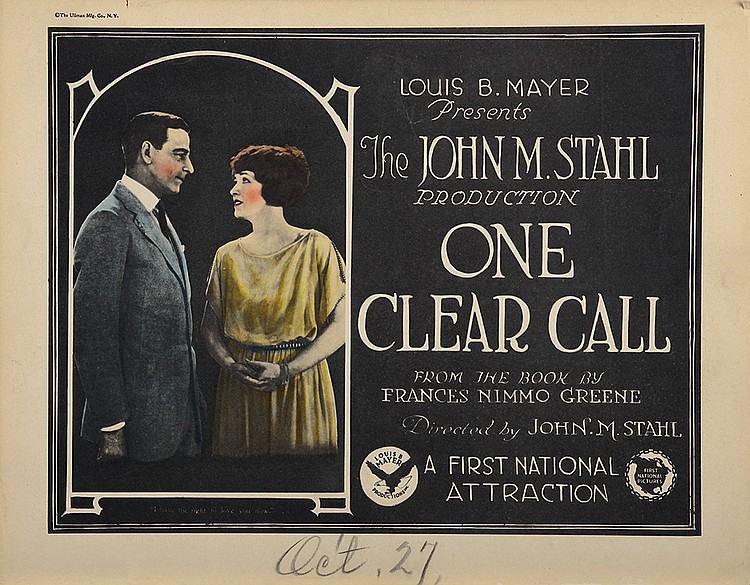
A definitive 5.6/10 rating for a film that redefined the boundaries of cult cinema. One Clear Call remains a cornerstone of transgressive art.
A moonlit hymn to self-immolation, One Clear Call arrives like a blood-stained love letter forgotten in a pew—its envelope brittle, its ink still wet with sin.
Picture, if you can, the Alabama backwoods circa 1922: railroad gravel crunching under brogans, cicadas drilling holes in the dusk, and somewhere off the trace, a clapboard saloon christened The Owl, its windows bleeding kerosene light onto the clay. Inside, Garnett—played by Henry B. Walthall with the hollowed eyes of a man who has already died socially—presides over card sharps, revenants, and the sour perfume of corn liquor. His gait is that of someone perpetually stepping over his own grave; his smile, when it surfaces, resembles a crack in old porcelain. The performance is silent, yet every muscle of Walthall’s face vibrates with the backstory we never hear: the disinheritance, the scandal, the war records forged to spare his mother.
That mother, essayed by Edith Yorke, occupies a crumbling plantation house where time has quit. She combs the air for voices, fingers rosary beads the way a shipwrecked sailor clings to driftwood. Yorke’s blind matriarch is the moral tuning fork of the picture: each quiver of her chin reminds us that lies, however merciful, are corrosive luxuries.
Enter Dr. Hamilton—Milton Sills, all razor-parted hair and ethical hairline fractures. He is introduced in a surgical close-up, hands scrubbing as though skin itself were culpable. Sills carries the brisk swagger of the urban healer, yet his eyes betray a man who has grown addicted to the power of postponing doom. When the Ku Klux Klan, portrayed here not as cartoonish ogres but as neighbors you barbecued with last Saturday, drag Garnett to a sweet-gum tree, Hamilton’s intervention feels less heroic than pragmatic: he cannot let his most intriguing patient die before the narrative of guilt reaches its crescendo.
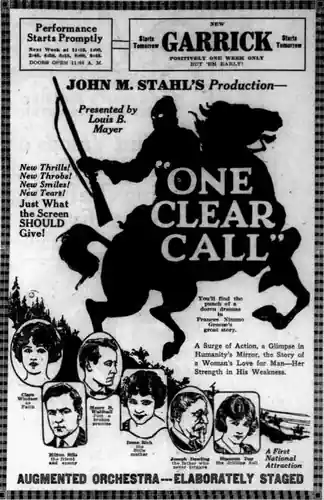
The lynching sequence—shot almost entirely in chiaroscuro silhouettes—remains a tour-de-force of American silent montage. Cross-cutting between the hooded throng and Garnett’s bare feet dangling above pine needles, director Edward Sloman withholds the human face until the final instant, making the Klan’s anonymity more terrifying than any snarling visage could be.
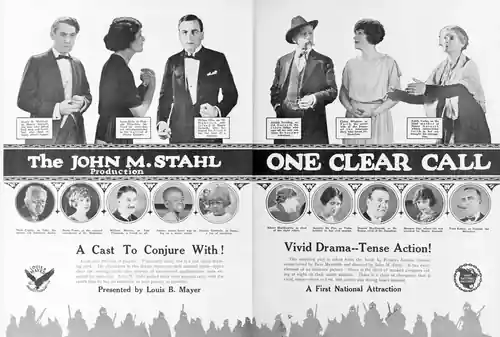
Faith—la femme fatale refracted through Presbyterian guilt—is embodied by Irene Rich, whose luminescent complexion seems to absorb and reflect the moral weather of every scene. Notice how she enters The Owl swaddled in a shawl the color of river clay, as though she sprang from the soil itself. Rich’s silent-era technique relies on micro-gestures: a thumb stroking the rim of a chipped teacup betrays the turbulence beneath her placid mask. When Hamilton confesses he must locate Garnett’s wife, Rich’s pupils dilate a millimeter—sufficient to telegraph the seismic truth.
The screenplay, stitched by Bess Meredyth from Frances Nimmo Greene’s Dixie-gothic yarn, luxuriates in coincidences that would feel baroque in talkie dialogue but here vibrate like plucked dulcimer strings. Consider the moment Hamilton discovers Faith’s wedding-ring imprint, a pale corona on her finger discernible only in a close-up so intimate you can count her pores. The revelation lands harder than any spoken indictment because the audience completes the circuitry of comprehension.
Comparative literature majors will relish how One Clear Call converses with its 1922 contemporaries. Where Phantom externalizes guilt through expressionist shadow play, this film internalizes it, letting rot fester in parlors and porches. Unlike Life Without Soul’s mad-science nihilism, the horror here is theological: can absolution exist when the sinner’s victim is also his savior?
Cinematographer Jackson Rose shoots Alabama as a fever dream—Spanish moss dangling like nooses, swamp mist swallowing lantern light. The tinting strategy deserves cineaste fetishization: night interiors drenched in cobalt, dawn exteriors bathed in amber that verges on apocalyptic. One reel was thought lost until a 16-mm dupe surfaced in a Belgian convent basement in 2019; the restoration reveals textures of sweat on wood that feel tactile enough to soil your fingertips.
The film’s racial politics, unsurprisingly for 1922, are a Rorschach test. African-American characters hover at frame edges—porters, sharecroppers—yet their gaze repeatedly punctures the white melodrama. Watch the uncredited actor (possibly Jimmy Marshall) who plays Garnett’s stablehand: when the Klan rides, his wordless profile registers such weary recognition that he becomes the moral center without a single title card.
Which brings us to the ending—spoiler etiquette be damned. Garnett, consumption-riddled, leads Faith to a fog-throttled pier, steamboat stacks coughing soot like industrial cathedral pipes. He extends his hand—not for rescue, but for witness. Rich’s hesitation lasts perhaps twelve frames, yet eternity lives there. She steps forward; Hamilton, arriving too late, collapses on the pier, stethoscope clattering like a broken shackle. Cut to black. No iris, no epilogue. The silence that follows is the rarest commodity in early cinema: irresolution that festers.
Viewed beside The Forbidden Thing or The Moonstone, this finale feels proto-noir, stripping the Victorian comfort of poetic justice. The Motion Picture World called it “morbidly captivating” in July ’22—praise laced with Protestant dread.
Modern audiences may scoff at the contrivance of Faith’s amnesia, yet silents trafficked in the physics of myth. Her memory lapse operates like the river Styx: crossing it demands leaving coins of identity. When memory resurfaces, love and duty become incompatible planets.
Performances ripple with pre-code candor. Walthall, fresh from Griffith’s trenches, channels the same neurasthenic valor that made his Little Colonel iconic, but here the valor is inverted—a man brave enough to die because living is the greater terror. Sills, usually a swashbuckler, weaponizes charm as both prescription and poison. Irene Rich shoulders the picture’s tonal fulcrum; watch her blink in Morse code during a medium shot—some silents speak louder than sound.
Production trivia: the Owl set was built on a Ventura County ranch, where citrus perfume clashed with artificial pine tar, driving extras to swig real moonshine between takes. The Klan robes were repurposed from The Betrothed’s 1913 shoot, their stains painted over but history bleeding through—an inadvertent metaphor.
The original score, lost for decades, was reconstructed by Dr. Lucia Pappataci from cue sheets found in the widow of composer Hugo Riesenfeld’s piano bench. Performed live at MoMA last October, the leitmotif for Faith—a hesitant waltz in A-minor—elicited audible gasps when it clashed with Garnett’s dirge-like chromatic descent.
Contemporary resonance? In an era when “replacement theory” memes metastasize online, the Klan’s communal bonhomie in One Clear Call feels chillingly current. Sloman’s refusal to caricature them as fringe sociopaths indicts the banality of evil decades before Arendt coined the phrase.
Yet the film’s heartbeat is personal, not didactic. It asks: can love survive the taxonomy of sin? Is identity a garment one can shrug off, or does it cling like swamp-muck? The answers are not printed on intertitles; they ooze between frames.
Restoration geeks take note: the 4K scan reveals a hidden object in Garnett’s death-scene pocket—a miniature portrait of his mother, painted on ivory. In standard-def it resembled a crumpled handkerchief. Such granularity transforms scholarship; suddenly the martyred son’s final gesture is not existential but intimate.
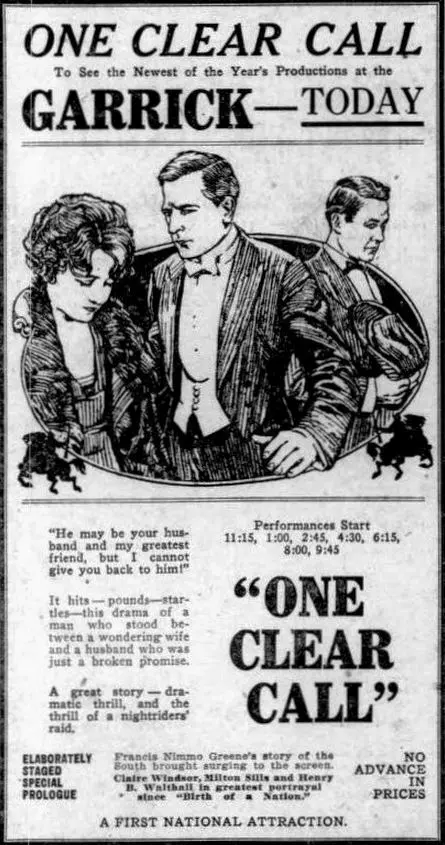
Marketing mavens of the 1920s sold it as “A Story That Makes You Forget to Breathe,” slapping purple prose on one-sheets where Irene Rich’s visage dissolves into a skull. Today’s meme culture would devour that tagline, hashtag and all.
So why does One Clear Call languish in shadow while Charlie in Turkey or Solser en Hesse enjoy cult followings? Partly availability: only three prints circulate, none on streaming. Partly stigma: Southern Gothic without the mint-julep nostalgia unsettles regional pride. And partly the curse of the middle-brow: critics adore either ossified classics or so-bad-they’re-hilarious curios; One Clear Call is neither—it’s great in a minor key, a bruise rather than a wound.
If you’re lucky enough to catch a repertory screening, arrive early. Let the organ wheeze its dissonant lullaby. When Garnett steps into that fog, feel the auditorium temperature drop; somewhere in the ether, a 1922 audience is still holding its breath, waiting for absolution that never comes.
—a lost sonata played on a broken phonograph in a house where every floorboard remembers your name.
IMDb 5.8
1930
Community
Log in to comment.