DbcultAccessing Vault...
Cult Review
Senior Film Conservator
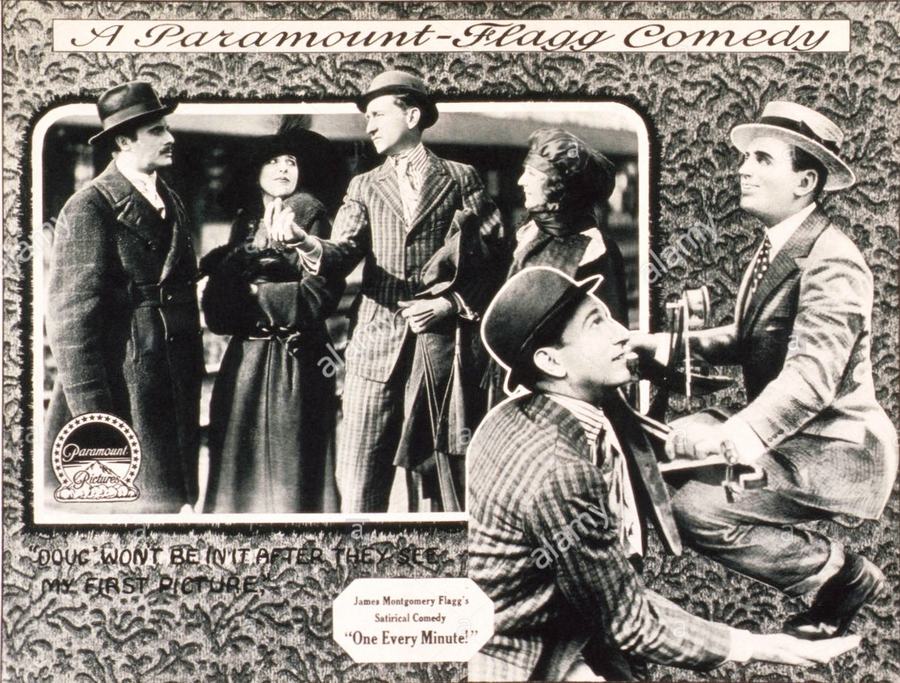
Ah, the silent era! A time of grand gestures, flickering shadows, and dreams writ large across the silver screen. Among the myriad narratives vying for audience attention, some films, even those with seemingly simple premises, manage to etch themselves into the collective memory, or at least into the annals of film history, by capturing a universal human experience. 'One Every Minute,' a 1921 production, is one such cinematic artifact, offering a window into the aspirations and inevitable disillusionments of an era. Penned by the multifaceted talent James Montgomery Flagg, who also graces the screen as part of its distinguished cast alongside Florence Dixon and Olin Howland, this film delves into the perennial tale of the country mouse in the big city, amplified by the intoxicating allure of early Hollywood stardom.
Our narrative's anchor is a young man, a 'bumpkin' as the synopsis so affectionately labels him, who arrives in the bustling metropolis, his heart swelling with an almost unbearable optimism. His singular ambition? To become the next Douglas Fairbanks. Fairbanks, a name synonymous with athletic prowess, dashing heroism, and an infectious grin, represented the pinnacle of male stardom in the 1920s. To aspire to be Fairbanks was not merely to seek fame; it was to chase an ideal of masculinity, adventure, and boundless charisma. This humble protagonist, armed with little more than fervent belief and perhaps a rudimentary understanding of stage combat gleaned from local fairgrounds, embarks on a journey paved with more potholes than red carpets.
The city, in 'One Every Minute,' is less a backdrop and more a character unto itself – a leviathan of possibility and peril. For our young hero, it initially shimmers with the promise of transformation, a crucible where his raw talent, 'if he only had the chanst,' could be forged into cinematic gold. Yet, as many a cinematic journey has shown, from the pastoral exodus in The Country Boy to the more cynical urban explorations of its contemporaries, the city is an unforgiving mistress. It demands resilience, cunning, and a thick skin, qualities often scarce in those fresh from the tranquil embrace of rural life. The initial encounters with the city's indifference, its relentless pace, and its myriad scams would undoubtedly form the core of his early 'woes.'
Imagine the scene: our hero, perhaps clad in ill-fitting, homespun attire, standing agape amidst the towering buildings and roaring streetcars, a stark contrast to the quiet fields he left behind. His attempts to break into the film industry would likely be met with patronizing smiles, outright derision, or, worse still, exploitation. The casting calls, the relentless rejections, the sheer anonymity of it all – these are the initial blows to his buoyant spirit. It's a narrative arc that speaks to anyone who has ever pursued a dream against overwhelming odds, a testament to the universal struggle between ambition and reality. The film, through its silent storytelling, must have masterfully conveyed these emotional shifts, relying on the expressive power of its actors and the visual cues of its direction.
The success of such a character-driven piece hinges heavily on its cast. Florence Dixon, an actress whose work often imbued her characters with a certain grace and understated strength, likely plays a pivotal role in our protagonist's journey. Perhaps she is the sympathetic ear, the voice of reason, or even a fellow struggling artist who understands the pangs of unfulfilled ambition. Her presence would provide a much-needed anchor in the chaotic urban landscape, a beacon of humanity amidst the impersonal churn of the film industry. The dynamic between her character and the aspiring Fairbanks would be crucial in conveying the emotional heart of the story, offering moments of respite and perhaps even a burgeoning romance.
Olin Howland, known for his distinctive character work and later a prolific career in sound films, would bring a unique flavour to the proceedings. His ability to convey a wide range of emotions, from bumbling charm to cynical realism, suggests he might embody a character who either aids or hinders our hero's quest. Perhaps he is a seasoned veteran of the industry, a disillusioned bit player, or even a benevolent mentor who offers a dose of hard-won wisdom. His comedic timing, evident in his later roles, could also be subtly deployed here to lighten the heavier moments of the protagonist's 'woes,' ensuring the film maintains a balanced tone between pathos and gentle humor. The interplay between these established talents would undoubtedly elevate the emotional resonance of the narrative, providing layers of depth to what could otherwise be a straightforward 'rags to almost-riches' tale.
And then there is James Montgomery Flagg, not only the writer but also a cast member. Flagg, an iconic illustrator whose 'I Want You for U.S. Army' poster is etched into American consciousness, brought a keen eye for human nature and a sharp wit to his writing. His dual role as writer and actor suggests an intimate understanding of the characters and their struggles. Perhaps he plays a figure of authority, a casting director, or even a rival, lending an authenticity to the film's portrayal of the industry. His presence in front of the camera, guided by his own words, would offer a unique convergence of artistic vision, allowing for a nuanced depiction of the dreams and disappointments inherent in show business. This multi-talented approach, not uncommon in early cinema, often imbued films with a singular, cohesive artistic voice.
The central plea of our protagonist – 'if he only had the chanst' – resonates deeply. It's a cry heard from countless aspiring artists, entrepreneurs, and dreamers throughout history. The film, in its exploration of this yearning, must navigate the delicate balance between hope and despair. Does our hero get his 'chanst'? And if so, what does it cost him? The 'woes' mentioned in the plot summary suggest that his path is far from smooth. These tribulations could manifest in various forms: financial hardship, betrayal, the loss of innocence, or even a stark realization that the glamorous world of Fairbanks is an illusion, unattainable for most.
The film likely builds towards a climax where our hero faces a crucial decision or a moment of profound introspection. Does he cling to his Fairbanks fantasy, or does he find a different, perhaps more realistic, path to fulfillment? The beauty of such a narrative lies not just in the pursuit of the dream, but in the lessons learned along the way. It's a theme explored in many films of the era, where the protagonist's journey often leads to self-discovery rather than the attainment of their initial, perhaps superficial, goal. One might draw parallels to the spiritual journey in L'enfant prodigue, where the prodigal son's return is marked by a newfound understanding of life's true values, or the societal critiques woven into narratives like The Auction Block, which also explored the harsh realities faced by individuals trying to make their way in an unforgiving world.
'One Every Minute' exists within a fascinating period of cinematic history, the early 1920s. This was an era of rapid expansion for the film industry, a time when Hollywood was truly solidifying its identity as the dream factory. Audiences were captivated by the larger-than-life personalities on screen, and the escapism offered by cinema provided a much-needed balm in the aftermath of World War I and during burgeoning social changes. Films like this, which humanized the pursuit of stardom, offered audiences a relatable entry point into that glamorous world, even as they exposed its harsher truths.
The film's exploration of ambition and its consequences also ties into broader societal anxieties of the time. The transition from a predominantly agrarian society to an industrial, urban one meant that many young people left their homes for the promise of cities. This migration often brought with it a clash of values, a struggle to adapt, and the painful realization that opportunity was not always equally distributed. 'One Every Minute' can be seen as a microcosm of this larger social phenomenon, using the specific context of the film industry to comment on universal experiences of displacement and the search for identity. It mirrors the plight seen in The City of Comrades, where individuals seek belonging and purpose within the urban labyrinth, or even the complex family dynamics explored in films like Kampen om barnet, where personal desires clash with societal expectations.
While details on the specific directorial choices for 'One Every Minute' are sparse, one can infer certain stylistic elements common to the period. The use of intertitles would have been crucial, not just for dialogue but for conveying the protagonist's inner thoughts, his aspirations, and his growing despair. Visual storytelling would have relied heavily on exaggerated expressions and gestures, a necessity in the absence of spoken dialogue. The cinematography would likely employ a mix of wide shots to establish the overwhelming scale of the city and close-ups to emphasize the emotional turmoil etched on the actors' faces. The contrast between the open, idyllic countryside and the cramped, bustling cityscapes would have been a powerful visual metaphor for the protagonist's internal journey.
Furthermore, the film's pacing would have been meticulously crafted to build tension and elicit audience sympathy. The initial scenes of naive hope would gradually give way to moments of struggle and doubt, punctuated by flashes of humor or unexpected kindness. The silent film era, often underestimated in its sophistication, was adept at manipulating audience emotions through rhythm, visual composition, and the judicious use of orchestral accompaniment in live screenings. The film's ability to tackle a theme as universal as chasing a dream, especially one as grand as becoming a Douglas Fairbanks, suggests a narrative structure designed to resonate deeply with its viewers, regardless of their own personal ambitions.
'One Every Minute' serves as a valuable historical document, not just of early cinema but of a particular cultural moment. It reminds us that the dreams of yesteryear, though perhaps couched in different terms, are fundamentally the same as those we harbor today. The yearning for recognition, the desire to achieve something extraordinary, and the inevitable encounters with adversity are timeless human experiences. The 'woes' of our young bumpkin are not merely the trials of a fictional character; they are echoes of countless real-life struggles, both then and now. The film's title itself, 'One Every Minute,' could be interpreted as a commentary on the sheer volume of dreamers flocking to the city, or perhaps the rapid pace at which dreams are made and broken.
Comparing this film to others of its period further illuminates its significance. While Daybreak might have explored different facets of social awakening, or The Divorcee delved into changing gender roles, 'One Every Minute' grounds itself in the very personal, almost intimate, journey of self-discovery through aspiration. It stands alongside films like Ashes of Embers, which might have explored themes of destruction and rebirth, or Rebuilding Broken Lives, which focused on redemption, by offering a narrative centered on the forging of a character through the fires of experience. The film, in its quiet way, contributes to the rich tapestry of early 20th-century storytelling, demonstrating that even without sound, profound emotional narratives could be conveyed with immense power.
Ultimately, 'One Every Minute' is a poignant reminder of the enduring human spirit's capacity for hope and resilience. It's a story that, despite its period setting and silent presentation, speaks volumes about the universal pursuit of a better life, the allure of fame, and the often-painful lessons learned when dreams collide with reality. It is a testament to the power of cinema, even in its nascent form, to capture the essence of the human condition and to transport audiences into worlds both familiar and fantastical. This film, with its simple premise and profound implications, remains a compelling piece of cinematic history, inviting us to reflect on our own aspirations and the paths we choose to pursue them.
The legacy of 'One Every Minute' isn't just in its historical context or its charming portrayal of a bygone era. It's in the way it continues to articulate a fundamental truth: that the journey of self-discovery, particularly when fueled by grand ambitions, is rarely linear. It's filled with detours, disappointments, and unexpected moments of grace. The 'bumpkin's' quest to become Douglas Fairbanks is more than just a comedic premise; it's a metaphor for every individual who has ever dared to dream beyond their immediate circumstances. It reminds us that while not everyone achieves the pinnacle of their initial aspirations, the act of striving itself, of pursuing that 'chanst,' is where true character is forged. The film, therefore, is not merely a chronicle of a young man's woes, but a celebration of the indomitable human spirit that, even in the face of relentless adversity, dares to dream, 'one every minute.'
IMDb —
1922
Community
Log in to comment.