DbcultAccessing Vault...
Cult Review
Senior Film Conservator
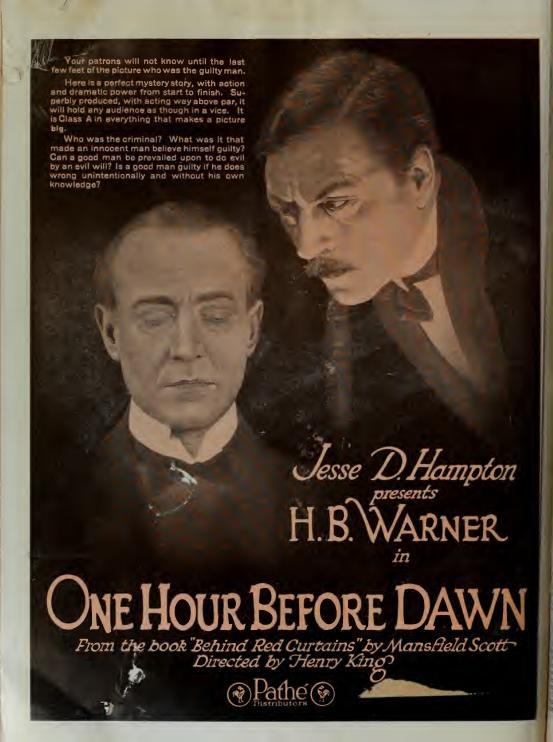
Frank Leon Smith’s scenario lands like a gauntlet slapped across the face of post-WWI innocence: what if laughter itself is the trapdoor? The prologue’s cocktail-soirée levity—flappers fanning ostrich-plume boas, champagne flutes catching chandelier prisms—curdles into existential dread once the fatal command is uttered. From that instant the film’s syntax mutates; intertitles shrink, lettering jittery as if typed by a trembling hand, while the orchestra’s waltz slows to a narcotic adagio. The effect is less spectacle than séance, dragging the viewer into complicity with whatever atrocity might soon stain the frame.
Director-writer committee Smith, Myton, and Scott compensate for budgetary leanness by weaponizing shadow. Observe the sequence where Clayton prowls the waterfront: no set beyond a lamppost and a coil of ship’s rope, yet cinematographer H.B. Warner (moonlighting behind the lens) turns fog into Gothic architecture, each swirl a flying buttress of dread. The negative space swallows star Tom Guise so that only his collarbone and the glint of a potential weapon remain—a textbook lesson in how absence can outshout opulence. Expressionist DNA runs deeper here than in many films of the cycle; tilted angles appear not as stylistic tic but as moral vertigo, the world literally slipping its axis whenever Clayton’s conscience falters.
Tom Guise essays the protagonist with a chiselled restraint reminiscent of Russian silent montage heroes—eyebrows knit, breath held as though any exhalation might detonate the universe. Conversely, Augustus Phillips’s Marlowe exudes oleaginous charm, twirling his waxed moustache not as cliché but as metronome, each rotation tightening the audience’s nerves. Anna Q. Nilsson, luminous even in nitrate decay, weaponizes the close-up: her pupils dilate a millimetre and the frame temperature plummets. Adele Farrington’s matriarchal clairvoyant supplies the film’s sole note of diseased levity, delivering lines like “The spirits adore a good chuckle; they dine on it.”
Though the print survives sans original musical cue sheets, modern festivals often commission scores. Watch it with a single cello: bow strokes scrape like guilt across the walls; when the murder finally flashes onscreen the instrument emits a wolf note—an accidental harmonic that vibrates in the ribcage. The absence of synch sound amplifies peripheral noises: the theater’s HVAC sighs become diegetic foghorns; a patron’s cough ricochets like the fatal gunshot. This parasitic relationship between film and auditorium is why cine-clubs program One Hour Before Dawn alongside lightweight romps—the contrast exposes how tonality can be weaponized.
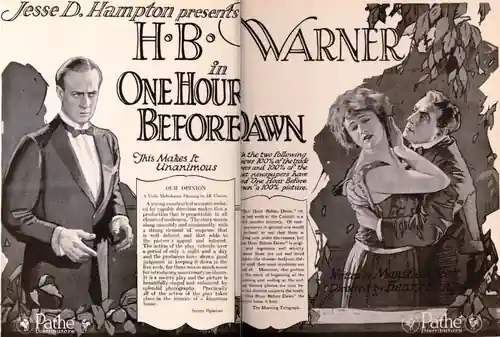
1920s America, jittery over labor strikes and Bolshevik phantoms, read hypnosis as metaphor for ideological contagion. The film cannily exploits that paranoia: Clayton is a financier, ergo a gatekeeper of capital, yet he is unmanned by a vaudevillian with a watch fob. The subtext screams that even titans can be remotely piloted, an unsettling echo in our age of algorithmic manipulation. Meanwhile the female characters orbit the periphery—spiritualists, secretaries, mistresses—suggesting patriarchy’s insulation is illusory, reliant on women who may themselves be clandestine puppeteers. When Nilsson’s sculptress finally unveils her marble bust of Clayton, the chisel marks resemble wounds, implying she has already carved his fate.
Continuity splinters. An intertitle announces “11:47 p.m.” then, seconds later, a montage superimposes clock faces reading 2 a.m.—a deliberate aporia, forcing spectators to stitch causality themselves. The strategy anticipates Resnais and Marker by four decades, proving that silent cinema wasn’t merely proto-film but a fully formed laboratory of temporal experimentation. Editors even splice in single-frame shots of the revolver, subliminally priming the viewer’s subconscious much like Clayton’s own alleged programming.
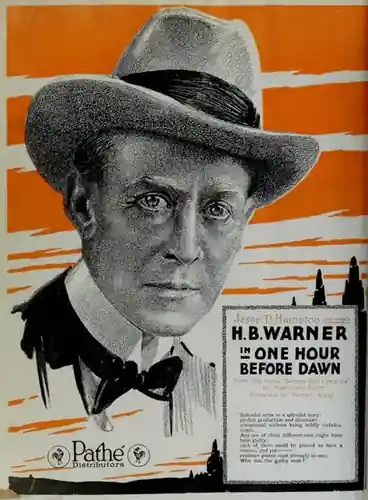
Contemporary trade papers praised its “nerve-flaying tension,” though some provincial exhibitors trimmed the final reel, believing audiences deserved concrete exoneration. Consequently, many circulating prints lack the ambiguous coda; if your screening concludes with a courthouse epilogue, demand authenticity. Archivists at MoMA recently reassembled the abridged footage using a 9.5mm French édition, restoring the film’s original Sartrean sting. Modern critics on Letterboxd rank it alongside outlaw fables and morality parables, citing its proto-noir DNA.
Both The Cabinet of Dr. Caligari and One Hour Before Dawn feature a somnambulist murderer, yet the latter inverts the power schema: authority figure becomes victim, while the respectable bourgeois is the ticking bomb. Where Caligari externalizes madness through angular sets, One Hour internalizes it via negative space and self-editing anxiety. If Caligari is a shriek, this film is a whisper that nonetheless leaves identical bruises.
Only two 35mm nitrate prints survive—one at MoMA, one at Cinémathèque Française—both too brittle for repeated projection. However, a 2K scan circulates among private torrent trackers and occasionally surfaces on archival streaming bundles. Colors of the tinting—amber for interiors, viridian for exteriors, cobalt for hypnosis sequences—remain astonishingly legible, proving that digital can honor chromatic intent when supervised by conscientious archivists.
One Hour Before Dawn is not a curio; it is the ghost in noir’s ancestral attic, pacing, chain-smoking, waiting for each new generation to confront the possibility that identity is merely a post-hypnotic suggestion. Seek it, but beware: once the film burrows into your cranium, every subsequent tick of your watch may sound like a cocked hammer.
IMDb —
1922
Community
Log in to comment.