DbcultAccessing Vault...
Cult Review
Senior Film Conservator
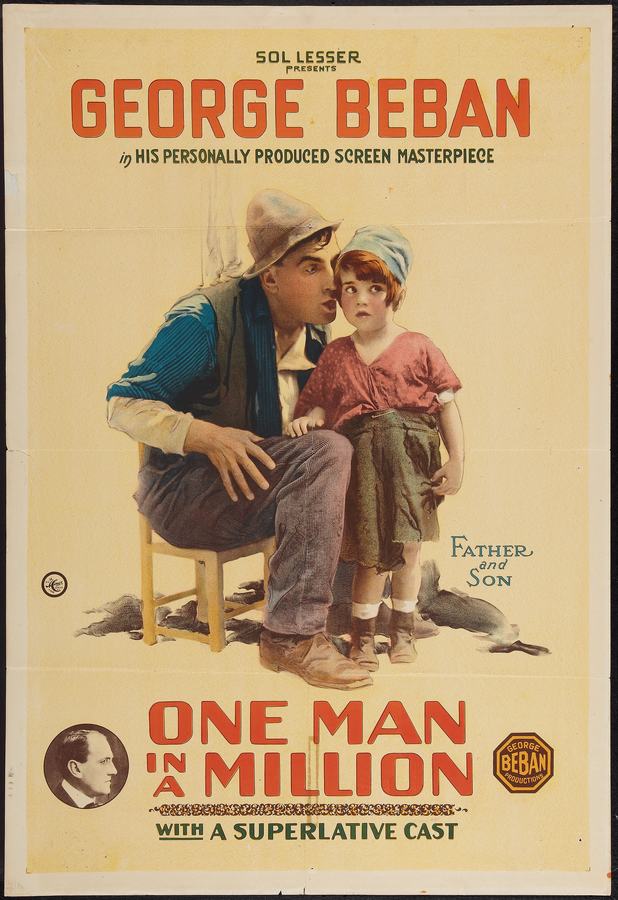
The opening act of One Man in a Million introduces Lupino Delchini (George B. Williams) as a man whose moral compass is as unyielding as the cobblestone streets of his working-class neighborhood. His dismissal from a modest restaurant for feeding a beggar—a gesture framed as both selfless and subversive—sets the tone for a narrative where generosity becomes a catalyst for upheaval. The film’s tonal shift from kitchen drudgery to bureaucratic intrigue is masterfully executed; when Detective Hartley (George Beban) rescues Delchini from destitution by appointing him pound master, the camera lingers on Williams’ crumpled expression, his gratitude laced with unease. This duality—recognition of virtue as both admirable and precarious—foreshadows the ethical tightropes Delchini will later walk.
Barbara Maier’s Flora, introduced in a vignette of quiet resilience, embodies the film’s contrasting ideals of love. Her attraction to Delchini is rooted in his principled refusal to exploit kindness, a stark contrast to the transactional relationships that permeate the Maureveau household. When Delchini assumes the role of a father to the orphaned Belgian boy, his emotional arc pivots from romantic idealism to pragmatic parenthood, a transition mirrored in Williams’ subtle physicality—shoulders broadening as he transitions from a man of action to a man of responsibility.
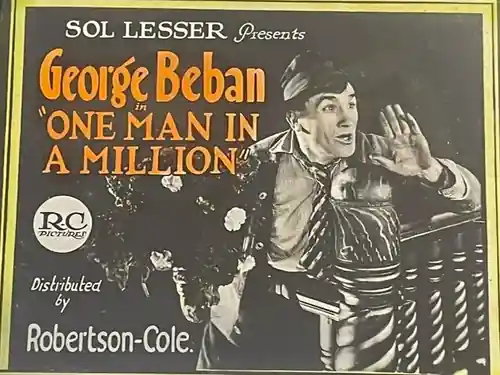
The film’s central deception, orchestrated by Madame Maureveau (Jennie Lee), operates on multiple levels. Her manipulation of Delchini’s paternal instincts is not merely a plot device but a critique of how society conflates maternal legitimacy with biological ties. The revelation of her true identity—neither mother nor widow—as orchestrated by Hartley’s investigative acumen, is rendered with a clinical detachment that contrasts sharply with the emotional crescendos of Delchini’s disillusionment. Lee’s performance here is a masterclass in restrained villainy; her smiles are calculated, her gestures deliberate, a constant reminder that her presence is a destabilizing force in Delchini’s life.
The subplot involving Hartley’s romantic entanglement with Madame Maureveau adds a layer of moral ambiguity. Beban’s portrayal of the detective is nuanced; his authority is undercut by personal vulnerability, a tension that manifests in his interactions with both Delchini and Maureveau. The film’s refusal to vilify any character outright—Hartley’s infidelity is portrayed as a tragic flaw rather than a moral failing—reflects the era’s shifting attitudes toward human complexity.
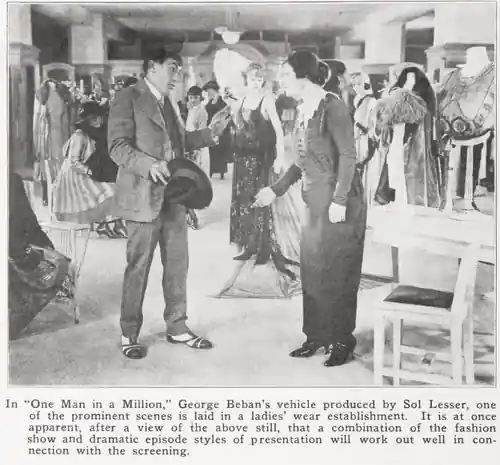
The set design in One Man in a Million is a character in itself. The stark contrast between Delchini’s dimly lit tenement and the opulent, but emotionally hollow, Maureveau home underscores the film’s class commentary. Director Dorothy Yost (co-writing with George Beban) employs deep focus to emphasize the isolation of Delchini in crowded spaces—his solitary figure in a bustling pound, his isolation in the Maureveau parlor—techniques that evoke the emotional dissonance of his journey.
Color palettes shift subtly to mirror character arcs. The recurring use of sepia tones in early scenes gives way to bolder, more saturated hues as Delchini’s world expands, a visual metaphor for his awakening empathy. The climactic scene, where Delchini chooses to renounce his engagement to Flora in favor of raising the orphaned boy, is framed in cool blues and grays, a tonal inversion of the earlier, warmer domestic scenes. This visual contrast is reinforced by the score—a melancholic piano motif that evolves from dissonance to resolution as Delchini embraces his role as a father.
While One Man in a Million shares thematic DNA with other pre-Code dramas like The Screen Fan (1931) and A Woman's Awakening (1931), it distinguishes itself through its focus on paternal identity rather than romantic entanglements. The film’s treatment of immigration parallels the more overtly political Back to God’s Country (1919), but where that film romanticizes rural life, One Man in a Million critiques the bureaucratic systems that dehumanize outcasts.
Comparisons to The Shepherd of the Southern Cross (1922) are particularly apt; both films explore the moral dilemmas of individuals thrust into positions of authority. However, One Man in a Million diverges in its treatment of its protagonist’s agency—Delchini’s choices are more self-aware, his transformation less about divine intervention than personal growth.
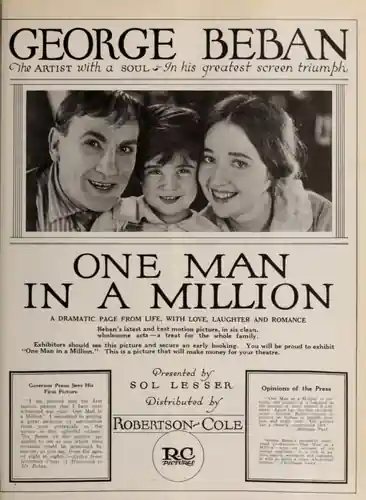
Though often overshadowed by contemporary classics, One Man in a Million anticipates modern narratives about identity and parenthood. Its critique of systemic neglect—the bureaucratic hurdles Delchini faces in claiming the boy’s custody—resonates with current debates about immigration policy. The film’s unflinching portrayal of Delchini’s vulnerability—the moment he kneels to plead his case to a indifferent official, his voice cracking under the weight of hope—feels startlingly contemporary.
Technically, the film’s use of montage in the final act is ahead of its time. The rapid cuts between Delchini’s interactions with the boy and his final confrontation with Madame Maureveau create a sense of temporal urgency, as if the narrative itself is racing to resolve its ethical questions. This technique, while not as sophisticated as later Soviet montage experiments, suggests a proto-Modernist approach to storytelling.
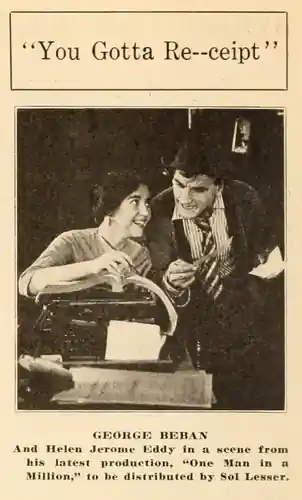
One Man in a Million remains a testament to the transformative power of cinema. George B. Williams’ performance, equal parts pathos and resilience, anchors the film’s emotional core, while the supporting cast—particularly Helen Jerome Eddy’s nuanced portrayal of Flora—elevates the material beyond melodramatic tropes. The film’s resolution, in which Delchini finds contentment not through romantic fulfillment but through paternal commitment, is a quiet revolutionary act in an era dominated by star-driven narratives.
For modern viewers, the film offers a poignant reminder that redemption is often found in the margins—in the overlooked, the outcast, the child who disrupts a life to redefine it. As Delchini walks away from the Maureveau estate, the camera following his retreating figure into a field of golden light, the message is clear: greatness isn’t measured by societal approval but by the courage to embrace the imperfect, untidy truths of human connection.
IMDb 7
1925
Community
Log in to comment.