DbcultAccessing Vault...
5.1/10
Senior Film Conservator
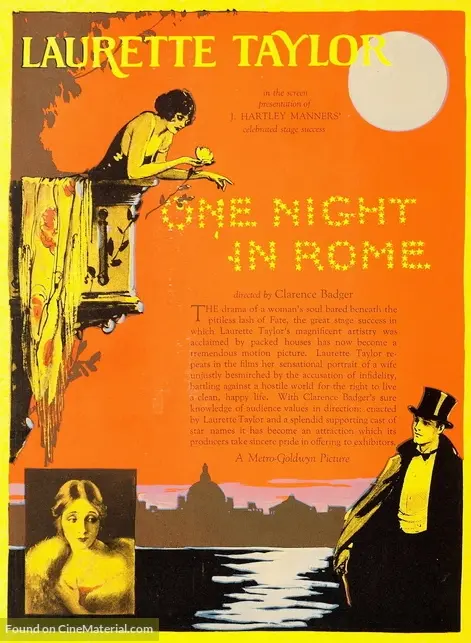
A definitive 5.1/10 rating for a film that redefined the boundaries of cult cinema. One Night in Rome remains a cornerstone of transgressive art.
The year 1924 was a watershed moment for the silent screen, a period where the primitive flickers of the early century matured into a sophisticated visual language. Amidst this evolution, One Night in Rome emerges not merely as a melodrama, but as a searing psychological study of displacement and the resilience of the feminine spirit. Directed with a keen eye for shadow and social hierarchy, the film serves as a magnificent showcase for Laurette Taylor, whose transition from the footlights of Broadway to the silver screen brought a gravity seldom seen in her contemporaries. Unlike the frenetic energy found in June Madness, this film breathes with a deliberate, haunting pace.
The narrative begins in the opulent, suffocating corridors of the Roman aristocracy. Here, the Duke Mareno, played with a chilling detachment, commits the ultimate act of cowardice. Guilty of wartime treachery—a sin that would strip his family of their prestige—he chooses the path of self-obliteration. However, his exit is not one of remorse but of calculated cruelty. By penning a suicide note that attributes his despair to his wife’s supposed infidelity, he effectively murders her social existence while ending his own physical life. It is a masterstroke of villainy that sets the stage for a grand odyssey of reinvention.
When Prince Danieli, the Duke's father, accepts this lie as gospel, he becomes the unwitting architect of the Duchess’s exile. The film brilliantly captures the claustrophobia of the Italian elite, contrasting it later with the foggy, democratic anonymity of London. This shift in locale is more than a change of scenery; it is a thematic pivot from the weight of tradition to the freedom of the unknown. One might find echoes of this narrative urgency in Her Moment, yet here the stakes feel infinitely more personal, anchored by the lead actress's expressive eyes.
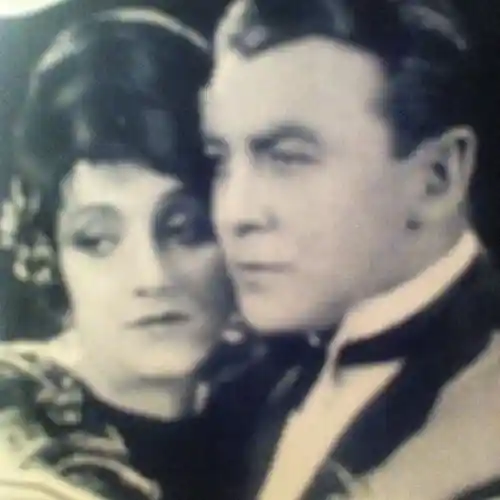
In London, the Duchess is reborn as Madame L'Enigme. The choice of profession—a fortune-teller—is a stroke of genius by writer J. Hartley Manners. It allows the character to occupy a space between worlds, observing the secrets of others while guarding her own with impenetrable ferocity. The production design of her psychic parlor is a masterclass in silent-era atmosphere, utilizing heavy drapes and flickering candlelight to create a sense of otherworldly tension. It reminds one of the suspenseful textures found in Fantomas - On the Stroke of Nine, where identity is a fluid and dangerous currency.
Laurette Taylor’s performance in these scenes is nothing short of luminous. She manages to convey a deep-seated melancholy beneath the theatricality of her new persona. When Richard Oak, portrayed by the dashing Tom Moore, enters her sanctum, the film shifts from a mystery into a poignant romance. Oak represents the life she was forced to abandon, a beacon of truth in a sea of fabricated futures. His recognition of her is not just a plot point; it is a moment of profound emotional vulnerability that challenges her carefully constructed armor.
While contemporary films like The Fortune Teller explored similar tropes of mysticism and hidden identities, One Night in Rome distinguishes itself through its moral complexity. The film doesn't shy away from the ugliness of the Duke's actions, nor does it simplify the Prince's grief. The supporting cast, including the formidable Warner Oland and Brandon Hurst, provide a robust framework that elevates the film above the standard fare of the era. Oland, in particular, brings a nuanced intensity that foreshadows his later legendary roles.
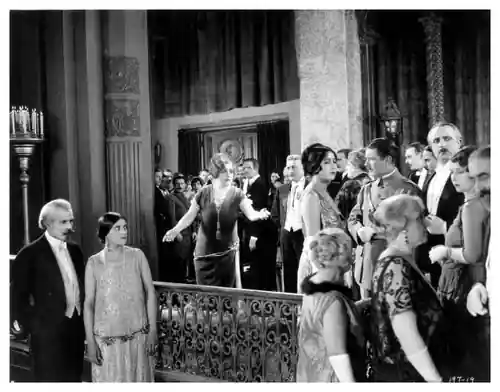
The cinematography by the uncredited but clearly skilled crew utilizes the chiaroscuro effects common in the mid-20s, highlighting the Duchess's internal conflict. The way the camera lingers on her hands as she reads the cards, or the slight tremor of her lip when her past is mentioned, showcases a level of directorial restraint that was ahead of its time. This isn't the broad, slapstick world of A Pair of Sixes or the lighthearted comedy of Don't Call Me Little Girl. This is a film that demands to be taken seriously as a piece of dramatic art.
The resolution of the film is where it truly breaks from the mold of traditional melodrama. The arrival of Prince Danieli with the news of the Duke’s true fate—murdered by a gardener in an act of righteous vengeance—is a startling subversion of the suicide narrative. It reframes the entire preceding hour, turning the Duke's "tragic end" into a sordid consequence of his own moral failures. The gardener, an unseen force for much of the film, becomes the instrument of a cosmic balance, proving that the Duke was not just a traitor to his country, but a predator to his own household.
This revelation provides the Duchess with a restoration that is both social and spiritual. Her acceptance of Richard Oak is not merely a romantic conclusion; it is an act of reclamation. She is no longer the victim of a dead man’s lies or the prisoner of a psychic’s veil. She is a woman who has navigated the treacherous waters of male ego and emerged with her dignity intact. The emotional resonance of this ending is far more satisfying than the epic sweep of Michael Strogoff, focusing instead on the intimate triumph of the soul.
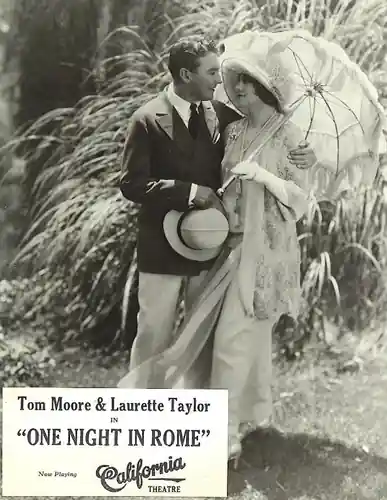
Looking back at One Night in Rome from the perspective of a century later, one is struck by its modernity. The themes of gaslighting, identity theft, and the struggle for female autonomy are as relevant today as they were in 1924. While it may not have the rugged outdoor grit of Pure Grit or the historical vastness of Armenia, the Cradle of Humanity, it possesses an emotional depth that is rare for any era. It is a film that invites the viewer to look beyond the surface, much like the patrons of Madame L'Enigme, to find the truth hidden in the shadows.
In the pantheon of silent cinema, Laurette Taylor’s performance remains a cornerstone. Her ability to translate the complexities of Manners’ play into a visual medium is a testament to her genius. The film stands as a reminder that even in the absence of spoken dialogue, the human experience can be articulated with profound clarity. Whether you are a scholar of the 1920s or a casual fan of classic drama, this film offers a rich, rewarding experience that transcends its age. It is a night in Rome—and a lifetime in London—that you will not soon forget.
Reviewer's Note: For those seeking more from this era, I highly recommend exploring the works of the cast in other 1924 staples like Call a Taxi or the episodic intrigue of Beatrice Fairfax Episode 9: Outside the Law. The sheer diversity of output in this single year is staggering, ranging from the comedic antics of Monty Works the Wires to the dramatic heights of the film discussed today.
IMDb 5.8
1922
Community
Log in to comment.