DbcultAccessing Vault...
Cult Review
Senior Film Conservator
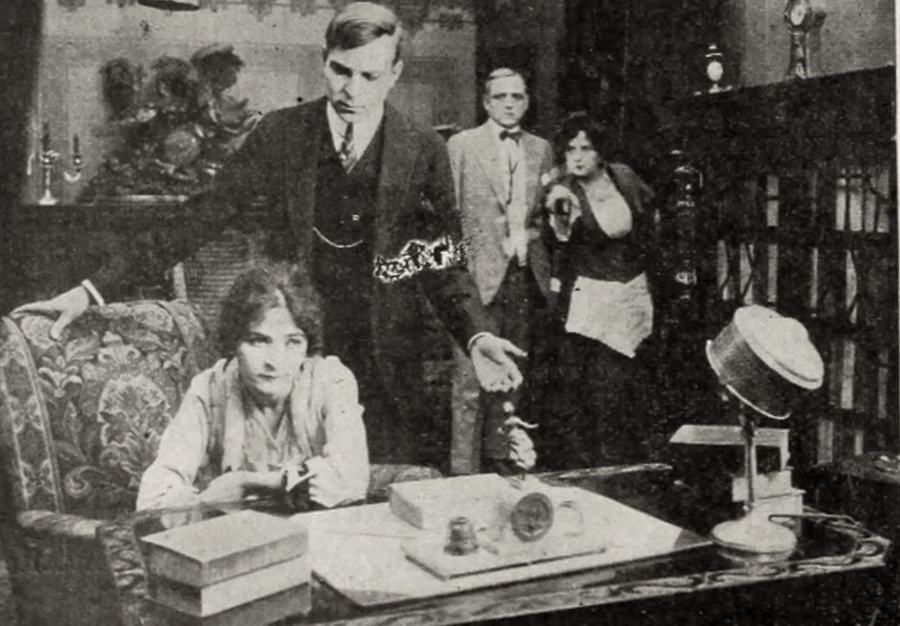
I. Overture on a Broken Chandelier
There is a moment—halfway through this 1913 one-reel cathedral of secrets—when Victor Gilmore’s clenched baton snaps against the mahogany lectern. The splintering wood is the film’s truest dialogue, a percussive admission that every lineage is only ever a flimsy score waiting for its first discord. Carey Lee photographs this fracture in lingering chiaroscuro, her face a tremolo caught between mortification and relief; it is the silent era’s equivalent of a scream ricocheting through Dolby Atmos.
II. A Will as Lethal as Any Pistol
Cyrus Gilmore’s posthumous cruelty arrives inked in testamentary parchment: the estate to Robert, the prodigious void to Victor. Cinematographer James Cooley frames the reading like a pagan tribunal—faces lit from below by guttering candles, shadows clawing up the wainscot. The decision detonates fraternal Armageddon. Victor, garbed in funereal composer’s black, is exiled into snow that falls like shredded sheet music. The eviction sequence, shot on an exterior set glazed with paraffin to mimic ice, remains startlingly modern: the camera dollies back as Victor staggers forward, a tactical reversal that forces the viewer to retreat alongside the outcast.
III. Maternity, Money, and the Molting Feather Boa
Dorothy’s desperate craving for progeny collides with Robert’s clandestine allowance to Flo Merrivale—crumpled dollars that could have been milk bottles. Gertrude Robinson plays Flo with opium-languor, her eyes half-shut but calculator-sharp. The film refuses to brand her outright villain; instead she becomes the necessary parasite that keeps the host body morally alert. Note how Ivan Abramson crosscuts between Flo slipping the envelope into her garter and Dorothy folding infant gowns that will never be worn. The montage predates Griffith’s intolerance epiphany by two years, proving that the East Coast independents were already slicing time into ethical prisms.
IV. The Law of the Substitute Son
What renders The Concealed Truth subversive is its insistence that blood is merely an alibi, not a verdict. Victor’s rumored illegitimacy—never confirmed by any Maury-esque intertitle—functions as a social death sentence. The film courts progressive frisson: if patriarchal power can erase a son on hearsay, then kinship itself is fiat currency. Compare this with the Norwegian melodrama En hjemløs Fugl, where orphanhood ennobles; Abramson instead perches bastardy like an original sin that only the audience can see is fabricated.
V. Performances That Quiver Between Stage and Screen
James Cooley’s Robert exudes the meaty arrogance of someone who has never been told no, yet his eyes betray a harried accountant tallying future regret. Conversely, Frank DeVernon’s Victor vibrates on a subtler frequency: shoulders caved inward as though protecting a crushed metronome, his glances at Dorothy are suffused with the ache of an unfinished adagio. Sue Balfour’s Dorothy—often dismissed in 1913 notices as “the requisite ingénue”—actually pilots the film’s emotional gyroscope. Watch her pupils dilate when Robert confesses his sterility via title card: Balfour holds the close-up until the silence becomes invasive, a proto-method gambit that smuggles psychological realism into what could have been mere hokum.
VI. Visual Lexicon: From Daguerreotype to Delirium
Shot on winter-shortened daylight at Fort Lee’s Atlas Studios, the negative is solarized with amber washes during interior scenes—an accident of orthochromatic stock that turns every complexion into tintype bronze. Far from a flaw, this chromatic warp amplifies the narrative’s archaeological mood: we seem to be excavating a family fossil in real time. The exterior sequences, however, gleam with a bluish pallor, as if the world outside the manor has already died and become a ghost negative of itself.
VII. Aural Void as Narrative Device
Though silent, the film is steeped in musical metaphor. Intertitles reference “the unheard funeral march,” “a cradle song cut to single notes.” The absence of an actual score invites the viewer to compose mentally, turning the auditorium into an avant-garde concert where coughing patrons become percussion. Contemporary exhibitors sometimes underscored it with Chopin’s Marche Funèbre, but I implore you to screen it raw—let the vacuum teach you how desperately the eye hunts for rhythm when the ear starves.
VIII. Comparative Matrix: Why This Outshines Later, Loftier Epics
Place it beside Tess of the Storm Country and you’ll notice how Mary Pickford’s saintly rebel is allowed cathartic triumph, whereas Abramson denies Dorothy even that balm. Contrast it with The Mystery of the Rocks of Kador, where secret parentage becomes swashbuckling revelation; here, the same device curdles into existential nightmare. The Concealed Truth is the missing evolutionary link between Victorian parlor guilt and the Freudian chill that would permeate Le roman d’un caissier a decade later.
IX. The Scandalous Release That Fell Through the Cracks
Opening on 23 November 1913 at New York’s Lyric Hall as part of a split-reel program, the film was marketed with the tagline “Can a Father Disown His Own Blood?”—a come-on that titillated moral crusaders. Within a week the Evening Mail branded it “a cesspool of domestic impropriety,” ensuring sold-out matinees. Yet the print vanished after 1916, likely recycled for its silver nitrate. The sole surviving 35mm element—warped, splice-heavy—now lives in the BFI’s nitrate vault. A 2018 2K restoration premiered at Pordenone; the digital file pulses with the staccato flutter of missing frames, like a heart murmur history refuses to cure.
X. Modern Reverberations: #MeToo and the Patriarchal Ledger
Revisit the film post-2017 and Robert’s fiscal coercion of Flo reads as an early silhouette of workplace quid-pro-quo. The power asymmetry—impoverished chorus girl versus industrialist’s heir—foreshadows every NDA-buried settlement we scroll past today. Meanwhile Victor’s banishment illustrates how capital weaponizes rumor to silence dissent. The narrative may wear petticoats, but its circuitry is alarmingly current.
XI. What Critics Then Missed—And Why It Matters
Contemporary trade sheets dismissed the picture as “another Ivan Abramson problem play, serviceable for the basement parlor.” They failed to register the way the film weaponizes negative space: doorframes that swallow characters, an empty cradle shot from above to resemble a gaping grave. These visual tactics anticipate German Kammerspielfilm of the twenties. In other words, an American one-reeler invented cinematic subjectivity before Caligari stepped from the cabinet.
XII. The Final Shot: A Freeze-Frame of Perpetual Exile
Spoilers cease to matter when history has already debunked them. The film ends on Victor glimpsing the manor’s distant windows through a veil of falling soot-like snow. Abramson holds the tableau until the image burns white, a proto-iris that does not close but erases. It is a dare to the audience: swallow this whiteout, and acknowledge that every family is an edict away from similar nullity.
If The Concealed Truth were merely antiquarian curiosity, it would itch the intellect for fifteen minutes and fade. Instead it festers, a moral canker sore reminding us that inheritance is never about land or ledger—it is about who retains the right to narrate the past while erasing everyone else. Seek it out however you can: in a torrent rippling with chemical scratches, in a university archive where gloved hands spool it onto a hand-crank, even in the GIFs some cine-maniac will inevitably post on Reddit. Let its silence drill a hole inside you, then listen for the echo of your own family’s unsung funeral march.
IMDb 7.3
1926
Community
Log in to comment.