DbcultAccessing Vault...
Cult Review
Senior Film Conservator
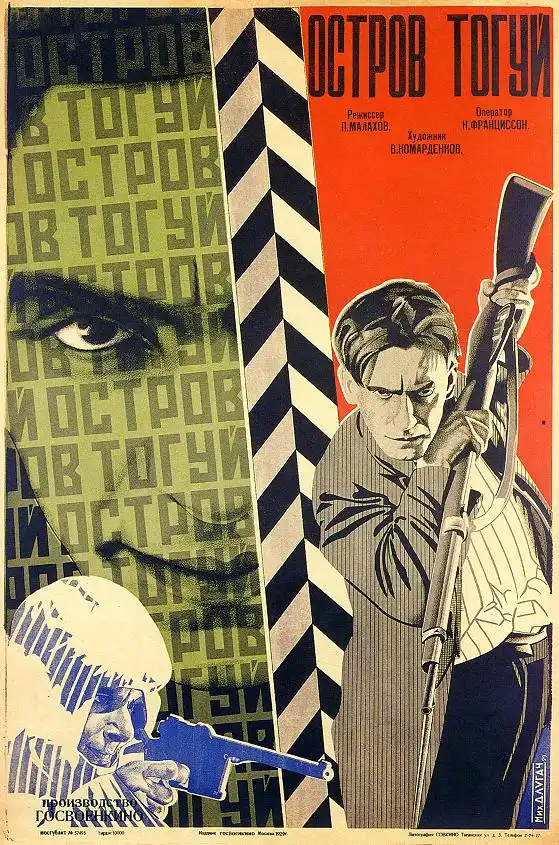
If you're looking for a high-octane thriller with CGI explosions, stop reading right now. Ostrov Toguy is not that.
It is worth watching today if you have a soft spot for grainy, black-and-white footage of men looking very intensely at the ocean. It’s also for people who like to see how the early Soviet cinema machine handled the idea of 'the enemy.'
Most people will probably hate it because it’s slow. Like, really slow.
The whole plot is basically border guards versus violators. It’s simple, maybe too simple for some, but there is something about the way it’s shot that kept me from turning it off.
The island itself feels like a character. It’s a cold, lonely rock where the wind probably never stops blowing.
I noticed early on that the actors don't really 'act' in the modern sense. They mostly just strike poses of vigilance.
Pavel Rozhitsky has this face that looks like it was carved out of a potato. He doesn't say much, but he stares at the horizon like he's trying to set it on fire with his mind.
There is this one scene where a guard is cleaning his rifle. The camera just hangs on his hands for what feels like three minutes.
It’s weirdly calming. You can almost smell the gun oil and the salt air.
The 'violators' are these shadowy figures who show up to cause trouble. They are treated like ghosts or monsters rather than actual people with motivations.
I guess that was the point back then. You weren't supposed to feel bad for them; they were just the 'bad guys' trying to mess with the Soviet borders.
The pacing reminds me a bit of Slesar i kantsler, but with less industrial clanging and more sand. It has that same heavy atmosphere where every decision feels like it has the weight of the whole world behind it.
There’s a sequence in the middle where they are chasing someone through the rocks. It’s supposed to be tense, but the music (in the version I saw) was this jaunty piano that didn't fit at all.
It made the whole life-or-death struggle look like a game of tag. I actually laughed out loud, which probably wasn't the intended reaction in 1929.
Speaking of struggle, the movie really wants you to know that being a border guard is hard. They eat bland food, they sleep in cramped quarters, and they never, ever relax.
It’s a bit different from something like The Last Chance, which feels more like a standard drama. This feels more like a training manual that accidentally became a movie.
The editing is jumpy in places. Sometimes a character is standing on a cliff, and in the next frame, they are suddenly inside a boat with no explanation.
I don't think it's a 'masterpiece' or anything like that. But it has this raw, unpolished energy that you don't see anymore.
"The sea doesn't care about borders, but the men with the guns definitely do."
That quote isn't in the movie, but it’s what I kept thinking. The film is obsessed with the line between 'us' and 'them.'
If you’ve seen South o' the North Pole, you might appreciate the isolation here. It's that same feeling of being at the end of the world.
The ending is pretty predictable. The guards do their duty, and the violators get what's coming to them.
It’s not exactly a spoiler to say the Soviet movie ends with the Soviet guards winning. That was basically the law back then.
I did find myself wondering about the actors, though. Most of them, like Ivan Kozlov or Nikolay Kutuzov, disappeared into history after this era.
They look so real in the film, like they just stepped off a fishing boat and were told to hold a gun. There’s no Hollywood polish here, just dirt and squinting.
One weird thing—there is a shot of a seagull that lasts for way too long. It’s just sitting there, looking at the camera, and then it flies away. Why was that in the final cut? I loved it.
It’s these little, pointless moments that make these old movies worth the effort. They feel human in a way that modern 'perfect' movies don't.
Don't expect a deep character study. Expect a lot of scenery and a lot of very serious faces.
It’s a solid piece of history. Just make sure you have some coffee ready, because the silence can get a bit heavy after the first hour.
Overall, I'm glad I watched it, even if I'll probably never watch it again. It’s like visiting a museum—you’re glad you went, but you don't want to live there. 🌊
IMDb 7.2
1928
Community
Log in to comment.