DbcultAccessing Vault...
Cult Review
Senior Film Conservator
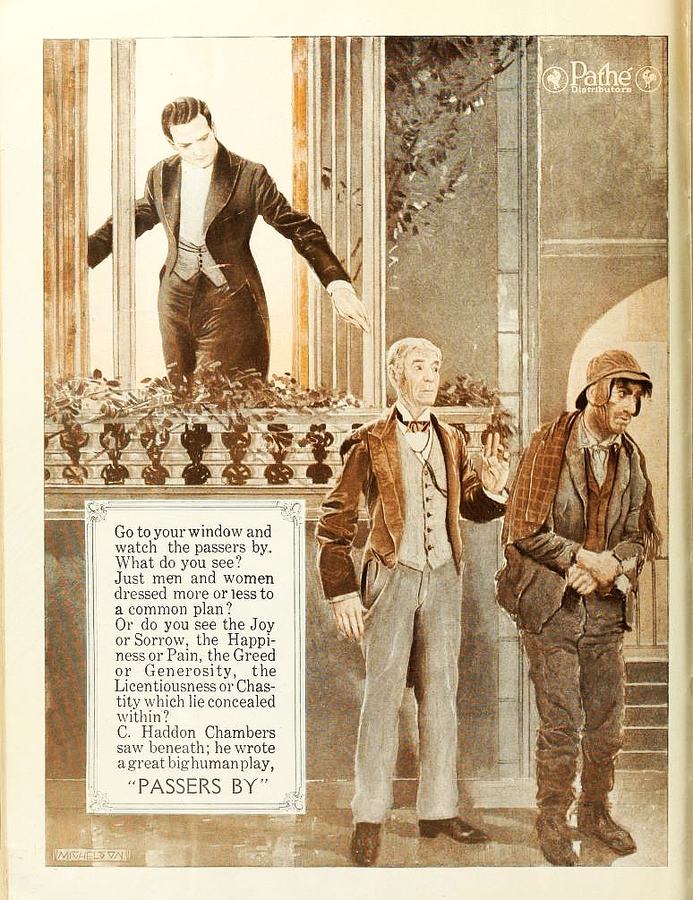
The early 1920s represented a period of immense psychological friction in British and American cinema. The Victorian era had gasped its last breath, yet the burgeoning modernism of the Jazz Age had not quite solidified its grip on the cultural imagination. Into this liminal space stepped Passers-by (1920), a film that functions less as a standard melodrama and more as a searing indictment of the social architecture that defines human worth. Directed with a keen eye for the spatial dynamics of class, the film navigates the suffocating interiors of the wealthy and the cold, expansive indifference of the London streets.
At the heart of this narrative is Peter Waverton, portrayed by Herbert Rawlinson with a stoicism that slowly erodes into a fascinating, quiet desperation. Waverton is a man trapped in the amber of his own privilege. When he falls in love with Margaret, the governess, he isn't just seeking a romantic partner; he is seeking an exit from the stifling expectations of his station. Unlike the more optimistic social climbing seen in Her Great Chance, the romance here is treated with a heavy sense of foreboding. The governess, played with a fragile dignity by Leila Valentine, represents the 'other'—the invisible labor force that maintains the comfort of the upper class while being denied a place within its emotional inner sanctum.
The true antagonist of the piece is not a villain in the traditional sense, but the personification of the status quo: Waverton's stepsister. Her refusal to acknowledge the validity of his affection for a mere employee is not portrayed as simple cruelty, but as a systemic necessity. In her view, the preservation of the class structure is more vital than her brother's happiness. This dynamic echoes the rigid social barriers explored in The Awakening of Ruth, though Passers-by takes a darker, more introspective turn. When the stepsister successfully drives Margaret away, she doesn't just end a relationship; she triggers a spiritual collapse in Waverton.
What follows is one of the most intriguing pivots in silent cinema. Waverton, consumed by a cocktail of boredom and profound grief, begins to invite total strangers—the 'passers-by' of the title—into his home. This isn't an act of charity in the Christian sense; it is an act of existential rebellion. He is populating his life with the very people his stepsister would find most abhorrent. In these scenes, the film shifts its tone, embracing a gritty realism that contrasts sharply with the polished veneer of the first act. We see a parade of the disenfranchised: a nightman, a vagrant, a disillusioned veteran. These characters are not caricature; they are presented with a raw, unvarnished humanity that challenges the viewer's own prejudices.
The brilliance of C. Haddon Chambers’ writing, adapted here for the screen, lies in its refusal to offer easy answers. Waverton’s house becomes a microcosm of a broken society. The interaction between the master of the house and his 'guests' is awkward, fraught with the tension of two worlds colliding. It reminds one of the servant-master subversions found in Ruggles of Red Gap, but without the safety net of comedy. Here, the stakes are visceral. The strangers bring with them the smell of the fog and the weight of poverty, forcing Waverton to confront the reality that his comfort is built upon their exclusion.
The cinematography, while limited by the technology of 1920, makes excellent use of shadow and depth. The way the 'passers-by' are framed—often appearing from the dark recesses of the street into the harsh, artificial light of the Waverton foyer—accentuates their status as ghosts of the industrial machine. This visual language of 'the outsider' is also prevalent in contemporary European works like Der fremde Fürst, suggesting a global cinematic interest in the figure of the interloper.
"Passers-by is not merely a film about a man who opens his door; it is a film about a man who tears down the walls of his own perception, only to find the rubble as beautiful as the structure it replaced."
Herbert Rawlinson’s performance deserves a modern reassessment. Often remembered for more rugged roles, his work here is surprisingly nuanced. He captures the 'modern malaise' of the post-war man—a sense that the old rules no longer apply, yet the new ones haven't been written. His chemistry with Leila Valentine is poignant, built on stolen glances and the heavy silence of the unsaid. Valentine, for her part, avoids the melodramatic excesses of the era, providing a performance of quiet strength that makes her eventual departure all the more tragic.
The supporting cast, including the veteran William J. Ferguson, adds layers of texture to the London street life. These characters provide a necessary counterweight to the internal drama of the Waverton family. The film’s pacing is deliberate, allowing the atmosphere of the house to become a character in itself—a gilded cage that slowly transforms into a communal hearth. This thematic progression from isolation to inclusion is a powerful narrative arc that remains relevant today.
When comparing this film to others of its year, such as the more lighthearted I'm on My Way or the domestic drama Upstairs, Passers-by stands out for its psychological depth. It doesn't shy away from the darker aspects of the human condition—the boredom that leads to madness, the pride that leads to loneliness, and the desperation that leads to unexpected connection. It shares a certain thematic DNA with The Village Smithy in its depiction of the working class, but it transposes that struggle into the heart of the metropolis.
As we look back at Passers-by over a century later, we see a film that was ahead of its time in its interrogation of social responsibility. It asks a question that still resonates: what do we owe to those who pass by us every day? Is our charity merely a way to soothe our own guilt, or can it be a radical act of human recognition? Waverton’s journey from a man of leisure to a man of the people is a fascinating, if incomplete, transformation. The film ends not with a grand resolution, but with a sense of shift—a tectonic movement in the characters' understanding of their place in the world.
For fans of silent cinema, this is a mandatory watch. It lacks the explosive action of some of its contemporaries, but it compensates with an intellectual rigor and an emotional honesty that is rare for the period. It is a quiet masterpiece of the interior life, a study of what happens when the walls we build to keep others out finally crumble, leaving us standing in the cold, bright light of reality. In the context of 1920, it was a daring piece of art; today, it remains a haunting reminder of the invisible lines that still divide us.
Related Reading: If you enjoyed the social commentary of Passers-by, consider exploring our reviews of Hiding in Holland for more on wartime displacement, or Winning His Wife for a different take on domestic negotiations.
IMDb 5.2
1935
Community
Log in to comment.