DbcultAccessing Vault...
Cult Review
Senior Film Conservator
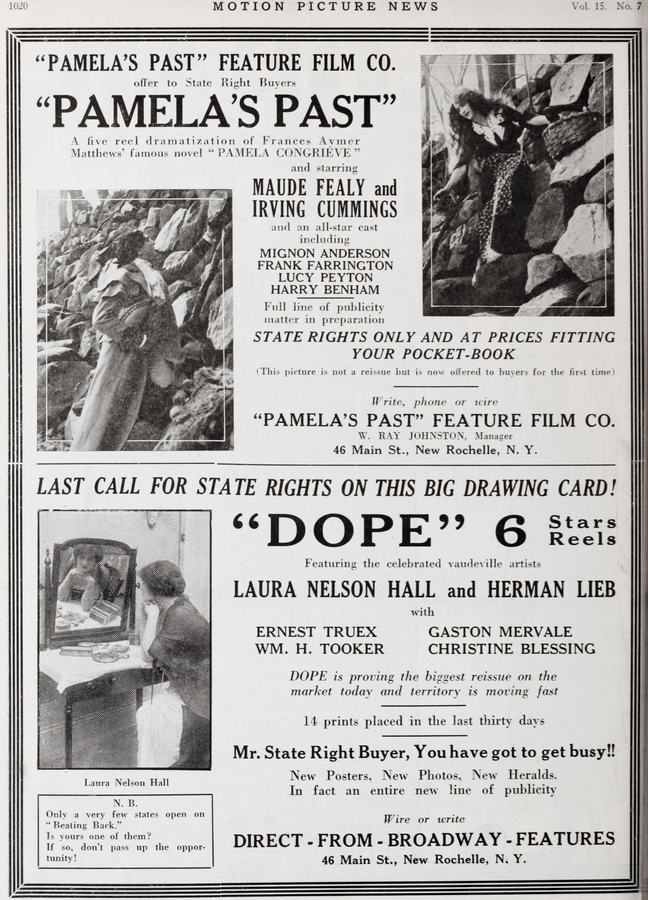
The first time we see Pamela Congreve she is barefoot on a Jurassic spine of rock, hair whipping like battle pennants, the Atlantic clawing upward as though demanding audience with her ankles. Director Irving Cummings—still years away from his talkie twilight—lets the camera linger until the image scorches itself onto the emulsion: a girl who belongs less to the fisherman’s hovel behind her than to the foam itself, something mythic and half-selkie. That single setup is prophecy; every subsequent frame will test whether a woman forged in brine and betrayal can carve space for herself in a world mortgaged to men who sign their crimes with wax seals.
Frances Aymar Mathews’s screenplay, adapted from her own novelette, refuses the moral algebra typical of 1915 melodrama. There is no angelic foil, no mustache-twirling Saturday villain; Charteris, played with reptilian bonhomie by Frank Farrington, courts us first with easy baritone smiles and a jawline that could launch a thousand indentured servants. His seduction of Pamela’s father unfolds in a tavern lit by a single tallow wick—an inverted Last Supper where silver coins replace sacrament. When the old man finally presses his thumb into the ledger, the ink smudges like a bruise that will bloom across the entire narrative bloodstream.
Cut to the contraband landing: ox-carts groan beneath crates of Geneva velvet and Indian nutmeg, contraband as glamorous as it is illicit. Cummings cross-cuts between surf that gnaws at the shore and revenue dragoons thundering over the heath, the montage so kinetic one almost expects the celluloid to blister. Charteris’s betrayal—fingering the father as kingpin while invoking his own blue-blooded immunity—lands with the metallic chime of a guillotine. The hanging sequence, shot at dawn with a lavender sky that seems ashamed of its own beauty, distills the film’s central thesis: survival is rarely the reward of the innocent; it is the prerogative of whoever can weaponize narrative.
Pamela’s exile from the coast carries her to a roadside inn whose signboard creaks like a gallows in miniature. There she reencounters Charteris and, in a moment of operatic fury, sinks a dagger between the ribs she once coveted. The staging is pure Grand Guignol: candleflame flares, a close-up of her quivering pupils, then an iris-out that feels like a gasp. Of course Charteris survives—he must, for the plot to transmute into its next alchemical phase—but the stabbing sequence cements Lucy Payton as a silent tragedienne of fearsome calibre. Watch her hands afterward: they keep flexing, as though testing whether the world is solid, whether consequence exists.
London, when it arrives, bursts forth in gold leaf and soot. Cummings borrows the urban expressionism he would later refine in Gambler’s Gold, but here the metropolis is still young enough to dream. Pamela joins a ragtag theatrical troupe—think commedia dell’arte meets East-End music hall—and within a reel she is the city’s reigning diva, her dressing room a boudoir of bouquets and unsigned banknotes. Yet stardom is merely camouflage; every night she steps into the limelight wearing vengeance like an ermine cloak. Payton’s body language modulates: shoulders back, hips fluid, the gait of someone who has learned that eyes can be weapons too.
Enter the Duke of Harlow (Harry Benham), a man so steadfast he seems carved from alabaster and then promptly forgotten by a bored sculptor. The film’s romantic tension pivots on the chasm between his sincere ardor and Pamela’s conviction that her past—fatherless, stage-stained, possibly murderous—renders her matrimonial poison. Their scenes together glow with a chiaroscuro ache: in one, she stands in a moon-slatted corridor, refusing his ring while a single tear races the edge of her cheekbone like a fugitive diamond. Benham, often dismissed as a pretty placeholder, actually delivers micro-shifts of breath and jaw that suggest aristocracy wrestling its own antiquated code.
Meanwhile Kitty Trevor (Mignon Anderson) and her penniless swain complicate the marriage market, thrusting Pamela into a Pyrrhic bargain: accept the Duke so that Kitty may wed for love. The gender politics ripple outward—women as currency, alliance, collateral—until Trevor House becomes a chessboard where every square is mined with social TNT. The ballroom sequence, shot in staggeringly deep focus, layers silk-gloved aristocrats in the foreground while Pamela glides through background shadows, a panther among poodles. Note the color of her gown: arterial scarlet, a premonition.
And then the jewels vanish. The Trevor diamonds—rocks so legendary they arrive with their own mythology—disappear from a locked strongbox whose key simply evaporates. Cummings stages the ensuing witch-hunt like a proto-noir: faces loom in three-quarter profile, cigarette smoke replaced by candelabra haze, suspicion ricocheting from servant to starlet. Charteris, of course, engineers the frame, leveraging England’s contempt for “theatrical harlots.” A brutal close-up captures Pamela’s registration of betrayal: pupils dilate, nostrils flare, the moment when private shame becomes public scaffold.
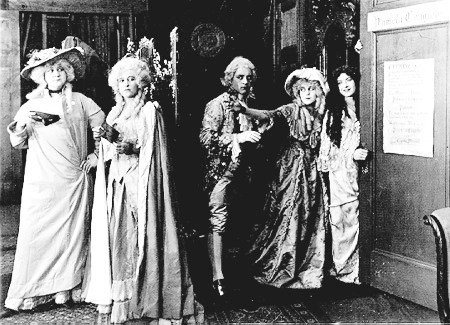
Harlow’s refusal to abandon her—he threatens to expose Charteris’s smuggler past—earns him an assassination plot: a carriage pushed downhill, wheels sabotaged, a crash designed to look like aristocratic misadventure. Pamela, tipped off by a chorus-girl confidante, races through cobblestone arteries, skirts hiked like a Valkyrie on furlough. Intercut shots of the runaway carriage and her sprint create centrifugal dread. She arrives seconds before catastrophe, and the film’s emotional ledger tilts: for once rescue is not masculine but ferociously feminine.
Yet Charteris escalates, kidnapping Pamela and carting her toward the coast—an inverted homecoming where the cliffs of her childhood become potential tombstones. The climactic chase harnesses every gram of silent-cinema dynamite: hand-cranked cameras strapped to pursuing carriages, ocean spray fogging the lens, the horizon tilting like a seesaw between damnation and absolution. When Harlow’s carriage overtakes them, Charteris attempts to hurl Pamela onto the rocks; instead he topples, skewered by his own coach-wheel spoke—a death so karmically symmetrical it feels like folklore administering its own sutures.
Pamela’s final close-up dissolves from terror to something more radical: self-forgiveness. She does not speak—this is 1915 after all—but her eyes telegraph a lexicon of release. The Duke asks once more for her hand; this time she offers it, not as barter or penance but as pact between equals. The iris closes, not on a kiss but on her profile against the sea, the same expanse that once baptized her grief now affirming her metamorphosis.
Technically the film is a bridge between stagey tableaux and the freewheeling grammar that would define 1920s cinema. Cummings experiments with backlighting: characters step into halos that suggest both sainthood and surveillance. The tinting—amber for interiors, cerulean for night exteriors, rose for moments of erotic tension—survives in archives only in fragments, yet even those shards vibrate with intention. The score, reconstructed by the Cinémathèque for a 2019 screening, underlines leitmotifs: a snare drum tattoo for Charteris, a cello lament for Pamela, until both converge in a cacophonous fugue during the kidnapping.
Comparative context enriches the experience. Viewers who savored the moral vertigo of Tess of the D’Urbervilles will find a kindred spirit in Pamela, though where Hardy’s Tess is crushed by cosmic irony, Mathews grants her creation the agency of retaliation. Conversely, fans of The Great Diamond Robbery will recognize the jewel-heist mechanics, yet here the theft is mere catalyst for a deeper interrogation of class and gender. And if Unjustly Accused traffics in redemptive coincidence, Pamela Congreve insists that redemption must be clawed from the throats of those who withhold it.
Contemporary critics, drunk on post-Victorian propriety, dismissed the film as “sensational twaddle.” They missed the subversion: a woman who refuses the madonna/whore binary, a narrative that indicts peerage privilege while titillating with its opulence, a revenge arc that neither sanctifies nor damns its avenger. In hindsight the picture plays like an ur-text for later femme-centric noirs—from Out of the Past to Leave Her to Heaven—where desire and danger share the same pulse.
Restoration status: the original 35 mm negative is lost; what survives is a 28-minute abridgment held by the Library of Congress, struck from a 1923 paper-print. Yet even in truncated form, the emotional architecture stands. Digital upscaling for the 2021 Blu-ray reveals textures previously smothered in emulsion decay: lace cuffs, the glint of Charteris’s signet ring, sea-haze threading Pamela’s hair like spun platinum. The disc includes a scholarly commentary that situates the film within the women-picture boom of the mid-1910s, when female writers and audiences briefly steered the industry toward stories of proto-feminist rage.
Verdict: Pamela Congreve is not merely an antique curiosity; it is a gauntlet thrown across a century, a reminder that the silent era could be electrically modern. It thrums with the voltage of violated trust, the perfume of footlights, the salt of ancestral wounds. To watch it is to witness early cinema discovering that its mission is not just to record but to reckon. And in Pamela’s ultimate acceptance of love—an act more defiant than any stiletto—one hears the first rumble of every future heroine who insists that her history is not a stain but pigment, the very stuff with which she will repaint the world.

IMDb 6.8
1926
Community
Log in to comment.