DbcultAccessing Vault...
6/10
Senior Film Conservator
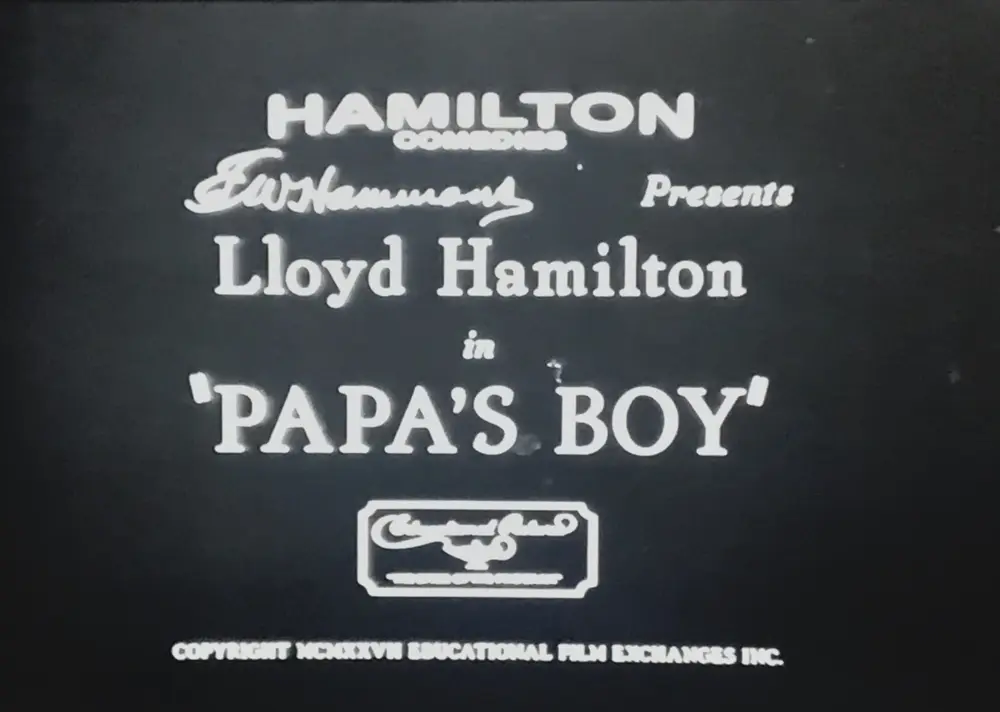
A definitive 6/10 rating for a film that redefined the boundaries of cult cinema. Papa's Boy remains a cornerstone of transgressive art.
Is Papa’s Boy worth your time in the modern era? Short answer: Yes, but only if you are a student of physical comedy or a silent film completionist. For the casual viewer, the pacing and dated gender politics might feel like a chore, but for those who appreciate the 'comedian’s comedian' Lloyd Hamilton, it is an essential artifact of a lost style of performance.
This film is specifically for those who want to see the DNA of the modern 'man-child' trope before it was popularized by the likes of Adam Sandler or Will Ferrell. It is decidedly NOT for viewers who demand fast-paced narratives or those who are easily frustrated by the repetitive nature of 1920s two-reelers. It works. But it’s flawed.
1) This film works because: Lloyd Hamilton possess a physical language that is entirely his own; his 'waddle' and facial micro-expressions provide a level of character depth that transcends the simple 'sissy' archetype of the era.
2) This film fails because: The middle act drags significantly during the camping sequence, relying on repetitive gags involving fire and tents that were already clichés by 1927.
3) You should watch it if: You have already exhausted the filmographies of Keaton and Chaplin and want to understand why contemporaries considered Hamilton a genius of the form.
Lloyd Hamilton is the great 'what if' of the silent era. Often cited by Buster Keaton as one of the funniest men alive, Hamilton never achieved the enduring global icon status of his peers. In Papa's Boy, we see exactly why. He doesn't play for the rafters; he plays for the lens. His character, Ham, is a fascinating study in contrast. He is physically large but moves with the delicate, fluttering uncertainty of the very butterflies he chases.
The film opens with a sequence that defines Hamilton’s 'Ham' persona. He is skipping—not running, skipping—with a net. Most comedians of the time would have played this for broad, mocking laughs. Hamilton, however, plays it with a terrifyingly sincere commitment. He isn't pretending to be a child; in his mind, he is a child. This sincerity makes the subsequent 'man-making' camping trip feel less like a comedy setup and more like a psychological experiment.
Compared to the athletic prowess seen in films like The Busher, Hamilton’s physicality is grounded in failure. Where a Keaton character might accidentally perform a stunt, Hamilton’s Ham accidentally survives one. It is a comedy of endurance rather than a comedy of skill. This distinction is vital to understanding the film's unique flavor.
Director Norman Taurog, who would later find massive success in the talkie era with films like Skippy, shows an early knack for framing character-driven slapstick. In Papa's Boy, Taurog understands that the joke isn't the camping trip itself, but Ham’s reaction to the camping trip. He uses wide shots to emphasize Ham’s isolation in the wilderness, making the character look like a misplaced polka-dot in a world of jagged rocks and pine needles.
There is a specific scene involving the setting up of a tent that highlights Taurog’s precision. While many silent comedies of the time, such as Huntin' Trouble, relied on frantic editing, Taurog allows the camera to linger. We watch Ham struggle with a tent pole for a full thirty seconds without a cut. The humor builds through frustration, a technique that feels surprisingly modern. It’s the kind of slow-burn comedy that paved the way for later legends of the awkward.
"Hamilton’s face is a canvas of bewilderment. He looks like a man who has just been told that gravity is merely a suggestion."
To review Papa's Boy without addressing its central theme of 'making a man' out of an effeminate son would be a disservice. The film is a product of its time, reflecting a post-WWI anxiety about the 'softening' of American men. The father character is played with a gruff, almost menacing intensity by the supporting cast, creating a genuine sense of stakes. This isn't just a fun trip; it's a forced re-education.
However, the film takes an unconventional stance for 1927. While it mocks Ham’s daintiness, it also mocks the father’s rigid hyper-masculinity. The father often finds himself just as humiliated by the elements as his son. In this way, Papa's Boy shares some thematic DNA with Boys Will Be Boys, questioning the performance of adulthood itself. The 'manly' activities—chopping wood, starting fires—are presented as absurd rituals that lead to more pain than they are worth.
One surprising observation: Ham’s effeminacy is never actually 'cured.' By the end of the film, he hasn't become a rugged outdoorsman. Instead, he has simply survived. This subversion of the typical 'growth' arc is one of the reasons Hamilton’s work remains interesting. He refuses to allow his character to conform, even for a happy ending. It’s a stubbornness that feels like a quiet rebellion against the genre's tropes.
If you are looking for a laugh-a-minute riot, no. Papa's Boy is a slower, more deliberate piece of comedy. It requires the viewer to settle into the rhythm of 1920s storytelling. However, if you are interested in the evolution of the comedic persona, it is a goldmine. The way Hamilton uses his costume—the checkered cap that seems to have a life of its own—is a masterclass in prop comedy. It is a film that rewards attention rather than passive viewing.
Compared to the high-octane stunts of Greased Lightning, Papa's Boy is a quiet character study disguised as a slapstick short. It doesn't need to blow things up to be effective. It only needs Lloyd Hamilton’s face looking at a bear with a mixture of polite curiosity and profound terror.
Technically, Papa's Boy is superior to many of its contemporaries. The location shooting for the camping scenes provides a depth of field that you don't see in studio-bound comedies like Adam's Rib. The natural lighting, though harsh at times, adds to the 'man vs. nature' theme. There is a specific shot of Ham standing on the edge of a cliff, looking down with a mix of vertigo and boredom, that is beautifully composed.
The pacing, however, is where the film shows its age. Silent comedy often relied on the 'rule of three,' but Papa's Boy sometimes pushes it to a 'rule of six.' A gag involving a folding chair, for instance, goes on long after the audience has reached the punchline. This stuttering rhythm is a hallmark of the era, but it prevents the film from reaching the heights of a Keaton masterpiece like The General.
Despite this, the editing remains crisp. The cuts between Ham’s delicate movements and the father’s aggressive actions create a rhythmic tension that carries the film through its slower moments. It’s a visual dialogue between two different worlds—the world of the butterfly and the world of the bear.
Papa's Boy is a fascinating, if slightly uneven, relic. It serves as a reminder that the silent era was not just about the 'Big Three' (Chaplin, Keaton, Lloyd), but also about idiosyncratic artists like Lloyd Hamilton who were carving out their own strange niches. The film doesn't offer a grand cinematic journey, but it does offer a series of brilliant, small moments. It is a quiet comedy of errors that finds humor in the simple act of existing in a world that demands you be something you are not. It works. It’s flawed. But it is undeniably Hamilton.
IMDb 4.5
1927
Community
Log in to comment.