DbcultAccessing Vault...
6.4/10
Senior Film Conservator
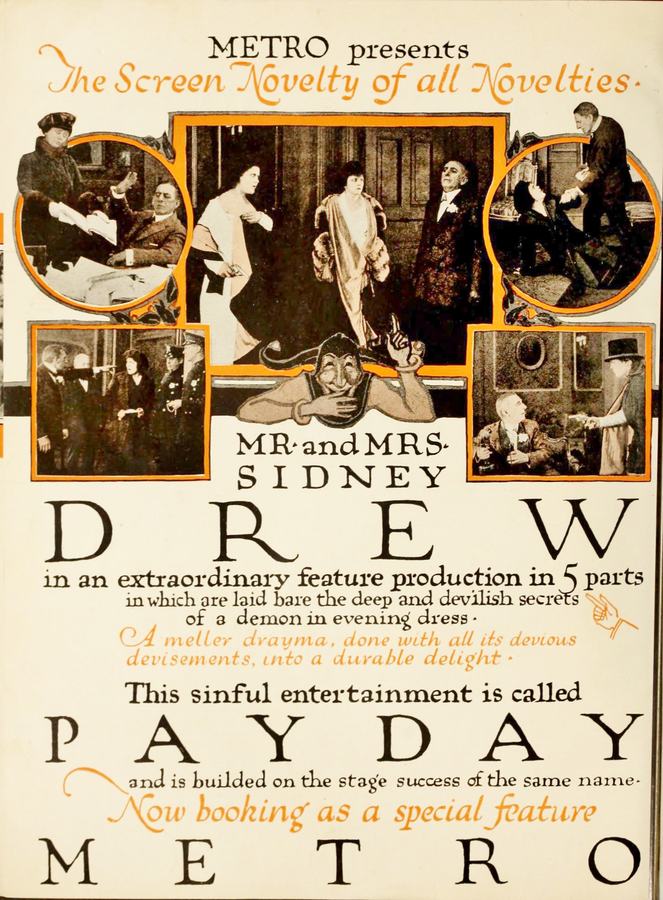
A definitive 6.4/10 rating for a film that redefined the boundaries of cult cinema. Pay Day remains a cornerstone of transgressive art.
In the annals of early cinema, few genres commanded the visceral attention and emotional investment quite like the melodrama. These were the narratives that, unburdened by the subtle nuances of later cinematic eras, dove headfirst into the grandest human struggles: love, betrayal, sacrifice, and often, the most exquisite forms of suffering. Such is the proposed spectacle of Pay Day, a scenario so audacious in its dramatic contrivances that it compelled the seasoned Metro comedians Mr. and Mrs. Sidney Drew to consider bringing its heightened realities to the silver screen. Far from a mere comedic interlude, this film within a film—or rather, a proposed film—promised a journey into the darkest recesses of human depravity and the relentless pursuit of a twisted justice. It’s a testament to the era’s appetite for emotional extremes, where every turn of the plot was designed to elicit gasps, tears, and a profound sense of moral outrage.
At the heart of Pay Day’s intricate web of woe lies Kirke Brentwood, a character etched from the very essence of cinematic villainy. Portrayed, in the Drews’ vision, by Sidney Drew himself, Brentwood is no common ruffian, but a man of apparent means, cloaked in a dapper exterior that belies a soul utterly devoid of scruples. His wealth, rather than a source of benevolence, becomes a tool for his insidious machinations, a shield behind which he orchestrates the downfall of those foolish enough to trust him. The narrative opens with his cruel manipulation of Doris Fenton, a young woman whose poverty renders her tragically vulnerable, yet whose heart holds the naive hope of marriage to this charming predator. Brentwood's demand that she steal for him is not merely a crime; it is an act of profound psychological abuse, a calculated shattering of her innocence and agency. This initial transgression sets a devastating precedent, establishing a cycle of exploitation and injustice that defines Doris’s tragic trajectory. It echoes, perhaps, the societal critiques found in films like The Whirlpool of Destiny, where innocent individuals are often caught in currents far beyond their control, swept away by the machinations of the powerful or the cruel hand of fate.
Doris’s subsequent imprisonment is a stark illustration of the era’s often unforgiving legal and social landscape. While she serves time for a crime she was coerced into committing, Brentwood, with a chilling nonchalance, moves on, marrying Isabel. This act of blatant betrayal is not just a personal affront; it is a profound moral failing, demonstrating a complete absence of remorse or loyalty. The speed and ease with which he replaces Doris underscore his transactional view of relationships, where individuals are merely pawns in his relentless pursuit of self-gratification. This callous disregard for human connection and the consequences of his actions paints Brentwood as a truly reprehensible figure, a mirror to the darker aspects of human nature that melodramas so often sought to expose.
The narrative, however, is far from finished with Doris Fenton. Upon her release, a moment that should signify liberation, she is drawn back into Brentwood’s toxic orbit, a moth to a dangerous flame. Her return coincides with a scene of breathtaking brutality: Kirke Brentwood in the act of strangling Isabel, his second wife. But the horror does not end there. With a cunning born of pure malice, Brentwood seizes the opportunity to frame Doris for the very crime he is committing, ensuring her swift return to prison, this time for life. It is a grotesque perversion of justice, a testament to the power of the manipulative individual to bend reality to their malevolent will. The audience, no doubt, would have been left reeling by this audacious twist, feeling the full weight of Doris’s compounded misfortune. Her fate here is reminiscent of the harrowing predicaments faced by women in other contemporary dramas, like The Rose of Blood or Without Hope, where external forces or malevolent figures dictate a woman's destiny with cruel impunity.
Five years elapse, a period that solidifies Doris’s image as a perpetual victim of circumstance and Kirke’s unrelenting villainy. Yet, the melodrama demands a reckoning, and Doris, with an almost mythical resilience, escapes. Her reappearance is not a gentle homecoming but a confrontation, a desperate attempt to reclaim some semblance of agency. She finds Brentwood once again entrenched in marital bliss, this time with Ruth, illustrating his perpetual cycle of discarding and acquiring women as if they were mere possessions. The emotional weight of this encounter is immense; Doris, bearing the scars of years of unjust imprisonment, faces the architect of her misery, who remains outwardly untouched by his crimes.
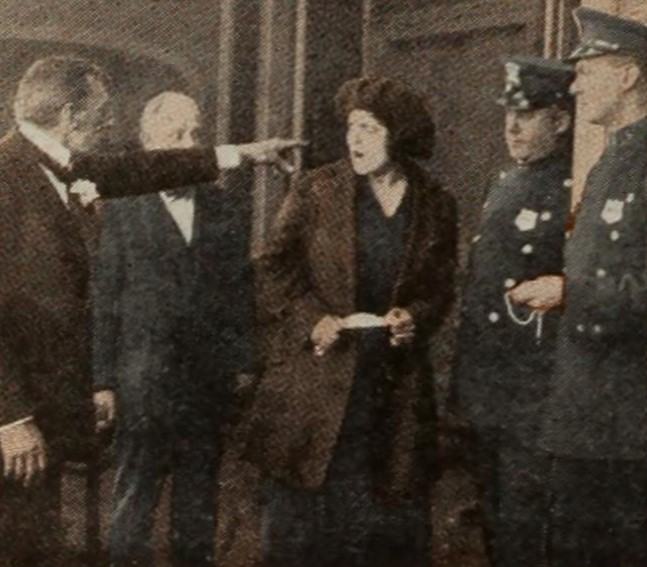
It is in this final confrontation that Pay Day veers sharply from conventional melodrama into something far more unsettling and profoundly original. Doris, seemingly softened by time or perhaps a morbid resignation, suggests forgetting the past. A kiss, a gesture that might signify forgiveness or a rekindling of a twisted affection, instead becomes the vehicle for a revelation of truly shocking proportions. Doris confesses to Kirke that she has leprosy. This is not merely a plot twist; it is a seismic shift that redefines the entire narrative, transforming a story of crime and punishment into a macabre tale of shared, inescapable doom. The disease, with its historical connotations of ostracism and slow decay, becomes the ultimate equalizer, a grotesque form of poetic justice. Kirke, who has escaped every legal and moral consequence, is now bound to Doris by an affliction far more potent and inescapable than any prison sentence. They are condemned not to a cell, but to a leper colony, a fate that is both a living death and an eternal, inescapable union. It is a conclusion that is as audacious as it is horrifying, pushing the boundaries of what audiences expected from a dramatic narrative. This kind of shocking, almost supernatural retribution might find a distant echo in the more fantastical elements of early cinema, perhaps even bordering on the psychological torment seen in films like The She Devil, though here the torment is biological and tragically real.
The genius of this ending lies in its subversion of traditional melodramatic resolutions. There is no triumphant hero, no clear-cut victory for justice in the conventional sense. Instead, there is a shared damnation, a chilling irony where the victim, through her own suffering, becomes the instrument of her tormentor's ultimate, inescapable punishment. It is a dark, almost nihilistic vision of justice, where fate, rather than the law, delivers the final, most agonizing blow. The sheer audacity of this twist would undoubtedly have left contemporary audiences stunned, marking Pay Day as a narrative that dared to venture beyond the familiar tropes of its genre, crafting a conclusion that is both unforgettable and deeply disturbing.
The framing device—the Metro comedians Mr. and Mrs. Sidney Drew considering this very scenario—adds a fascinating metatextual layer to Pay Day. It positions the melodrama not just as a story, but as a commodity, a potential financial juggernaut. The Drews, known for their comedic prowess, venturing into such dark territory speaks volumes about the commercial appeal of sensational narratives. Their discussion, their contemplation of the screenplay, transforms the act of viewing into an act of shared judgment and anticipation. It allows the audience to consider the mechanisms of storytelling, the deliberate crafting of emotional peaks and valleys, and the calculated deployment of shocking twists for maximum impact.
Richard A. Rowland, the Metro president, definitively declaring the film a "huge financial success" and advocating for its production, serves as the ultimate validation of Pay Day’s narrative power. It underscores the commercial viability of stories that plumb the depths of human suffering and deliver truly unexpected conclusions. This endorsement from a studio executive of the time is a crucial detail, highlighting the business acumen behind the art, and the understanding that raw, unadulterated drama, no matter how grim, could captivate and draw crowds. It speaks to an era where storytelling was both a craft and an industry, keenly attuned to the desires of a mass audience hungry for escapism and emotional catharsis, even if that catharsis came in the form of shared horror and moral indignation. The commercial viability of such intense narratives might be compared to the audience draw for thrilling adventures or intense character studies in other films of the period, such as In the Lion's Den, which promises spectacle and danger, albeit of a different kind.
While specific details of the proposed direction or the nuances of the Drews’ performances are not explicitly detailed in the synopsis, one can readily imagine the immense potential for dramatic flair. Sidney Drew, known for his comedic timing, would have had a field day with the role of Kirke Brentwood. To inhabit such an unrepentant villain, shifting from dapper charm to brutal manipulation to panicked self-preservation, would demand a performance of considerable range. His comedic background might even lend a subtle, unsettling edge to Brentwood’s villainy, perhaps a chilling casualness that makes his cruelty all the more horrifying. The contrast between his usual persona and this dark role would have been a significant draw for audiences.
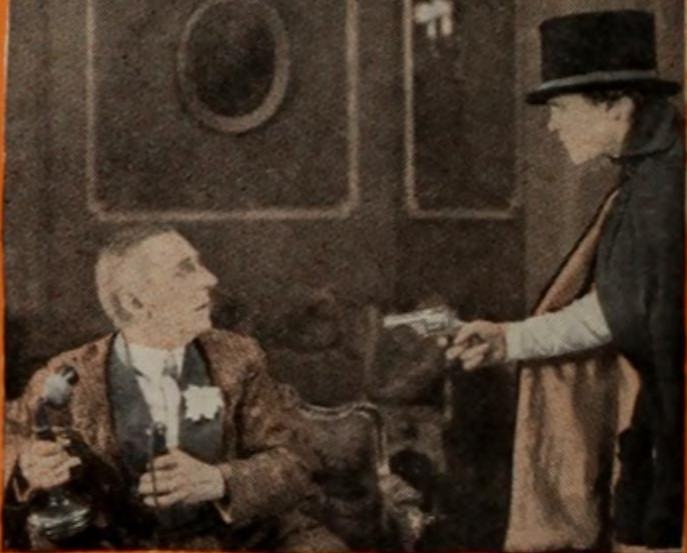
Mrs. Sidney Drew, presumably taking on the role of Doris Fenton, would face an equally demanding task. Doris’s journey is one of relentless suffering, from hopeful innocence to exploited victim, unjustly imprisoned, and ultimately, a harbinger of a terrible fate. Her portrayal would require a nuanced understanding of vulnerability, resilience, and the slow erosion of hope, culminating in that shocking, almost defiant revelation of her illness. The success of the melodrama would hinge significantly on the audience's ability to empathize with Doris, to feel the weight of her injustices, and to grapple with the moral ambiguity of her ultimate act of "justice." The emotional depth required for such a role aligns with the demanding performances seen in other women-centric dramas like Maternity or The Make-Believe Wife, where the female protagonist often carries the narrative's emotional core.
The direction, too, would be paramount. To effectively convey the escalating tension, the abrupt shifts in fortune, and the sheer horror of the final twist, the film would require a deft hand. The strangulation scene, the prison escapes, and the climactic reveal of leprosy would all demand careful staging and visual storytelling to maximize their impact without descending into mere sensationalism. The power of silent film relied heavily on exaggerated expressions, dramatic gestures, and carefully composed shots to convey internal states and external conflicts. One can envision stark contrasts in lighting to emphasize Kirke’s villainy, and close-ups to capture Doris’s anguish and later, her grim resolve. The visual language of early cinema was uniquely suited to the grand narratives of melodrama, allowing for a heightened reality that embraced the genre's inherent theatricality.
Pay Day, even as a proposed scenario, stands as a fascinating artifact of cinematic history, embodying the very essence of early 20th-century melodrama. It showcases a willingness to push boundaries, to explore the darkest aspects of human nature, and to deliver resolutions that were anything but predictable. The film's narrative, with its relentless cycle of betrayal, injustice, and a shocking, almost supernatural retribution, speaks to a fundamental human fascination with consequence and fate. It taps into primal fears and desires for justice, even if that justice is delivered in the most unconventional and horrifying manner imaginable.
The film’s audacity, particularly in its leprosy twist, distinguishes it from many of its contemporaries. While other melodramas might conclude with a hero's triumph or a villain's conventional downfall, Pay Day opts for a shared, inescapable damnation, a chillingly intimate form of eternal punishment. This makes it more than just a sensational story; it becomes a profound, albeit dark, meditation on the interconnectedness of human lives, even in their most antagonistic forms. The idea that one person's suffering could lead to such a grotesque and inescapable fate for their tormentor is a powerful, if disturbing, concept. It suggests that some debts cannot be paid in mere currency or prison sentences, but only through a shared, agonizing existence.
In an era when cinema was still defining its narrative language, Pay Day represents a bold experiment in storytelling. It’s a testament to the power of a well-crafted scenario to captivate, to shock, and to provoke thought, even decades after its conception. The film, had it been realized exactly as conceived, would undoubtedly have been a memorable, if unsettling, entry in the canon of early American cinema. It serves as a reminder that the appeal of high drama, moral complexity, and genuinely surprising twists is not a modern phenomenon, but a foundational element of cinematic storytelling, perpetually capable of drawing audiences into its intricate, often uncomfortable, embrace. Its capacity for shock and its exploration of dark themes place it in a lineage with other films that dared to challenge audience expectations, perhaps even those with psychological depth like John Needham's Double, which delves into complex moral quandaries.
Ultimately, Pay Day is a fascinating glimpse into the commercial and artistic impulses of early Hollywood. It’s a story designed to be a financial success, yet it achieves this through a narrative that is anything but simplistic. It offers a rich tapestry of human failing, societal injustice, and a macabre form of retribution that lingers long after the final scene. For those interested in the evolution of cinematic narrative, and particularly the enduring power of melodrama, Pay Day stands as a compelling, if darkly unsettling, example of the genre's enduring appeal and its capacity for truly shocking innovation.
IMDb —
1927
Community
Log in to comment.