DbcultAccessing Vault...
Cult Review
Senior Film Conservator
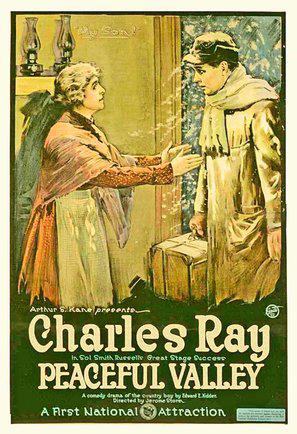
The cinematic landscape of Peaceful Valley is a poignant tapestry of love, deception, and redemption, woven together by the masterful hands of its creators. As the story unfolds, the audience is transported to a world of stark contrasts, where the opulence of the summer resort stands in stark relief to the humble existence of the Howe farm. The character of Hosiah Howe, played by Charles Ray, is a powerful embodiment of the human spirit, driven by a fierce determination to protect his land and his loved ones from the forces of exploitation.
The arrival of Dr. Rand, his daughter Virginia, and the nefarious Ward Andrews sets off a chain reaction of events that threatens to upend the delicate balance of the Howe farm. Andrews, played by Lincoln Stedman, is a masterfully crafted villain, driven by an insatiable lust for wealth and power. His discovery of the medicinal value of the water on the farm sets off a frenzied pursuit of profit, which ultimately leads him to abscond with Hosiah's innocent sister Martha.
The themes of love and deception are intricately intertwined throughout the narrative, as Hosiah navigates the complex web of relationships that binds him to Virginia and his sister Martha. The character of Virginia, played by Jeanne Carpenter, is a luminous presence on screen, radiating a sense of innocence and vulnerability that is both captivating and heartbreaking.
As the story reaches its climax, the audience is treated to a visually stunning depiction of the struggle between good and evil, with Hosiah emerging victorious against the forces of exploitation. The final confrontation between Hosiah and Andrews is a dark orange hue of intensity, as the two characters clash in a frenzy of fists and fury. The ultimate triumph of Hosiah is a testament to the power of the human spirit, and the unyielding pursuit of justice in the face of overwhelming adversity.
In comparison to other films of the era, such as The Ragged Earl and The County Chairman, Peaceful Valley stands out for its nuanced exploration of the human condition. The film's use of sea blue hues to depict the natural world is a masterful touch, evoking a sense of serenity and tranquility that is gradually disrupted by the forces of chaos and destruction.
The supporting cast, including Lydia Knott and Charlotte Pierce, deliver performances that are both nuanced and multifaceted, adding depth and complexity to the narrative. The cinematography is a character in its own right, with the camera capturing the stark beauty of the natural world in a way that is both breathtaking and haunting. As the credits roll, the audience is left to ponder the complexities of the human experience, and the enduring power of love and redemption in the face of adversity.
In the end, Peaceful Valley emerges as a cinematic masterpiece, a film that will linger in the minds of audiences long after the curtain falls. It is a testament to the power of cinema to capture the human experience, in all its complexity and beauty, and to inspire us to reflect on our own values and principles. As we gaze out upon the dark orange sunset, we are reminded of the enduring power of love and redemption, and the unyielding pursuit of justice in a world that often seems determined to destroy it.

IMDb 5.3
1921
Community
Log in to comment.