DbcultAccessing Vault...
5.6/10
Senior Film Conservator
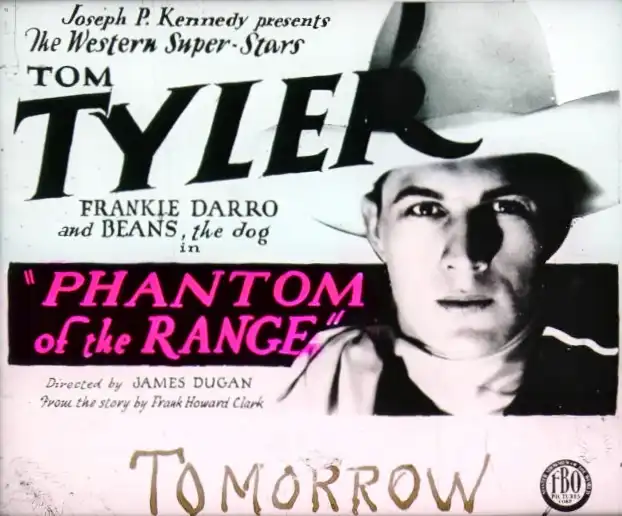
A definitive 5.6/10 rating for a film that redefined the boundaries of cult cinema. Phantom of the Range remains a cornerstone of transgressive art.
Look, if you’re not already a deep-cut B-Western enthusiast, you can probably skip Phantom of the Range. This is one for the true believers, the folks who get a kick out of seeing how these things were cobbled together in the mid-30s, or maybe just want to see Beans the Dog do his thing. Everyone else? You’ll likely find it a bit of a slog, honestly. But if you’re in the mood for something genuinely old-school, with all its rough edges and peculiar charms, then pull up a chair.
The whole premise starts with Duke Carlton, played by Frankie Darro, who’s supposed to be an actor stranded in a small town. You don't really get a sense of him being an 'actor' though. He just kind of... shows up. Then he beats up a shifty real estate agent, 'Flash' Corbin, in a saloon brawl that feels less like a fight and more like two guys trying to remember their choreography. But it’s enough to impress rancher Tim O'Brien, who immediately offers him a job. It’s a very movie way to get hired, you know?
Marjorie Zier plays Patsy, O'Brien's daughter, and the romantic interest. Their chemistry is… fine. It feels less like two people falling for each other and more like two actors hitting their marks and reciting lines. There’s a scene where they’re talking by a fence, and the dialogue just hangs in the air, a little flat. You can almost feel the movie trying to convince you this moment matters, but it never quite lands.
The pacing is a real rollercoaster. Some scenes rush by, chopping from one plot point to the next with almost no transition. Then you get moments that just stretch out. There's a particular shot of a horse galloping across a field that feels like it goes on for a solid minute, just to pad things out, I guess. It’s not a bad shot, but it definitely makes you check the time.
And then Vera Van Swank shows up. Vera, Duke’s former stage partner, claiming he’s her husband. This is where the plot really takes a turn into the absurd. It’s a bigamy accusation in the middle of a Western land dispute! The tonal shift is pretty jarring. One minute you’re watching cowboys ride horses, the next it’s a courtroom drama, or at least the B-movie equivalent of one. It’s handled with such a straight face, which almost makes it funnier.
Beans the Dog, though. Beans is a highlight. He’s often just there in the background, but he has this presence. There’s a scene where he’s just sitting by the porch, watching the human drama unfold, and you can almost imagine him thinking, 'These people, honestly.' He gets a few moments to shine, too, particularly when he’s chasing off a bad guy. He’s a natural.
The villain, Flash Corbin (James Pierce), is pretty standard mustache-twirling stuff. His motivations are clear enough – he wants the O'Brien ranch, which apparently has some valuable land. The whole $90,000 figure gets thrown around a lot, which sounds like an enormous sum for this kind of production, making the stakes feel a little out of whack with the cheap sets.
Visually, it's exactly what you'd expect from a low-budget 1936 Western. Lots of outdoor shots that are functional, not artistic. The interiors look like, well, sets. There’s a saloon where the lighting seems to change between shots, like they only had one lamp they kept moving around. It’s charming in its own way, if you appreciate that kind of thing. The costumes are mostly dusty cowboy gear, nothing particularly memorable, but they fit the bill.
The dialogue is often clunky. People state their intentions very plainly, or explain things that just happened. It’s like the writers didn’t trust the audience to follow along. There's a point where Duke is trying to clear his name regarding Vera, and the explanation he gives is so convoluted, it makes you wonder if anyone on set fully understood it.
One moment that actually worked for me was when Duke, despite being an 'actor,' shows he can actually ride and shoot. It’s a small detail, but it grounds him a little bit. He's not just fumbling through it. And the final resolution, where everything ties up neatly, is predictable but satisfying in that old-fashioned way. The bad guys get their comeuppance, the hero gets the girl, the ranch is saved. All in a brisk 58 minutes.
So, is Phantom of the Range a lost classic? Absolutely not. Is it a fascinating glimpse into early B-movie filmmaking, complete with some surprisingly watchable animal acting and plot points that swing wildly between cowboy adventure and domestic drama? Yeah, it kind of is. Don’t go in expecting greatness, but if you’re looking for a weird little piece of cinema history, and you have a soft spot for dogs, you might just find something to appreciate here.
IMDb —
1920
Community
Log in to comment.