DbcultAccessing Vault...
Cult Review
Senior Film Conservator
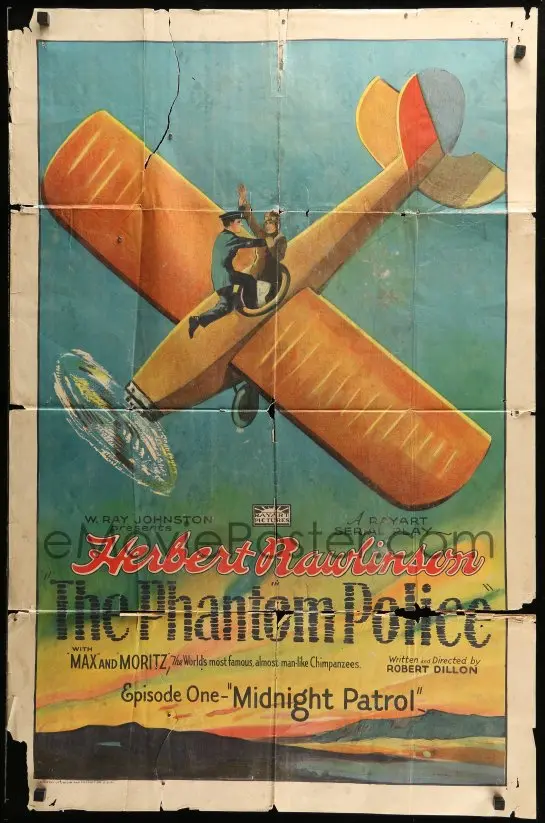
Is Phantom Police worth watching today? Short answer: yes, but with significant caveats. This silent-era thriller, while undeniably a product of its time, offers a fascinating glimpse into early cinematic storytelling and thematic explorations that remain surprisingly potent. It’s a film that demands patience and an appreciation for the historical context of cinema, rewarding those who approach it not just as entertainment, but as an artifact.
This film is unequivocally for devotees of silent cinema, film historians, and those intrigued by the nascent stages of the crime and mystery genres. If you’re accustomed to modern pacing, dialogue-heavy narratives, or high-budget spectacle, Phantom Police might prove a challenging watch. It’s a niche experience, but a deeply rewarding one for its target audience.
Phantom Police plunges viewers into a world where the lines between law enforcement and vigilante justice blur with audacious clarity. The narrative, while sometimes broad in its strokes, effectively captures the zeitgeist of a society grappling with perceived systemic failures and the allure of an unseen, righteous hand. It’s a story told through grand gestures and stark visual contrasts, a hallmark of its era.
This film works because of its audacious thematic premise and the earnest, often exaggerated, performances that defined silent cinema. It fails because its pacing can be glacial by modern standards, and some narrative resolutions feel overly simplistic. You should watch it if you appreciate the artistry of early filmmaking and are willing to engage with its unique storytelling language.
The film’s central conceit—a secret organization dispensing justice—is a compelling one, even if its execution occasionally stumbles. It forces the audience to confront uncomfortable questions about morality, a surprisingly sophisticated undertaking for a film of this vintage. We’re not simply watching a good versus evil tale; it’s a nuanced exploration of justice, or at least, one side of it.
To truly appreciate Phantom Police, one must first adjust to the conventions of silent film. The acting, often characterized by overt facial expressions and dramatic body language, serves as the primary vehicle for emotion and intent. Subtlety, as we know it today, was largely absent, replaced by a theatricality designed to convey meaning without spoken words. This is where the film truly shines, allowing its performers to leave a lasting impression.
Herbert Rawlinson, as Detective John Harding, delivers a performance that anchors the film with a sense of unwavering determination. His portrayal is archetypal, embodying the stoic, incorruptible lawman. Rawlinson’s ability to convey complex emotions through his eyes alone is commendable, a skill honed by years in the silent era, often reminiscent of his work in The Tornado, where he also played a character of strong moral fiber.
Rosemary Cooper, as Eleanor Vance, brings a much-needed layer of emotional vulnerability and intellectual curiosity. Her character’s journey from societal comfort to active investigator is one of the film’s more engaging arcs. Cooper navigates this transformation with a grace that prevents her from becoming a mere damsel in distress, injecting a surprising agency into her role.
Purnell Pratt, often cast in roles of authority or menace, here embodies a more ambiguous figure within the city’s power structure. His presence is always impactful, even when his character’s motivations are initially shrouded in mystery. The ensemble, including J.C. Fowler and James Gordon, collectively creates a believable world, each actor contributing to the film’s dramatic weight through their distinctive silent performances.
The direction in Phantom Police, while not groundbreaking by today's standards, is effective in building suspense and conveying narrative. The use of shadow and light, a staple of early thrillers, is employed to great effect, particularly in scenes involving the elusive Phantom Police. The silhouettes and obscured faces contribute significantly to their mysterious aura, a technique that would later become a cornerstone of film noir.
Cinematography, though rudimentary compared to later eras, demonstrates a keen understanding of visual composition. There are moments of striking imagery, particularly during the Phantom Police’s operations, where the camera cleverly utilizes angles to suggest their omnipresence and the fear they inspire. Consider the scene where a victim finds a calling card left in their ransacked office; the stark close-up on the card, framed against the chaos, amplifies its chilling message.
However, the visual language can sometimes feel repetitive. A reliance on static shots and straightforward editing, typical of the period, means that dynamic action sequences, while present, lack the fluidity audiences expect today. This isn't a criticism of the film's quality, but rather an observation of its historical context. It’s a different kind of visual grammar.
The pacing of Phantom Police is deliberate, building tension through sustained sequences rather than rapid cuts. Intertitles, the textual explanations that punctuate silent films, are well-integrated, providing necessary exposition and character dialogue. While they do interrupt the visual flow, they are essential to understanding the film’s intricate plot and character motivations. The tone oscillates between a serious crime drama and moments of heightened melodrama, a common characteristic of silent-era storytelling.
The film’s greatest strength in terms of tone is its ability to maintain a consistent sense of mystery and threat. The Phantom Police are genuinely menacing, not just because of their actions, but because of their anonymity. This creates an atmosphere of unease that permeates the entire narrative, keeping the audience engaged even through slower passages.
At its core, Phantom Police is a fascinating exploration of justice outside the law. It dares to ask whether a society, disillusioned with its institutions, might embrace a morally ambiguous solution. This theme feels remarkably prescient, echoing debates about vigilantism that persist to this day. It’s a testament to the film’s underlying intelligence that it doesn’t offer easy answers.
My unconventional observation here is that the film inadvertently serves as a powerful commentary on the power of public perception. The 'Phantom Police' gain their strength not just from their actions, but from the narrative the public builds around them. They become a symbol, a reflection of societal frustration, which is arguably more impactful than any individual act of vigilantism. This dynamic adds a layer of sociological depth often overlooked in analyses of early cinema.
One could argue that the film, despite its somewhat simplistic resolution, posits a surprisingly modern question: when does righteous anger transform into dangerous extremism? The answer, as presented, is not as clear-cut as one might expect from a film of this period, which often favored clear moral distinctions. This ambiguity is its most potent legacy.
Absolutely, for the right audience. It’s a compelling piece of cinematic history. While its pacing and acting style require a degree of adjustment for contemporary viewers, its thematic depth and the sheer earnestness of its performances make it a valuable watch. It’s not just a film; it’s a time capsule.
However, it’s not for everyone. If you’re seeking fast-paced action or character development that relies on nuanced dialogue, you will be disappointed. This is a film that rewards patience and a genuine interest in the evolution of storytelling.
Phantom Police is more than just a relic; it's a vibrant, if sometimes quaint, piece of cinema that speaks to enduring human fascinations with justice and power. It works. But it’s flawed. Its strengths lie in its bold thematic approach and the earnest performances of its cast, particularly Rawlinson, who commands the screen with a silent intensity. While the pacing might test the patience of some, those willing to immerse themselves in the unique language of silent film will find a rewarding experience.
It’s a film that deserves to be seen, not just for its historical value, but for the surprisingly relevant questions it poses. For film students and classic cinema aficionados, Phantom Police is an essential watch, a testament to the power of visual storytelling even in its earliest forms. It might not be a masterpiece, but it’s certainly a compelling and educational journey back in time.
IMDb 5.4
1918
Community
Log in to comment.