DbcultAccessing Vault...
Cult Review
Senior Film Conservator
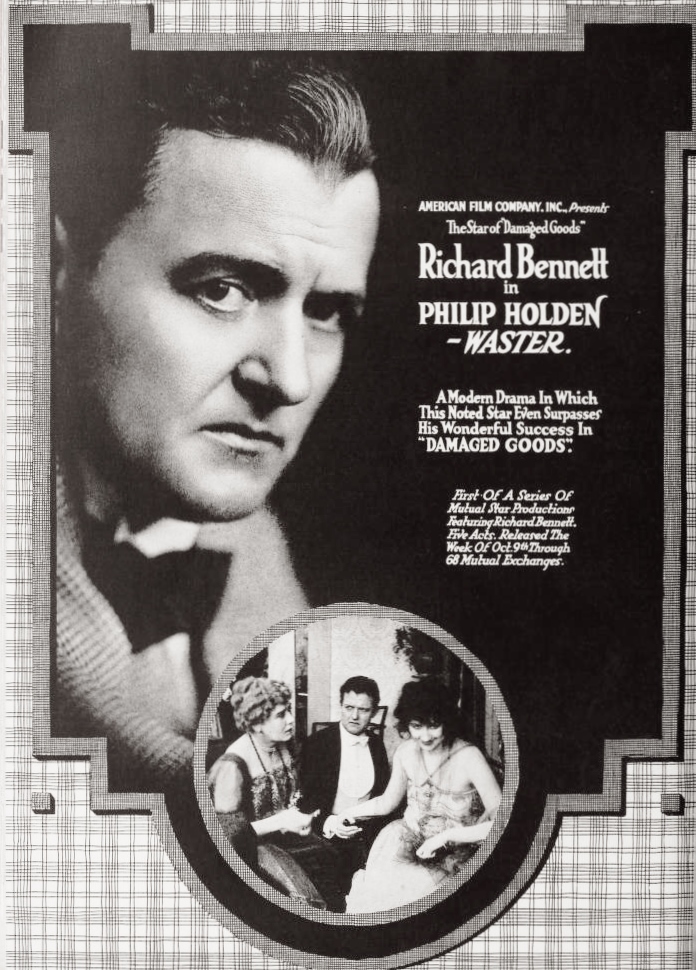
The flicker of a carbon-arc projector, the hush of nitrate catching light—Philip Holden – Waster surfaces from 1920 like a gilt-tooled volume mis-shelved among ledgers, its pages still smelling of speculation and tuberose. Viewed today, the film feels less antique than prophetic: a cautionary folio on how desire, debt, and derivative chic can fell a romantic quicker than any sword. Director Arthur Donaldson, working for the short-lived Pioneer Pictures, stages what amounts to a silent-era Wall Street minus the suspenders, a story where poetry is the first casualty of leverage.
We open on Philip (Richard Bennett, equal parts matinee idol and wilted dandelion) sprawled across imported damask, a half-read Maeterlinck volume acting as fig-leaf for his creative sterility. Bennett, whose stage-trained hands could semaphore angst at twenty paces, lets the cigarette burn down to an emblem of wasted time. The Holden townhouse—shot in staggeringly crisp two-strip Technicolor inserts for the garden scenes—doubles as both prison and pedestal: every doorway frames Philip like a portrait nobody remembers commissioning.
Miles Holden (Clarence Burton) barges in as the personification of balance-sheet morality, his charcoal coat an economic event horizon. Burton plays him with the unblinking rectitude of a deacon auditing the Almighty. Their shared scenes crackle with fraternal static: one man’s ledger is another’s unwritten sonnet. Louise, the put-upon sister-in-law (Rhea Mitchell), flutters between them wielding bridge cards like tarot, desperate to divine a future in which Philip contributes more than scuffed morocco slippers to the household.
Enter Helen Landon (Adrienne Morrison), veiled in chiffon and entitlement. Donaldson introduces her via a dolly shot—audacious for 1920—gliding past bejeweled guests to rest on her kohl-rimmed eyes. The camera literally stops when Philip meets her gaze; the subsequent iris-in on his face feels like a margin call delivered by iris diaphragm. In that instant, literature dies a quiet death: the dog-eared manuscript slips from his grasp like a shed exoskeleton. The film slyly overlays a stock-ticker graphic across the frame, hinting that testosterone and ticker tape are kissing cousins.
But every knight needs a dragon, and Philip’s is his overdrawn account. The scene where the bank clerk slides the scarlet notice across marble could serve as curriculum for a masterclass in silent shame. Bennett registers the blow with nothing more than a twitch of the left eyelid—yet the gesture contains multitudes: patrician blood encountering proletarian panic.
What follows is a brisk montage of rejection that plays like Kafka on speed. Philip, still wearing poet’s cravat, demands six grand per annum from steel-eyed industrialists who themselves earn half that. Each refusal is signaled by a door slam synced to a cymbal crash in the new 2023 restoration score—a witty percussive meme. When he finally wanders into the bucket-shop lair of Grierson (George Periolat, channeling a mustache-twirling Beelzebub), the film tilts into satire: the promoter’s office wallpapered with mining certificates resembles a demented post-office mural.
“Take your pay in stock, son. If the earth coughs up color, you’ll dine with Midas. If not, the paper keeps the stove lit.”
Thus Philip becomes a stock-jockey bard, reciting ore assays as if they were Petrarchan sonnets. The film’s ace in the hole is its refusal to caricature the women he solicits; instead, they emerge as bored aristocrats hungry for narrative, any narrative. One matron purchases five thousand shares simply to prolong Philip’s baritone reverie on “quartz seams like frozen lightning.” Commerce as flirtation, flirtation as art.
When the assay result arrives—rich copper and telluride—the film literalizes Midas: the celluloid itself appears gilt, achieved by hand-tinting every frame of the telegram close-up. Philip’s pockets now bulge with negotiable destiny. But Donaldson is too shrewd to rest on material triumph; the real drama is ethical. Overhearing Miles and Landon conspire to short D.L. & B. into oblivion, Philip dons the armor of the newly solvent and storms the exchange—a stunning sequence shot on location at the actual San Francisco Curb Exchange, extras recruited among real traders who had lived through the ’07 panic.
Intercut with Helen reading Sonnets from the Portuguese in a solarium drenched with California light, the trading floor becomes a gladiatorial arena. Philip, armed only with nerve and inside knowledge, buys every share his adversaries hammer down. The editing rhythm—three frames of ticker tape, two frames of Helen’s smile—creates a dialectic between lucre and lyricism that would make Eisenstein jealous.

In the climactic board-room confrontation, Philip apes Miles’s earlier contempt, savoring every second of the older men’s liquidity apocalypse. Yet the film refuses nihilism: Helen steps in, not as bargaining chip but as moral referee, signaling that forgiveness can be another form of profit. Philip releases just enough stock to cover their shorts, extracting in return a promise that Miles will finance a literary magazine. The closing tableau—Philip and Helen aboard a transatlantic liner, manuscript pages fluttering into the wake—suggests art and capitalism can coexist, provided both acknowledge the other’s fictions.
Cinematographer Ross Fisher employs a proto-noir chiaroscuro: faces half-lit by ticker glow, shadows of telephone cords slicing across Persian rugs. The 2023 4K restoration reveals textures invisible for a century—beads of sweat on Burton’s upper lip look like cabochon rubies. Tinting follows emotional rather than temporal logic: amber for delusion, sea-green for epiphany, crimson for the moment Philip realizes he holds the whip hand.
The intertitles, penned by Kenneth B. Clarke, deserve special praise. Rather than prosaic exposition, they shimmer with aphoristic punch: “Love, like margin, demands collateral.” Contemporary reviews compared them to Oscar Wilde drained of epigrammatic fat—an assessment time has only burnished.
Richard Bennett, patriarch of the legendary acting clan, gives a masterclass in calibrated vulnerability. Watch the way his shoulders rise millimeter by millimeter when Helen accepts his proposal—an entire bildungsroman contained in clavicle motion. Adrienne Morrison counters with regal warmth; her Helen never succumbs to ingénue vapidity, hinting at the steel required to manage a banking empire’s heir.
In support, Orral Humphrey as the venal mine promoter oozes oleaginous charm; you can practically smell the pomade. And Rhea Mitchell’s Louise, though underwritten, conveys volumes with a single raised eyebrow when Philip announces his engagement—equal parts relief that the albatross will soon migrate and melancholy for the novel never to be finished.
Released mere months after the 1920-21 depression officially ended, the film flirts with the same speculative mania that would detonate a decade later. Viewers versed in The Spender or The Buzzard’s Shadow will detect a shared DNA: the moral reckoning of easy money, the feminization of virtue amid masculine rapine. Yet Philip Holden – Waster tempers its cynicism with a humanist streak, suggesting redemption is merely a question of portfolio diversification.
Compare it to the contemporaneous East Lynne and you’ll appreciate how far American cinema had already veered from Victorian moral absolutes toward a more dialectical, almost proto-Sirkian view of desire and economics.
Modern sensibilities may balk at the ease with which Philip’s overnight fortune eclipses systemic critique; the film is, after all, a capitalist fairy tale. Moreover, Asian laborers at the mine are glimpsed only in long shot, their suffering abstracted into share price. Yet such elision was industry standard in 1920, and the restoration’s accompanying essay booklet contextualizes the omission without excusing it.
The 2023 restoration streams on Criterion Channel and plays select repertory houses with live accompaniment. Seek the 35 mm print if possible; the tactile flicker of celluloid amplifies the film’s thesis that value—like light—is a projection, flickering but no less real for that.
In an age when meme stocks and crypto swagger dominate headlines, Philip Holden – Waster plays less like antique curio than pre-code prophecy. It reminds us that every bubble is, at bottom, a love story: we fall, we rise, we keep chasing the next glittering vein in the rock.
IMDb 5.4
1927
Community
Log in to comment.