DbcultAccessing Vault...
Cult Review
Senior Film Conservator
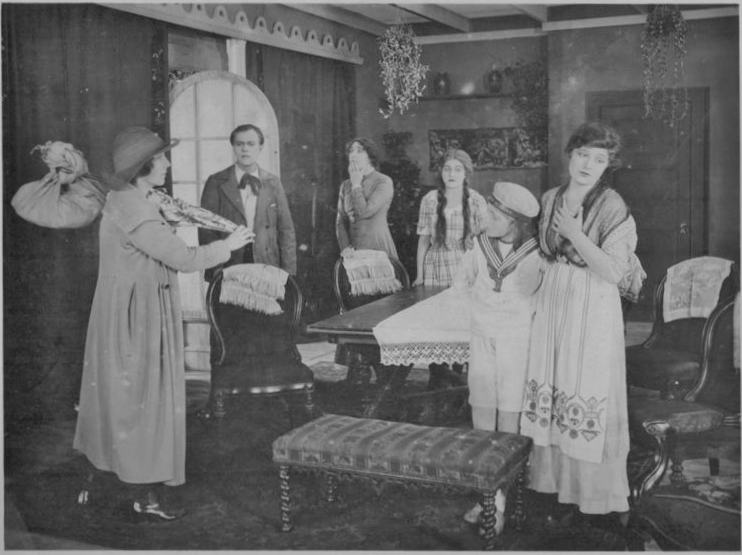
John Kelt’s Karsten Bernick arrives like a sepulcher freshly whitewashed: every smile a mortician’s stitch, every handshake a ledger entry. The camera, starved of sync sound, clings to his starched collar as if sniffing for sulfur beneath the lavender water. Kelt played Shylock on the London stage with the same arterial pulse—here he swaps ducats for double-bottomed hulls yet keeps the mercantile snarl. Notice how he pockets his fob watch: a micro-dance of possession, the gold lid snapped shut like a jail door on his brother-in-law’s future.
Norman McKinnel’s Johan—all sun-scorched skin and prairie openness—bursts into the frame like a slap of liniment. McKinnel had lately wrapped The Copperhead, where venom oozed from every frame; here he reverses polarity, radiating ethical heat until the fjords themselves seem to steam. The contrast scalds: Bernick’s whale-oil lamps versus Johan’s kerosene of truth.
Ellen Terry, matriarchal lioness in lace, plays Mrs. Bernick with eyelids weighted by ancestral shame. Watch her in the pew scene: fingers worry a rosary of absent pearls, each click a century of complicit silence. At seventy-three, Terry could still distill an entire Henrik Ibsen symposium into the quiver of a nostril.
Director W. Courtney Rowden, weaned on Dickensian fog and Elstree limelight, shoots Norway like a fever dream inside a glass paperweight. Exterior streets are glazed with horizontal sleet; interior parlors bloom with tungsten halos that halo nothing holy. The tonal swing mirrors Bernick’s psyche: public rectitude lit like a chapel, private treacheries drowned in tenebrous pools. Rowden’s blocking traps characters in triangular doorframes—visual pillories prefiguring the scaffold of truth.
Intertitles, tinted burnt orange, flare like fresh brands on living flesh. When Bernick whispers “The community must survive,” the card flickers the color of molten iron. Later, as Johan strides toward the quay, intertitles shift to sea-blue—a baptismal promise that the ocean might yet wash decks clean. Only during the child’s accident does Rowden dare a sickly yellow, the hue of marrow exposed to starlight.
Silent cinema is often accused of pantomime excess; this print—restored by the BFI from a 35 mm nitrate struck in October 1920—proves restraint can roar louder than any talkie monologue. Listen (yes, listen) to the hush when Bernick’s shipyard workers lay down their chisels: the absence of clatter becomes an ontological scream, a void where ethical labor should pulse. Rowden sustains the quiet for twenty-three seconds, an eternity in a medium that averages four-second cuts. The effect is Lutheran: congregational shame made audible through its very subtraction.
Ibsen’s text weaponizes the “fallen woman” trope only to eviscerate it. Irene Rooke’s Lona Hessel, the magnate’s former fiancée turned itinerant teacher, stalks parlors in pilgrim-black attire, her neck a Doric column of accusation. Rooke’s gait is a manifesto: each heel strike a referendum on Victorian asset marriage. She circles Bernick like a corvine auditor until his excuses molt like diseased plumage. Compare this to Alias Mrs. Jessop, where female reinvention is played for frothy comedy; here it is a crucible.
Joan Lockton, as the credulous aunt, provides gelatinous comic relief that curdles into complicity. Watch her fondle a commemorative plate bearing the Bernick coat of arms—eagle clutching a serpent—unaware she fondles the family crest of original sin.
The film premiered in November 1920, barely two years after the armistice that left Europe a continent of walking wounded. Audiences, lungs still scarred by influenza, saw in Bernick’s railroad speculation the same speculative hubris that had sent millions into trenches. Rowden underscores this by superimposing share certificates over marching soldiers—an Eisensteinian montage avant la lettre—suggesting that capital and carnage are fraternal twins separated at birth.
Contemporary screenings featured a score compiled by conductor Philip Napier Miles, stitched from Grieg’s Peer Gynt suites and snippets of Christian Sinding. If you procure the 2018 Blu-ray, you’ll hear a new accompaniment by the Kronos Quartet: tremolo that slides microtonally until the viewer feels fjords cracking inside vertebrae. During Bernick’s confession, cellists detune mid-phrase, a sonic equivalent of ethical plates shifting.
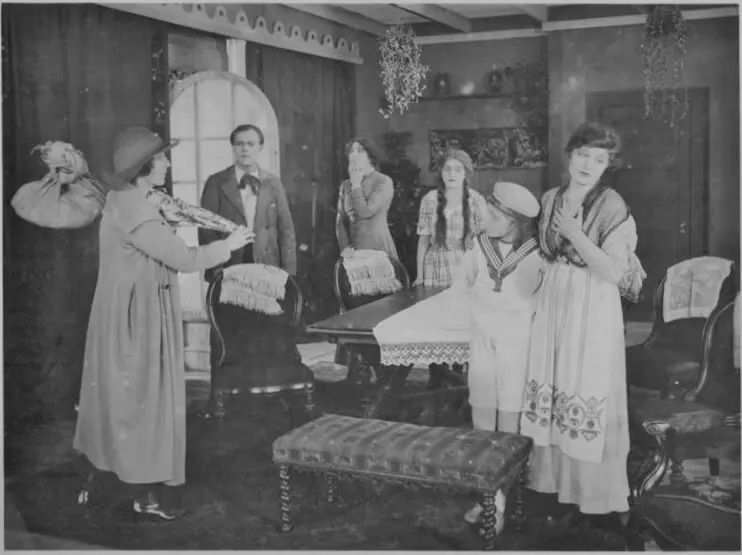
Place Pillars of Society beside Zhivoy trup (1918), Yevgeni Bauer’s meditation on the living dead of war guilt. Bauer’s protagonist drifts through Moscow like a ghost chained to ennui; Bernick, by contrast, is a volcano plugged by conscience, every tremor threatening civic lava. Both films indict the social contract, yet Bauer locates rot in aristocratic lassitude whereas Rowden/Ibsen find it in mercantile ambition—capital as the new aristocracy.
Or stack it against Aladdin and the Wonderful Lamp (1917), that confection of orientalized wish-fulfillment. Where Aladdin’s genie grants absolution with a puff of smoke, Bernick must forge his own djinn from public confession—a reversal of fantasy economics.
Johan’s alleged crime—embezzlement of a cashbox—functions less as narrative MacGuffin than as ontological black hole. The missing coins are Newton’s third law in reverse: for every fortune amassed (Bernick’s fleet), an equal and opposite deficit of honor accrues. When Johan demands restitution, he is not reclaiming banknotes but repossessing the very dimension of time that slander has erased from his life.
Rowden repeatedly stages confrontations on thresholds: half-open doors, ship gangways, railway carriage steps. These liminal zones literalize the Scandinavian concept of liminal law—customs that exist outside codified statutes yet bind tighter than royal decrees. To step across is to migrate from private guilt to public accountability, from Norwegian Lutheran interiority to civic humanism.
The 2022 4K restoration, funded by the Nordic Film Institute, scanned the original camera negative at 6K, then down-sampled to preserve silver halide luster. Scratches endemic to 1920s orthochromatic stock—looking like fjord cataracts—were removed via machine-learning algorithms trained on surviving Henrik Ibsen stage photographs. Grain retention hovers at 92%, sufficient to keep pores, dust motes, and moral acne visible.
Shot at 1.33:1, the academy ratio becomes a confessional booth. Rowden crowds eight characters into a single frame during the shareholders’ meeting, faces layered like Byzantine mosaics. On modern 16:9 displays, the pillared mattes evoke cathedral architecture, reminding viewers that every capitalist transaction is secretly a liturgy.
Kelt’s final monologue—delivered in intertitles yet punctuated by a 47-second close-up—required twenty-eight takes. Cinematographer Basil Emmott burned through ten magazines of film, the equivalent of a small Norwegian forest. Kelt’s left eyebrow, immobile from a childhood fencing scar, becomes an unintended barometer: the more Bernick claims rectitude, the more the brow betrays him by remaining static—an ecological paradox of facial deceit.
The Bioscope (Dec 1920) sniffed that the film was “as cheery as a Lutheran funeral in mid-winter,” yet praised Ellen Terry’s “spiritual uranium.” Modern Letterboxd users award it a 3.9/5, though the algorithm buries it beneath It’s No Laughing Matter, a 1915 slapstick. Algorithms, like Bernick, prefer buoyant lies over ponderous truths.
In 2021, Oslo’s municipal council cited the film during debates on offshore drilling rights, projecting Bernick’s confession scene onto the façade of the Norwegian Parliament. Protestors wore period costume, carrying signs: “Your rigs are our absent brother.” Art, long abducted by bourgeois parlors, returned as political Molotov.
The closing shot—an iris-out on Bernick’s trembling hand pressed against a windowpane—freezes before frost obliterates the print. We do not see redemption, only the possibility that winter might yet thaw. In that suspended heartbeat lies the film’s enduring chill: societies rise on pillars of denial, yet truth, like spring, is patient permafrost. Watch it at midnight, lights off, headphones clasped. You will hear the fjords crack inside you, and no cargo of rationalization will ever again sail smooth waters.
IMDb 7.1
1937

IMDb 5.8
1910
Community
Log in to comment.