DbcultAccessing Vault...
6.4/10
Senior Film Conservator
A definitive 6.4/10 rating for a film that redefined the boundaries of cult cinema. Pink Gods remains a cornerstone of transgressive art.
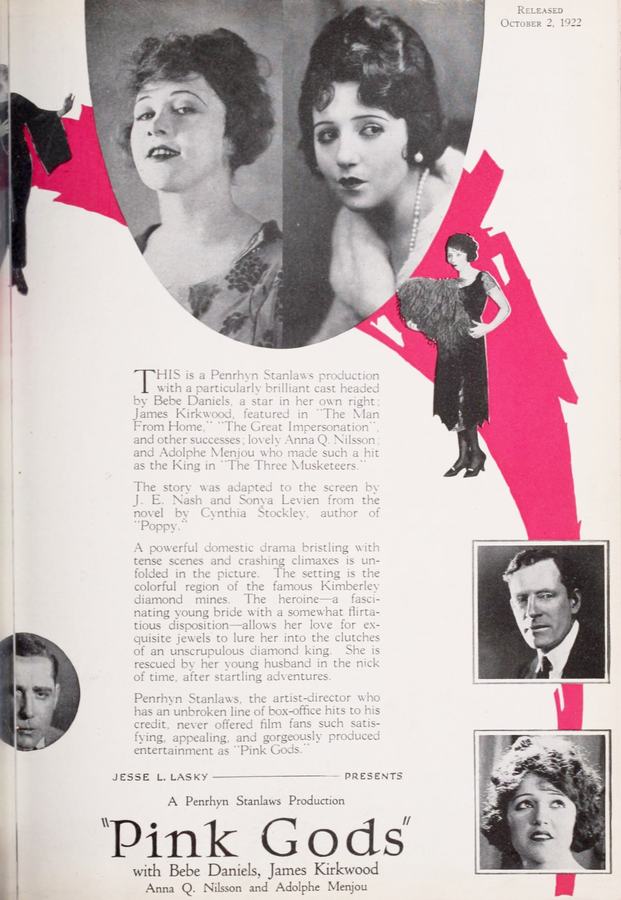
There is a moment, roughly two-thirds through Pink Gods, when the camera lingers on a close-up of Anna Q. Nilsson’s tear-wet iris and the reflection of a diamond bracelet dances inside it like a predatory firefly. That micro-image is the entire film in miniature: desire made lucent, conscience made liquid. Long before the Hays office began trimming sin from American screens, this 1922 curiosity—part morality play, part sulphuric melodrama—dared to suggest that jewels are not symbols of wealth but portable hells, each facet catching a different angle of the human soul.
Director William C. deMille (often eclipsed by his more flamboyant brother Cecil) stages the action in a world that feels underwater—sub-audible might be the word. Footsteps land on plush carpets with the hush of snow; chandeliers throb like jellyfish; the diamond mine itself is a Cyclopean maw, all ladders of darkness and pickaxes that glitter ominously. The effect is not documentary but narcotic: you feel as though you are breathing pressed coal dust rather than oxygen.
John Quelch—Adolphe Menjou wearing disdain like a bespoke lapel—believes he has solved the woman problem by translating it into carat weight. His philosophy is delivered in a single intertitle that crackles with cynicism: "A woman will mortgage tomorrow for a stone that outshines the moon." Menjou, who would later corner the market on suave rotters, gives Quelch a nervy brittleness; every time he fingers a gemstone, his thumb rubs against the setting as though testing for blood. It is a performance of exquisite containment—the more he hoards, the more he haemorrhages humanity.
Against him stands Lady Margot Cork, essayed by Anna Q. Nilsson with a regal tremor. Nilsson, Swedish and six-foot of Scandinavian glacier, here melts by degrees. Note the sequence in which she first fondles the tiara Quelch loans her for the resort’s masquerade: her gloved hand pauses, the satin puckers, and for a heartbeat you cannot tell whether she is about to don the crown or snap its strings. That hesitation is worth ten pages of psychological exposition.
The hinge of the plot is a single swallowed diamond, a gesture so compact it feels almost folkloric. Jim Wingate—minor employee, major appetite—gulps the stone in a panic, and for that intestinal larceny is subjected to a punishment the film never fully spells out. We glimpse only the aftermath: a man curled on a flagstone floor, mouth ringed with purple bruises that look suspiciously like boot prints. The ellipsis is deliberate; the filmmakers trust our imaginations to supply agonies far worse than censorship would allow them to show. When Margot discovers the cruelty, she recoils as though struck by an unseen hand. The engagement ring comes off in the same motion—not slowly, not tearfully, but with the decisive flick of someone brushing off a leech.
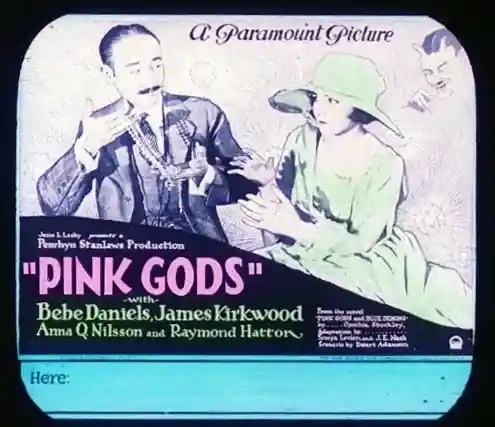
This rupture is the film’s moral epicentre. DeMille refuses to score it with melodramatic chords; instead, he cuts to a shot of the rejected ring lying on a window ledge while rain needles the glass. The diamond inside the band catches the lightning—that old cinematic cheat-sheet for cosmic judgment—and for an instant the jewel looks black.
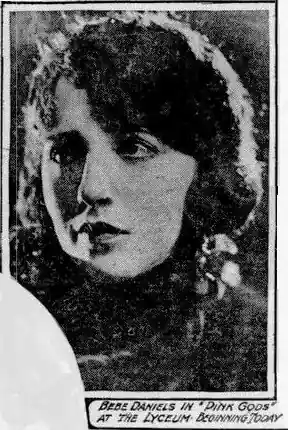
Enter Lorraine Temple, played by Bebe Daniels with the sprightly malice of a child pulling wings off flies. Where Margot is all Nordic restraint, Lorraine is tropical over-ripeness; her laugh arrives in pearls that seem ready to burst into pulp. Quelch, stung by Margot’s abandonment, decides to demonstrate female venality by dangling a fortune under Lorraine’s nose. The seduction unfolds in a parlour the colour of absinthe, walls lacquered so highly that faces glide across them like ghostly doubles.
Yet the scene pivots into something stranger than a simple transaction. Quelch suddenly pushes Lorraine away, declaring that he has "proven" her weakness and thus revenged himself on all womanhood. The abrupt reversal feels less like moral instruction than like self-castration; having summoned desire, he must torch it before it consumes him. Daniels registers the insult with a smile that goes stiff at the corners, as though the skin itself realises it is being archived for future humiliation.
The finale is apocalypse staged as chandelier-crumpling spectacle. Wingate, returned from his ordeal, steals into the mine with enough dynamite to turn geology into theology. DeMille cross-cuts between the sizzling fuse, the ballroom where guests waltz inside a gilded cage, and Quelch alone in his office fondling diamonds as if they were worry beads. When the explosion arrives, it is not the usual Keystone chaos but something almost serene: walls billow, curtains inhale, and then the world peels away in layers of velvet and dust.
Out of the smoke emerges Lorraine, dress torn to cobweb, thanking Quelch for teaching her the emptiness of glitter. Whether she dies or merely fades into allegory is left willfully vague—one contemporary review insists she "expires on the marble," another claims she is "spirited away by servants." That instability is part of the film’s intoxicating unease; it refuses to nail down its myths, preferring to let them hang like smoke rings.
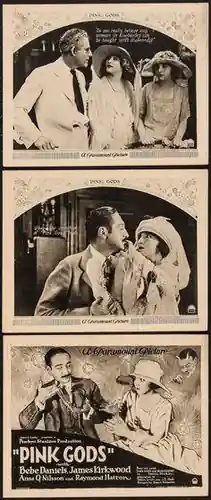
Margot arrives with Lorraine’s husband in tow, a man who has spent the film’s duration clutching a brandy snifter the way shipwrecked sailors cling to driftwood. The reconciliation between Margot and Quelch occurs off to the side, framed through a collapsing arch—two silhouettes sealing a pact while plaster snows down upon their shoulders. Love is restored, but only after the earth itself has been mined hollow.
Modern audiences sometimes patronise silent film as a quaint halfway house between theatre and talkies. Pink Gods annihilates that condescension. Its erotics are subdermal; the absence of spoken dialogue forces the eye to linger on textures—the nap of a lapel, the tremble of a cigarette ember, the way light pools in the hollow of a clavicle. The result is a kind of tactile voyeurism more intimate than any post-code pillow shot.
Compare it, for instance, with Joan of Plattsburg, whose flapper hi-jinks feel almost schematic beside the moral murk of this picture. Or set it against Whispering Devils, another 1922 release that trots out sin in order to chasten it within the final reel; that film ends on a church bell, whereas Pink Gods ends on a question mark hammered into scorched earth.
James Kirkwood’s Wingate is a revelation—he gives the miner a stocky, workmanlike dignity that makes his later vengeance feel tragic rather than villainous. In the brief canteen scene before the theft, Kirkwood lets a yawn crease into a shiver; you sense the mine’s chill has entered his marrow. When he reappears in the final act, his eyes have the flat sheen of a man who has already seen the afterlife and brought back photographic proof.
Raymond Hatton, as Quelch’s factotum, supplies sly comic relief without puncturing the film’s fever dream. Watch the way he counts diamonds with the rapidity of a card sharp, lips moving in silent calculus—pilfering time rather than gems.
Four writers are credited—Sonya Levien, J.E. Nash, Ewart Adamson, and Cynthia Stockley—yet the narrative feels less stitched than channelled. Levien, who would go on to script Resurrection (1931), brings a Tolstoyan appetite for moral paradox; Stockley, a South African novelist, sprinkles colonial slang that makes the dialogue snap like a whip. The resulting script is a bouillon of epigrams: "A conscience is easier pawned than redeemed." "Love fears the dark because it resembles the grave." Each intertitle arrives white on black with the finality of a headstone rubbing.
DeMille and cinematographer L. William O’Connell deploy a palette of infernal oranges, jaundiced yellows, and cadaverous blues. Note how the diamonds themselves are never permitted to sparkle in rainbow refraction; they catch only the molten orange of lamplight or the sickly amber of hallway sconces. The mine shafts, by contrast, are painted sea-blue to suggest subterranean drowning. When the blast finally vents those blues into the ballroom, the effect is like watching an ocean invade a jewellery box.
Contemporary critics praised the film’s "adult cynicism" but winced at its "ethical labyrinths." Variety declared it "too beautiful to be wholesome," while Photoplay lamented that "the moral gets lost among the gemstones." Today, the picture surfaces only in fragmentary 16 mm prints at cinematheques, usually missing its final reel and accompanied by a patchwork score pilfered from Grieg and Duke Ellington. Even maimed, it detonates in the mind, leaving you suspicious of every glittering object in your vicinity.
Film historians sometimes lump Pink Gods with the cycle of "diamond melodramas" that includes The Answer and Tough Luck, but those titles resolve into tidy parables. DeMille’s film is more like a fever that breaks only after it has infected your sense of value. Long after the projector’s click fades, you find yourself weighing the ethics of every trinket you own—and wondering what it might cost to swallow.
Is Pink Gods a masterpiece? That word feels too stately, too museum-ready. Call it instead a lacerating jewel—flawed, jagged, capable of cutting whatever tries to possess it. In 1922 it played to packed houses who gasped at the explosion; in 2024 it plays to the interior cinema of conscience, and the explosion is quieter but more lasting. Seek it out, should a print wander within a hundred miles of your postcode. Bring gloves; the diamonds still draw blood.
IMDb —
1917
Community
Log in to comment.